


.png)
Website design for hvac: Turn Visitors into Paying Customers
Let’s be honest, your website needs to be more than a digital business card. Think of it as your single hardest-working employee—the one that never sleeps, never calls in sick, and is constantly turning curious visitors into booked jobs. It’s your 24/7 salesperson, your lead qualifier, and your appointment setter, all rolled into one.
Your Website Is Your Hardest Working Employee
In a crowded market, a generic, five-year-old website gets lost in the noise. A strategically built HVAC site, on the other hand, is the central hub for all your marketing. It’s where people land after seeing your truck, getting a referral, or clicking on one of your Google Ads.
This is where a homeowner in West Hollywood or a property manager in Sherman Oaks goes to decide if you’re the real deal. Your site has to validate their choice and make them feel confident they’re calling the right company.
More Than a Brochure a Lead Generation Machine
A great website does the heavy lifting for you, building trust and showcasing your value before you even answer the phone. It’s not just about listing your services; it’s about proving you’re the best choice.
This means featuring things like:
Project Galleries: Clean, high-quality photos of your installations in places like Pasadena or Long Beach show you do professional work.
Five-Star Reviews: Nothing builds credibility faster than seeing glowing testimonials from other local homeowners.
Effortless Booking: When someone’s AC dies in the middle of a heatwave, they need a simple form and a clear "Book Emergency Service" button. Your site can turn their panic into a scheduled appointment.
Stop thinking of your website as a cost. It’s an investment engineered for growth. With the global HVAC market projected to hit $382.66 billion by 2030, a powerful online presence is no longer optional. We’ve seen HVAC companies go from $450,000 to $1.1 million in annual revenue in under two years after a site redesign. The ROI is undeniable. You can explore more home service industry stats to see just how competitive things are getting.
Your website is often the first interaction a potential customer has with your company. A professional, user-friendly design immediately signals that you are a trustworthy and reliable expert, making them more likely to choose you over a competitor with a subpar online presence.
This first impression is everything. Since 84% of customers start their search for a service provider online, your website is your digital storefront. Make it clean, welcoming, and easy to navigate, and you’ll be well on your way to winning more business.
How to Structure an HVAC Website That Turns Visitors into Customers
When a homeowner's AC quits on a sweltering July afternoon, their first move is to pull out their phone. Your website needs to be the clear, calm, and obvious solution in that moment of panic. It’s not just about looking good; it's about creating a frictionless path from their problem to your schedule.
Think of your website's structure as a guided tour. A confusing layout is a dead end. A frustrated visitor won't stick around to figure it out—they'll just hit the back button and call your competitor.
All your marketing, from Google Ads to truck wraps, points back to your website. It's the central hub where interest becomes action.
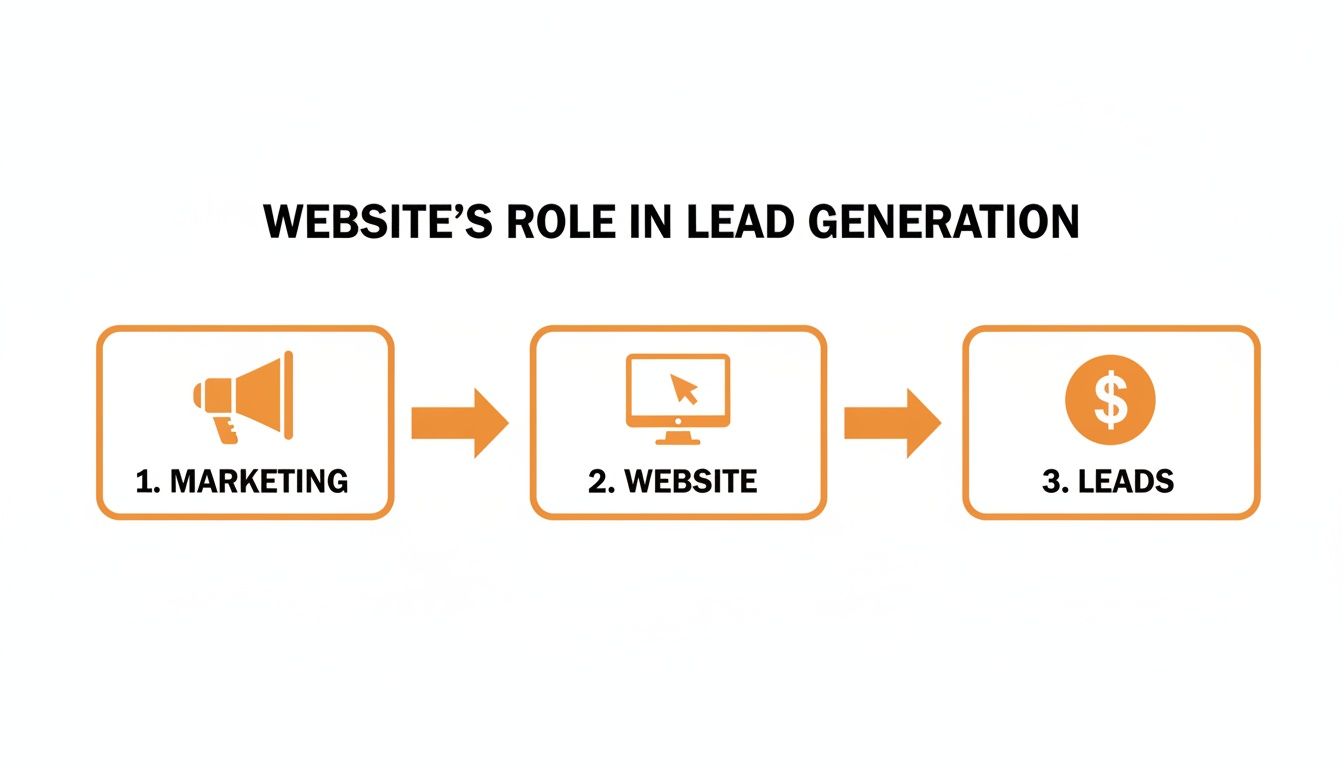
This flow really drives home the point: your site is the critical link between getting noticed and getting paid.
The Blueprint for a High-Performing HVAC Site
Every single page on your website needs a job to do. From establishing trust on the homepage to providing nitty-gritty details on a service page, they all work together to convince a potential customer you're the right choice. Your goal is to answer their questions before they even have to type them into a search bar.
Here’s a breakdown of the core pages your HVAC website absolutely must have to attract, inform, and convert visitors into paying customers.
Page Type | Primary Goal | Key Elements to Include |
|---|---|---|
Homepage | Make an immediate, trustworthy impression. | Clear headline, phone number front and center, bold call-to-action (e.g., "Schedule Service Now"), and trust signals like certifications or awards. |
About Us | Build a personal connection and show you're a local, reputable business. | Company history, mission, and genuine photos of your team. People hire people they feel they know and trust. |
Service Pages | Detail specific services to attract targeted searches and inform customers. | Create dedicated pages for AC Repair, Furnace Installation, Duct Cleaning, etc. Include what the service involves, signs they need it, and pricing info if possible. |
Emergency Services | Be the obvious choice for urgent, high-stress situations. | A bold, impossible-to-miss 24/7 phone number, clear info on your availability, and a simple contact form. Make it fast and easy. |
These pages form the backbone of a site that doesn’t just sit there—it actively works to bring you business.
Here's a gut check I use: could a stressed-out homeowner with a broken furnace at 2 a.m. easily find your number and book a call? If the answer is no, your site isn't working hard enough.
The Overlooked Power of a Dedicated Service Area Page
One of the most effective local SEO tools you have is a dedicated service area page. This is far more than just a bulleted list of towns—it's a strategic asset.
You need to meticulously map out every city, town, and even specific neighborhood you cover. For example, if you work in Los Angeles, don't just say "LA." Los Angeles is at the center of our service area, and we proudly support clients across a wide network of surrounding cities and neighborhoods throughout Southern California. Our reach includes every corner of L.A.—from Downtown Los Angeles, Hollywood, West Hollywood, Beverly Hills, and Santa Monica to the beach communities of Malibu, Venice, Marina del Rey, Hermosa Beach, Manhattan Beach, and Redondo Beach.
We also extend service through the San Fernando Valley, including Sherman Oaks, Studio City, Encino, Van Nuys, North Hollywood, Burbank, Glendale, Pasadena, Woodland Hills, Chatsworth, Canoga Park, Reseda, Northridge, and Tarzana. In the San Gabriel Valley, we work with clients in Alhambra, Monterey Park, San Gabriel, Temple City, Rosemead, Arcadia, El Monte, South El Monte, West Covina, Covina, Baldwin Park, Azusa, Glendora, Duarte, and Monrovia. Farther southeast, we serve Whittier, Pico Rivera, Downey, Norwalk, La Mirada, La Habra, and Cerritos. We also support the South Bay—including Torrance, Carson, Gardena, Hawthorne, Inglewood, and Long Beach—as well as the Gateway Cities and communities throughout the I-10, I-5, 101, and 405 corridors. Whether you’re in a major metro area or a smaller surrounding neighborhood, our team delivers reliable, high-quality service anywhere in or around Los Angeles. This level of detail sends a powerful signal to both Google and potential customers that you are the local expert for their specific community.
Building a site that is not only informative but also strategically structured is the key to creating a seamless journey. It's how you turn clicks into loyal customers. To really nail this, it helps to understand the broader principles of digital customer experience management, which is all about making every interaction a positive one.
Designing for Trust Before You Ring the Doorbell
When a homeowner’s AC dies in the middle of a heatwave, they’re not just looking for a service—they're looking for a hero. But they’re also inviting a stranger into their home. That’s a huge leap of faith, and it’s why trust is the ultimate currency in the HVAC business.
Long before your tech arrives in a branded van, your website is making that critical first impression. A clunky, outdated site screams "unreliable," while a professional, clean design instantly tells visitors you’re a serious business they can count on.
This is where you move past the cheesy, generic stock photos. Homeowners have a sixth sense for spotting a fake smile from a mile away. Instead, show them the real deal. Invest in authentic, high-quality photos of your actual team, your trucks parked in local neighborhoods, and your crew getting their hands dirty on real jobs. Seeing the faces of the people who might be in their home creates an immediate, genuine connection.

Showcase Your Credentials and Expertise
Your licenses and certifications aren't just fine print—they're powerful proof that you know your stuff. Don't make visitors hunt for them on some forgotten "About Us" page. Put them front and center where they can’t be missed.
A great way to do this is with a dedicated "trust bar" in your site's header or footer. This is prime real estate for badges that instantly build credibility.
NATE Certifications: The gold standard in our industry. It shows your team is trained to the highest level.
EPA Certifications: This tells customers you're committed to safety and doing things by the book.
Local Licenses and Insurance: Reassures homeowners that you’re a legitimate, protected, and professional operation.
Better Business Bureau (BBB) Ratings: A strong rating from a trusted third party speaks volumes.
These little logos are more than just graphics; they're shortcuts to trust. They tell a visitor everything they need to know about your qualifications at a single glance.
Leverage the Power of Social Proof
Let's be honest: what your customers say about you is far more persuasive than anything you can say about yourself. Social proof is the new word-of-mouth, and your website should be packed with it. Weave real customer testimonials directly into your service pages to validate your claims right when a potential customer is on the fence.
Don't just tell visitors you're reliable—let your happy customers do it for you. A single authentic video testimonial can be more convincing than an entire page of self-promotion.
And don't stop at text quotes. Create a dedicated "Reviews" or "Customer Stories" page with a mix of formats. Think video testimonials, detailed case studies on tricky installations, and even a live feed from your Google Business Profile. Every positive review chips away at a potential customer's hesitation, giving them the confidence to pick up the phone.
Finally, building trust also means ensuring your website is usable by everyone. Making your site accessible is not just good practice; it's a sign that you care about all potential customers. You can learn more by checking out these website accessibility best practices to ensure your digital doorstep is open to all.
Dominating Local Search and Winning Your Service Area
You can have the best HVAC techs in the city, but it means nothing if homeowners can’t find you when their AC dies on a hot summer day. The real test of your website is its ability to show up in local search results, especially when a frantic customer types "AC repair near me" into Google.
This is where a sharp focus on local search engine optimization (SEO) turns your site from a digital brochure into a lead-generating machine.
When someone in Van Nuys is looking for emergency furnace repair, Google’s mission is to give them the most relevant, local business for the job. Your website needs to send all the right signals to prove you're that business. This is about more than just listing what you do; it’s about structuring your site in a way that search engines can instantly understand and trust.

Speak Google’s Language with Local Schema Markup
One of the most powerful—and often overlooked—tools in your SEO arsenal is Local Business schema. Think of it as a secret language you use to talk directly to search engines. It's a bit of code you add to your site that acts like a digital name tag, explicitly telling Google critical information and removing any guesswork.
Schema markup spells out details like:
Your precise service area: Listing every single city, from Torrance and Carson to Hawthorne and Inglewood.
Your operating hours: Making sure Google knows about your 24/7 emergency availability.
Contact information: Your physical address and a clickable phone number.
Customer reviews: Pulling in your star ratings to display right there in the search results.
Getting this right is a huge step toward landing in the coveted Google "Map Pack"—that block of three local businesses that gets prime real estate at the top of the search results.
Create Hyper-Local Service Pages
Generic service pages just don't cut it anymore, especially in a crowded market. If you want to truly own your service area, you need dedicated pages that target both a specific service and a specific location.
So, instead of a single "AC Repair" page, think bigger.
You need pages like "Air Conditioner Repair in Sherman Oaks" or "Furnace Installation in Glendale." On these pages, you can talk directly to the people in those communities. Mention local landmarks, talk about common HVAC issues in their type of homes, and showcase testimonials from their actual neighbors. This approach doesn't just resonate better with potential customers; it screams to Google that you are the local authority for that service in that exact area. To really get ahead, you'll want to explore more advanced Local SEO strategies.
Your Google Business Profile is the other half of this equation. You have to treat it like a second website. Keep it updated with fresh photos, respond to every single review (good and bad), and use Google Posts to share offers. Your website and GBP need to work hand-in-hand to build a consistent, trustworthy local presence.
Don’t Forget the Technical Fundamentals
Finally, none of these strategies will move the needle if your website is slow or a pain to use on a smartphone. More than 50% of all web traffic now comes from mobile devices, and Google’s algorithm heavily favors sites that are mobile-friendly.
Fast loading speeds are just as important. A visitor isn’t going to wait around if your site takes more than a few seconds to load—they’ll just hit the back button. That bounce tells Google your site offers a poor user experience, which can hurt your rankings. Investing in a solid technical foundation isn’t just a good idea; it's non-negotiable for winning at local search.
For a complete guide, explore our article on local SEO services for businesses to elevate your reach.
Turning Website Clicks Into Booked Appointments
A beautiful website that doesn't make the phone ring is little more than an expensive digital billboard. The true test of your HVAC site is its power to turn a casual visitor into a booked appointment. This isn’t about luck; it's about a strategic approach, embedding conversion tools throughout your site so a customer can take the next step without a second thought.
Your number one job is to eliminate friction. When a homeowner’s AC dies in July, they're stressed, hot, and out of time. Your website has to offer an immediate, obvious path to a solution. Simple forms prompting visitors to “Get a Free Estimate” are a decent starting point, but the tools available today can do so much more.
Strategically Place Your Calls to Action
A call-to-action (CTA) is just a direct prompt telling a user what to do next, and it needs to be impossible to miss. Your phone number shouldn’t be buried on the contact page. It needs to be in the header of every single page, especially for mobile users who can click-to-call.
Put yourself in the customer's shoes. Someone frantically searching for emergency repairs needs a totally different CTA than someone researching a new heat pump.
For Urgent Needs: Use bold, action-focused buttons like "Schedule Service Now" or "24/7 Emergency Service" in the most prominent spots. A sticky header that keeps these options visible while the user scrolls is an incredibly powerful tool.
For Researchers: Offer something valuable in exchange for their contact info. A downloadable "HVAC Maintenance Checklist" or a quick guide on choosing the right AC unit can fill your email list with highly qualified leads.
The HVAC contractor industry is a massive $156.2 billion market, yet the average cost to acquire a new customer is between $296 and $350. A high-converting website is your best shot at maximizing that investment, especially since a single customer's lifetime value can climb to an impressive $15,340. You can learn more about the latest HVAC industry trends here.
Make Booking Effortless with Modern Tools
Go beyond basic contact forms and look into lead capture tools that plug directly into your daily operations. A modern online booking system can sync with your dispatch software, letting customers see your team's real-time availability and book a confirmed slot without ever having to make a phone call. It’s convenient for them and efficient for you.
Live chat widgets are another fantastic option. They provide instant answers to questions from potential customers, capturing leads from people who might not want to pick up the phone. By making communication instant and easy, you meet customers where they are and dramatically increase the odds of winning their business the moment they need help.
Choosing the Right Tech Foundation for Your Website
The platform your HVAC website is built on—its Content Management System (CMS)—is a lot like the foundation of a house. Get it wrong, and you'll be dealing with cracks and problems for years. It directly impacts your site’s speed, security, and whether it can grow with your business or holds you back.
Making the right choice from the get-go is critical. Too many contractors just go with the first name they recognize, but every platform has its trade-offs. This isn't just about getting a website online; it's about building a powerful asset that’s easy to manage and actually brings in new business.
Comparing Top Website Platforms
When it comes to building a website, there are three major players on the field. Each one serves a different kind of business owner, especially when you factor in customization needs, ongoing maintenance, and how well it can rank on Google.
WordPress: This is the big one. As the most popular CMS in the world, WordPress offers incredible flexibility. Its massive library of plugins lets you do almost anything, but that power comes with responsibility. You're in charge of regular maintenance, security updates, and making sure everything plays nicely together.
Webflow: A favorite among professional designers, Webflow gives you total design freedom without having to write a single line of code. It's a visual powerhouse that produces clean, lightning-fast websites. The trade-off? It can have a much steeper learning curve for a business owner who just wants to make a quick update.
Wix Studio: Known for being incredibly user-friendly, Wix Studio makes it easy for just about anyone to build a sharp, professional-looking site. While it's the simplest to jump into, it can sometimes be a bit more rigid when it comes to deep, technical SEO tweaks compared to something like WordPress.
Your choice of CMS is a long-term commitment. Don't just think about the initial cost. Ask yourself: who is actually going to be managing this thing day-to-day? A platform that's too complicated for your team to use will quickly become an outdated, useless expense.
If you want to go deeper, we've put together a detailed breakdown of the best website platforms for SEO to help you weigh the pros and cons for your business.
Essential Technical Must-Haves
Once you've picked your platform, there are a few technical elements that are completely non-negotiable for any modern HVAC website. Think of these as the bare minimum for earning a customer's trust and showing up in search results.
First up is mobile responsiveness. This is mandatory. The vast majority of homeowners are searching for "AC repair near me" on their phones, often in a moment of panic. If your site is a jumbled mess on a small screen, you’ve already lost them.
Next, your site must have SSL security. That’s the little padlock and "https" in the URL that tells visitors your site is secure. It encrypts the information they share in a contact form. Without it, browsers will literally flash a "Not Secure" warning to your visitors, which is the fastest way to kill trust and send a potential lead running to your competitor.
Finally, your website needs to meet ADA compliance standards. This simply means making your site accessible to people with disabilities. Not only does this open your business to a wider audience, but it also shows you’re a company that cares about serving everyone in your community.
Common Questions About HVAC Website Design
Investing in a new website always brings up a bunch of questions. Getting clear, straightforward answers is the key to making a confident decision for your business. Let's walk through some of the most common things we hear from HVAC owners.
How Much Should I Budget for a Professional HVAC Website?
A professional website is a core business asset, and honestly, the cost reflects that. A solid, well-designed site can run anywhere from a few thousand dollars for a template-based build to over $15,000 for a fully custom design packed with advanced features.
What moves that number? Things like the number of pages, custom graphic design, and special functions—like integrating an online booking system that talks directly to your dispatch software. The best way to think about it is as an investment in your primary lead generation tool. It's the one employee that works for you 24/7.
How Can My Site Stand Out from Local Competitors?
In a crowded local market, authenticity is your secret weapon. The goal is to stop looking and sounding like every other contractor out there and start showing customers what makes your business the right choice.
Use Real Photos: Ditch the generic stock images for good. Get high-quality photos of your actual team, your branded trucks parked in local neighborhoods like Burbank or Pasadena, and your crew on the job.
Highlight Your Difference: What makes you special? Clearly state it. Maybe it's your ironclad satisfaction guarantee, your 24/7 emergency availability in the San Fernando Valley, or the special financing you offer. Whatever it is, put it front and center.
Showcase Social Proof: People trust their neighbors. Prominently feature real customer reviews and, if you can get them, video testimonials. Nothing builds trust faster than hearing from a happy customer down the street.
Here's a simple but effective rule of thumb: make sure your phone number and service areas are visible on every single page. A stressed-out homeowner in a panic shouldn't have to hunt for a way to call you.
How Quickly Can I Expect SEO Results?
This is the big one. While a new website with a solid technical foundation can get indexed by Google pretty quickly, seeing significant local SEO results takes time and consistent effort. You’re not going to rank overnight.
For competitive keywords like "AC repair in Los Angeles," you're typically looking at a 3 to 6-month timeline to start climbing onto the first page. That's assuming you have a sustained strategy that includes on-page optimization, building out local business listings, and consistently earning new customer reviews. SEO isn't a one-and-done task; it's a long-term strategy that, when done right, delivers a steady flow of high-quality, organic leads.
Ready to build an HVAC website that actually dominates your service area and turns clicks into booked jobs? The team at DLL Studios specializes in creating high-performing websites for businesses just like yours. Get in touch with us today to start the conversation.
