


.png)
Local SEO Services for Businesses: Elevate Your Local Reach
At its core, local SEO services are all about making your business impossible to miss when potential customers in your immediate area search for what you offer on Google. Think of it as planting a giant, flashing sign on the digital version of your city's main street.
When someone nearby is looking for your products or services, you want to be the first name that pops up. Local SEO is the engine that makes that happen.
Why You Can't Afford to Ignore Local Search
Picture this: you run a business in a specific neighborhood, say, a cozy café in Sherman Oaks or a plumbing service in Downtown Los Angeles. When a potential customer pulls out their phone and searches for "coffee shop near me" or "plumber in Hollywood," they have an immediate need.
Local SEO is what bridges the gap between their urgent search and your front door. It’s not about getting seen by everyone, everywhere. It's about being found by the right people, right now.
This hyper-focused approach is non-negotiable because a huge chunk of all online searches are for local information. For that small café, a successful local strategy means grabbing the attention of someone walking just a few blocks away. That simple "near me" search is part of a massive trend: 46% of all Google searches have local intent.
Even more compelling? A staggering 76% of people who search on their smartphone for something nearby visit a business within 24 hours. You can dig into more of these eye-opening local SEO trends from WiserReview, but the takeaway is clear: local search drives real foot traffic.
Los Angeles is at the center of our service area, and we proudly support clients across a wide network of surrounding cities and neighborhoods throughout Southern California. Our reach includes every corner of L.A.—from Downtown Los Angeles, Hollywood, West Hollywood, Beverly Hills, and Santa Monica to the beach communities of Malibu, Venice, Marina del Rey, Hermosa Beach, Manhattan Beach, and Redondo Beach. We also extend service through the San Fernando Valley, including Sherman Oaks, Studio City, Encino, Van Nuys, North Hollywood, Burbank, Glendale, Pasadena, Woodland Hills, Chatsworth, Canoga Park, Reseda, Northridge, and Tarzana. In the San Gabriel Valley, we work with clients in Alhambra, Monterey Park, San Gabriel, Temple City, Rosemead, Arcadia, El Monte, South El Monte, West Covina, Covina, Baldwin Park, Azusa, Glendora, Duarte, and Monrovia. Farther southeast, we serve Whittier, Pico Rivera, Downey, Norwalk, La Mirada, La Habra, and Cerritos. We also support the South Bay—including Torrance, Carson, Gardena, Hawthorne, Inglewood, and Long Beach—as well as the Gateway Cities and communities throughout the I-10, I-5, 101, and 405 corridors. Whether you’re in a major metro area or a smaller surrounding neighborhood, our team delivers reliable, high-quality service anywhere in or around Los Angeles.
The Core Pillars of Local SEO Services
Service Component | What It Is | Why It's Critical |
|---|---|---|
Google Business Profile | Your free, supercharged business listing on Google Maps and Search. | It's your digital storefront. An optimized profile builds trust and gives customers the info they need to choose you. |
Local Keyword Research | Finding the exact search terms people in your area use. | This ensures you're targeting real-world queries like "best tacos in Pasadena," not generic terms. |
On-Page & Technical SEO | Weaving local signals into your website's content and code. | Tells Google your site is relevant to a specific city or neighborhood, boosting your authority. |
Citations & NAP | Getting your business Name, Address, and Phone number listed consistently online. | Consistency across directories (like Yelp, etc.) confirms your location and legitimacy to search engines. |
Local Link Building | Earning links from other reputable local websites. | Links from local partners act as "votes of confidence," proving your community involvement and relevance. |
Review Management | Actively encouraging and responding to customer reviews. | Positive reviews are a massive ranking factor and the modern-day word-of-mouth referral. |
Each of these pillars works together to build a strong, cohesive signal to Google that you are a trusted and relevant local business.
This handy diagram illustrates how these core pieces fit together to build a powerful local presence.
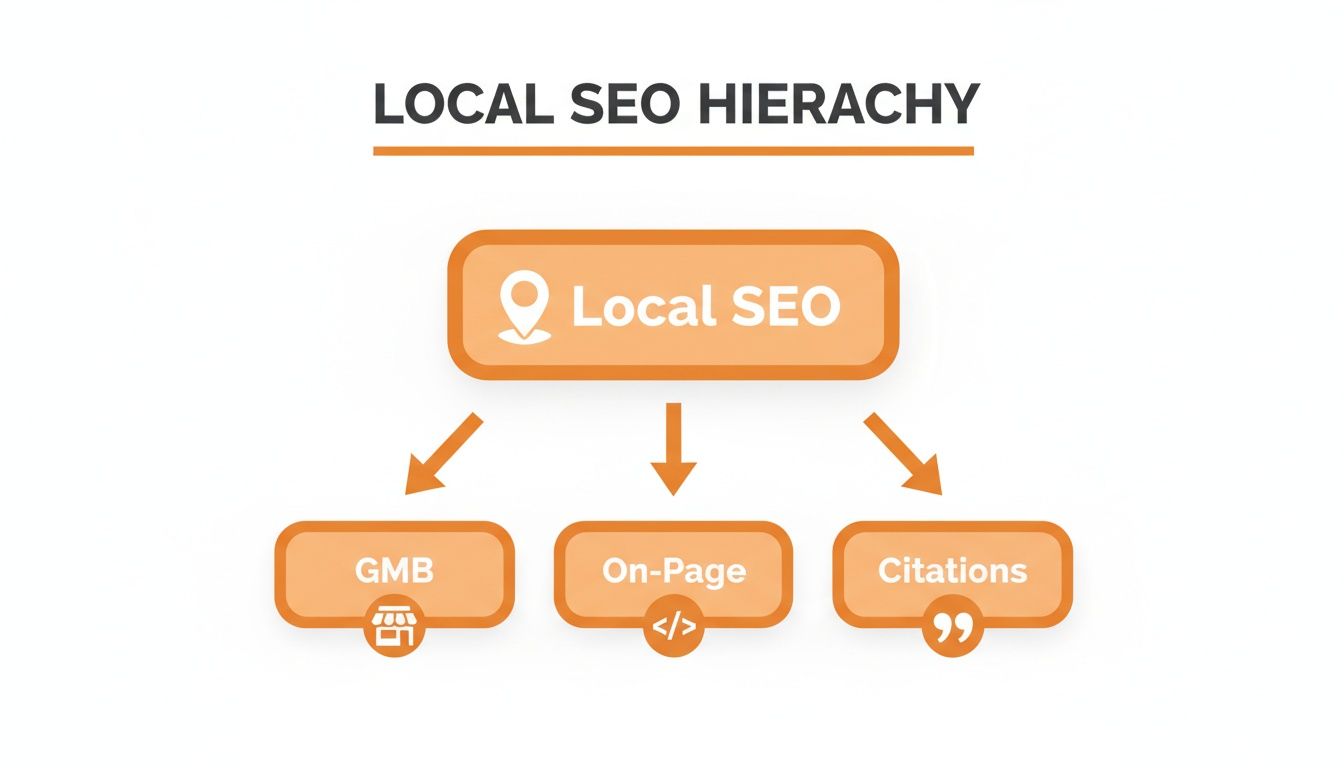
As you can see, everything starts with a rock-solid Google Business Profile. That's the foundation. From there, your own website's on-page optimizations and your business's consistency across the web (citations) build upon that foundation to create an unshakeable local presence.
Optimizing Your Google Business Profile for Maximum Impact
Think of your Google Business Profile (GBP) as your business’s digital front door. For local customers searching online, it's often the very first impression they get—long before they ever see your website or walk into your actual store. It's that dynamic, information-packed listing that pops up in Google Maps and the all-important Google Local Pack.
A neglected profile is basically a "Closed" sign hanging on your digital window. It signals to potential customers that you might not be active, open, or even trustworthy. On the flip side, a fully optimized GBP works like a magnet, pulling in local searchers who are ready to make a purchase. It’s the absolute bedrock of any solid local SEO strategy.
The Anatomy of a Winning Profile
Turning your GBP from a basic listing into a customer-generating machine starts with getting the fundamentals right. Every single piece of information you add strengthens your signal to Google and builds trust with potential customers. A complete, active profile isn't just a good idea—it's non-negotiable.
Here are the critical pieces you absolutely have to nail:
Claim and Verify Your Listing: This is step one. It proves to Google that you're the real owner and gives you the keys to control what people see.
Select Precise Categories: Choose a primary category that perfectly describes your main business (e.g., "Plumber," not something vague like "Home Services"). From there, add secondary categories to cover all the other services you offer.
Write a Compelling Business Description: This is your 750-character elevator pitch. Use every bit of it to explain what makes you unique, who you help, and why a customer should pick you over the competition.
Upload High-Quality Photos and Videos: Show off your work, your team, and your location. The proof is in the numbers: businesses with photos get 42% more requests for driving directions and 35% more clicks to their websites.
Advanced Tactics for Local Dominance
Once the foundation is solid, it's time to dig into the more advanced features that will make your profile truly pop. These are the interactive elements that keep your listing fresh and engaging, encouraging customers to interact and signaling to Google that you're an active, relevant business.
In competitive markets, this is the stuff that separates the winners from everyone else. In fact, comprehensive Google Business Profile management is valued above all other local SEO services by 52-76% of clients. That focus makes sense when you see that an optimized profile can pull in over 1,200 views monthly, and customers are 70% more likely to visit a business with a complete listing.
A consistently updated Google Business Profile doesn't just inform customers—it actively persuades them. Every post, photo, and answered question is another reason for them to choose you.
Use these features to get a real edge:
Google Posts: Think of these as mini-ads right on your profile. Share updates, special offers, events, and new products to keep your listing dynamic. To make sure your profile stays fresh, you can learn how to schedule your Google Business Profile posts effectively.
Q&A Section: Don't wait for customers to ask questions. Get ahead of the game by populating this section yourself. Ask and answer common questions to control the narrative and give people valuable information right away.
Services and Products: Don't be shy—detail everything you offer. This helps you show up for very specific searches (like "emergency pipe repair") and gives customers a crystal-clear picture of your expertise.
Laying the Groundwork with Local Keywords and On-Page SEO
While your Google Business Profile is your digital storefront, your website is your home base. To get local customers to knock on your door, your website needs to speak their language—literally. This is where local keyword research and on-page SEO come together to build a rock-solid foundation for your online presence.
Think of local keywords as the exact phrases your neighbors type into Google when they need your help. It’s not about ranking for some generic, broad term; it’s about capturing the searches happening right in your backyard from people ready to buy.
For a business in Southern California, this means getting specific. Instead of just "emergency plumber," you’d zero in on "emergency plumber in Santa Monica" or "best tacos near Hollywood." These hyper-local terms connect you directly with customers who aren't just browsing—they're ready to make a call.
Weaving Local Signals into Your Website
Once you’ve nailed down these valuable keywords, the next move is to weave them into the fabric of your website. This process, known as on-page SEO, is how you tell search engines that your business is the most relevant answer for local searches.
This involves fine-tuning some key elements on your webpages:
Title Tags: The main headline in search results, like "Expert HVAC Repair in Pasadena | Your Local Pro."
Meta Descriptions: The short blurb under the title that convinces people to click, often including a local phone number or address.
Header Tags (H1, H2, H3): The headings and subheadings in your content that should naturally include your service and location keywords.
Body Content: The main text on your pages, where you can talk about your services in the context of the neighborhoods you serve.
By syncing your website's content with local search terms, you're essentially creating a direct line to Google. You're explicitly saying, "Hey, my business serves this community," which is a huge signal for local rankings.
Creating Hyper-Local Service Area Pages
For businesses covering a wide area, like the greater Los Angeles region, one of the smartest plays is creating dedicated pages for each key city or neighborhood. This goes way beyond just listing the areas you serve on your contact page.
Take a landscaping company, for example. They could build out separate, fully optimized pages for:
Lawn Care Services in Long Beach
Drought-Tolerant Landscaping in the San Fernando Valley
Garden Design for Beverly Hills Homes
Each page becomes a new opportunity to rank for location-specific searches. You can feature localized testimonials, photos from projects in that area, and content that speaks directly to that community’s needs. This strategy ensures you pop up in searches no matter where your local customers are looking, from the beach towns of Malibu to the suburbs of the San Gabriel Valley. For a deeper look at this, check out our guide on building an effective keyword optimization strategy. This foundational work connects your website directly to your neighborhood, making you the obvious choice for local customers.
Building Local Trust with Citations and Reviews
Beyond your own website and Google Business Profile, your reputation is built all across the web. For a local business, trust is everything. Two of the most powerful ways to earn it are through citations and customer reviews.
Think of these as digital trust signals. They confirm to both search engines and potential customers that you are a legitimate, active business in the community.
A citation is simply any online mention of your business's Name, Address, and Phone number—your NAP. You'll find them on online directories, social media profiles, and industry-specific websites.
Each consistent NAP listing is like a vote of confidence, telling Google you're a real, established business at a physical location. Consistency here is non-negotiable. A tiny mismatch, like listing "St." on one site and "Street" on another, can confuse search engines and weaken your local authority.
Why NAP Consistency is a Big Deal
Imagine giving someone directions to your shop but using a slightly different street name each time. They’d get confused and might just give up. It’s the same for Google.
Inconsistent NAP information sends mixed signals, making it harder for Google to trust your business details. This directly hurts your chances of showing up in local search results and the all-important Google Map Pack.
You can get a quick health check on your online business information with a free local listing scan. It's a great way to spot and fix inconsistencies that might be holding you back.
Turning Customer Feedback into Your Best Marketing
If citations are about verification, reviews are all about persuasion. Today, customer reviews are the new word-of-mouth, and they have a massive impact on both search rankings and buying decisions.
Good reviews send a powerful signal to Google that your business is valued by the local community. But their effect on customers is even more profound. They offer a real, unfiltered look at what it's like to do business with you.
Reviews are a make-or-break factor for local customers. A staggering 75% of consumers always or regularly read them when checking out local businesses, and 91% trust them as much as personal recommendations. For rankings, the data is just as clear—profiles with 50+ reviews and a 4.5+ star rating rank 57% higher in top search results. This makes review management a non-negotiable part of any serious local SEO strategy.
Simple Steps for Managing Your Reviews
Just hoping for good reviews isn’t a strategy. You need a proactive plan to turn that customer feedback into your most powerful marketing tool.
Here’s how to get it done:
Actively ask for feedback. Make it incredibly easy for happy customers to leave a review. A follow-up email with a direct link or a simple handout with a QR code works wonders.
Respond to every single review. Thank customers for positive feedback—it shows you appreciate them. More importantly, respond professionally and helpfully to negative reviews to show everyone you're committed to customer satisfaction.
Show off your best reviews. Feature glowing testimonials on your website. Share them on your social media channels. This builds incredible social proof and amplifies your positive reputation.
To truly build local trust, understanding the power of leveraging Maps reviews is key. By actively managing both your citations and reviews, you create an unshakeable foundation of trust that attracts new customers and keeps the search engines happy.
How to Choose the Right Local SEO Partner

Picking the right partner to handle your local SEO is easily one of the biggest marketing decisions you’ll make. Get it right, and you’ll have an extension of your own team, someone who’s genuinely invested in your growth. But the wrong choice can burn through your budget and leave you in a worse spot than when you started.
This is where you move from just understanding the concepts to making a confident hiring decision. It’s all about finding a partner who gets your specific market, whether you're trying to stand out in a crowded area like Beverly Hills or connect with a tight-knit community in the San Gabriel Valley.
Vendor Evaluation Checklist
Before you even start the interviews, it helps to have a clear framework for vetting potential partners. A good agency will welcome tough questions because it shows you’re serious about your business. Their answers will tell you everything you need to know about their experience, strategic thinking, and whether they're transparent. Don't let them get away with vague promises; you want to hear clear, data-backed answers that show they’ve done their homework on your business.
This checklist will help you cut through the sales pitches and get to what really matters.
Evaluation Area | Key Question to Ask | What a Good Answer Looks Like |
|---|---|---|
Experience & Proof | "Can you show me case studies or results from businesses like mine, preferably in my industry or a similar local market?" | They should eagerly share specific examples with real numbers—increased Map Pack visibility, more calls from GBP, higher local keyword rankings. Generic success stories are a red flag. |
Strategy & Customization | "What would your strategic approach for my business look like? How do you tailor your services beyond a standard package?" | A great partner will have already done a quick audit of your online presence and will outline a custom plan. They’ll talk about your specific competitors, opportunities, and goals, not a one-size-fits-all solution. |
Measurement & Reporting | "How do you measure success, and what will my reports actually show me? Can I see a sample report?" | They’ll define clear Key Performance Indicators (KPIs) like organic traffic from local searches, phone calls, and direction requests. Their sample report should be easy to understand, connecting their work directly to business outcomes. |
Communication & Partnership | "What's your process for communication and collaboration? Who will be my main point of contact?" | Look for a clear structure—regular check-ins (weekly or bi-weekly), a dedicated account manager, and a commitment to being responsive. A true partnership is built on consistent, open communication. |
Technical Expertise | "What's your philosophy on technical SEO, link building, and content? What tools do you use?" | Their answer should show a deep understanding of the fundamentals. They’ll talk about building high-quality, relevant local links and creating content that serves local user intent, not just stuffing keywords. |
Contracts & Transparency | "What are your contract terms, and what's included in the monthly fee? Are there any hidden costs?" | A trustworthy provider offers clear, straightforward terms. They'll be upfront about what’s included (and what’s not) and won't lock you into an inescapable long-term contract without a clear performance clause. |
Using this checklist helps ensure you’re not just hiring a service provider, but a genuine partner who is aligned with your business goals.
Spotting the Red Flags
Knowing what to look for is only half the battle; knowing what to avoid is just as important. Some agencies make claims that should set off immediate alarm bells, often signaling that they’re using outdated, ineffective, or even harmful tactics.
Be very wary of any agency that:
Guarantees #1 Rankings: This is the oldest trick in the book. No one can guarantee a specific ranking on Google. The algorithm is far too complex and constantly changing for anyone to make that kind of promise. It shows a fundamental misunderstanding of how SEO works.
Offers Vague or "Secret" Strategies: A reputable partner will be an open book about their methods. If they’re secretive about what they’re doing, it’s often because they’re using "black-hat" techniques that could get your website penalized by Google. There are no secret sauces, just proven strategies.
Lacks Transparent Reporting: If they can’t clearly show you what they’re doing, why they’re doing it, and how it’s affecting your bottom line, walk away. Good reporting is about accountability, not just sending you a dashboard of vanity metrics.
Before you commit to anyone, it’s smart to get a clear picture of where you stand right now. Running a comprehensive SEO audit of your website will give you the data you need to have a much more informed conversation with any potential provider. At the end of the day, this is about finding a partner who will invest in your success and deliver measurable, lasting results.
Frequently Asked Questions About Local SEO Services
Jumping into local SEO always brings up a few questions. This final section is all about giving you direct, straightforward answers to help you set the right expectations and make smart decisions for your business, whether you’re in the heart of Downtown Los Angeles or a neighborhood like Encino.
How Long Until I See Results from Local SEO?
Think of local SEO as a marathon, not a sprint. While you might see some quick wins from early optimizations to your Google Business Profile—sometimes in just a few weeks—locking in significant, stable ranking improvements usually takes three to six months.
This timeline isn't set in stone. It really depends on factors like how competitive your market is (ranking in Beverly Hills is a different ballgame than in a smaller town), where your business currently stands online, and how consistently the strategy is applied. The real goal here is to build lasting digital authority, and that takes ongoing, dedicated effort.
What Is the Difference Between Local and General SEO?
They share some DNA, but their goals are worlds apart. General SEO is about casting a wide net to attract a national or even global audience. It’s all about broad keywords and building authority on a massive scale.
Local SEO, on the other hand, is hyper-focused on a specific geographic area. The entire game plan is built to catch customers searching for services "near me" or in a particular city, like "HVAC repair in Glendale." It leans heavily on local signals—your Google Business Profile, consistent business listings (NAP), and geo-targeted keywords—that are far less important for a company trying to rank nationwide.
How Much Should a Small Business Budget for Local SEO Services?
The investment for professional local SEO services for businesses can vary quite a bit, depending on your location, how fierce the competition is, and the scope of work needed. For a small business in a moderately competitive Southern California market, a realistic budget typically falls between $500 and $2,000 per month.
It’s important to see this as an investment in your visibility and lead pipeline, not just an expense. Be wary of rock-bottom prices; high-quality local SEO that actually works requires real expertise and a significant time commitment to get right.
A well-executed local SEO campaign is an investment in sustainable growth. It's about building a powerful, long-term asset that consistently brings qualified customers to your door.
How Can I Measure the ROI of My Local SEO Investment?
Measuring your Return on Investment (ROI) is all about tracking the Key Performance Indicators (KPIs) that tie directly back to your business goals. It's not just about rankings; it’s about revenue.
To see the real impact, you should be watching:
Local Pack Rankings: Are you showing up in the top three map results for your most important search terms?
Organic Traffic Growth: Is your website getting more visitors from local searches?
Conversion Metrics: This is where the money is. Track the number of phone calls coming from your GBP listing, contact form submissions, and clicks on the "Get Directions" button.
By assigning a value to each lead you get from these channels, you can calculate the direct financial impact of your local SEO efforts and prove its value to your bottom line.
Ready to make your business the top choice in your local market? The team at DLL Studios specializes in crafting customized local SEO strategies that drive real, measurable results for businesses across Southern California. Contact us today for a free consultation and see how we can help you grow.

