


.png)
Top 10 Construction Company Marketing Strategies That Build Success in 2026
- Feb 7
- 20 min read
In today's competitive construction landscape, relying solely on word-of-mouth referrals is no longer enough to guarantee a steady pipeline of high-value projects. To truly thrive, modern construction companies must adopt a multi-channel approach that builds a powerful digital presence while strengthening traditional networking efforts. This guide provides a comprehensive blueprint of the top 10 construction company marketing strategies designed to attract qualified leads, build a stellar reputation, and drive measurable growth. These are not generic tips; they are actionable tactics proven to deliver results.
Whether your goal is to become the go-to general contractor in a dense urban center like Downtown Los Angeles or the preferred custom home builder in suburban communities like Pasadena or Sherman Oaks, these strategies are engineered for success. We will break down each critical component, from Local SEO and Google Ads to strategic partnerships and video marketing, into clear, manageable steps. Our focus is on providing real-world examples and expert insights to help you lay the groundwork for a more profitable future.
This article moves beyond theory to give you a practical playbook. You will learn how to optimize your website to convert visitors, leverage social media to engage your community, and implement email campaigns that nurture leads into loyal clients. We cover the entire marketing spectrum, ensuring you have the tools to build a robust system that works for your specific business. Los Angeles is at the center of our service area, and we proudly support clients across a wide network of surrounding cities and neighborhoods throughout Southern California. Our reach includes every corner of L.A.—from Downtown Los Angeles, Hollywood, West Hollywood, Beverly Hills, and Santa Monica to the beach communities of Malibu, Venice, Marina del Rey, Hermosa Beach, Manhattan Beach, and Redondo Beach. We also extend service through the San Fernando Valley, including Sherman Oaks, Studio City, Encino, Van Nuys, North Hollywood, Burbank, Glendale, Pasadena, Woodland Hills, Chatsworth, Canoga Park, Reseda, Northridge, and Tarzana. In the San Gabriel Valley, we work with clients in Alhambra, Monterey Park, San Gabriel, Temple City, Rosemead, Arcadia, El Monte, South El Monte, West Covina, Covina, Baldwin Park, Azusa, Glendora, Duarte, and Monrovia. Farther southeast, we serve Whittier, Pico Rivera, Downey, Norwalk, La Mirada, La Habra, and Cerritos. We also support the South Bay—including Torrance, Carson, Gardena, Hawthorne, Inglewood, and Long Beach—as well as the Gateway Cities and communities throughout the I-10, I-5, 101, and 405 corridors. Whether you’re in a major metro area or a smaller surrounding neighborhood, our team delivers reliable, high-quality service anywhere in or around Los Angeles. Prepare to transform your marketing from an expense into a powerful, revenue-generating asset.
1. Mastering Your Digital Job Site: Advanced Local SEO Optimization
For construction companies, success is profoundly hyperlocal. Local Search Engine Optimization (SEO) is one of the most effective construction company marketing strategies because it acts as the digital equivalent of being the most trusted contractor in the neighborhood. It's a targeted approach designed to make your business hyper-visible in local search results and Google Maps, capturing high-intent customers actively seeking services in their immediate area. This strategy involves optimizing your digital footprint to dominate searches for projects right in your backyard.
Why It Works for Construction
Local SEO directly connects you with prospects at the exact moment they need a builder. When a homeowner searches for "kitchen remodeling in Encino" or a developer looks for "commercial build-outs in Downtown Los Angeles," you want your company to appear in the coveted Google Maps 3-pack and at the top of organic results. By focusing on your service areas, you cut through the noise and compete effectively against larger, non-local firms.
For instance, a general contractor serving the South Bay can build a network of powerful local citations on platforms like BuildZoom, Houzz, and the Better Business Bureau. This reinforces their authority in specific cities like Torrance, Long Beach, and Redondo Beach, signaling to Google that they are a legitimate and relevant local expert.
How to Implement This Strategy
Master Your Google Business Profile (GBP): This is your digital storefront. Fully complete every section, upload at least 20 high-quality photos of your projects, list every specific service you offer (e.g., "ADU construction," "seismic retrofitting"), and use the Q&A feature to proactively answer common questions.
Create Hyper-Targeted Landing Pages: Develop location-specific service pages for your top 5-10 service areas. A dedicated page for "Home Additions in Pasadena" with local project photos and testimonials will significantly outperform a generic "Services" page.
Build Citation Consistency: Ensure your company's Name, Address, and Phone number (NAP) are 100% consistent across every online directory. Inconsistencies can confuse search engines and harm your rankings. Use a tool like BrightLocal to audit and manage these listings.
Systematize Your Review Process: Create a simple system to request Google reviews from every satisfied client immediately upon project completion. Provide a direct link to make it effortless for them. You can learn more about the critical impact of these efforts by exploring the unmissable benefits of local SEO for your Los Angeles business.
2. Building Authority with Content Marketing & Blog Strategy
Instead of just selling services, the best construction company marketing strategies educate and empower potential clients. Content marketing positions your company as a trusted advisor by creating and sharing valuable, relevant content that addresses customer pain points and questions. This approach builds brand authority, improves search engine rankings, and attracts qualified inbound leads who already see you as an expert before the first sales call.

Why It Works for Construction
Content marketing directly answers the complex questions that clients have throughout their project journey. When a homeowner in Sherman Oaks wonders about the cost of a kitchen remodel, or a developer in Downtown Los Angeles needs to understand the ADU permitting process, a detailed blog post on your site can provide the answer. This strategy builds trust and keeps your brand top-of-mind from the initial research phase to the final decision.
For example, a roofing contractor can publish a guide on "Choosing the Right Roofing Material for Southern California Homes," establishing their expertise in the local climate. A general contractor can create in-depth case studies with before-and-after galleries of projects in Pasadena or Glendale, showcasing their craftsmanship and project management skills.
How to Implement This Strategy
Answer Common Client Questions: Brainstorm a list of questions you frequently hear from prospects. Create blog posts around topics like "How Much Does a Bathroom Remodel Cost in Los Angeles?" or "5 Signs Your Foundation Needs Repair."
Showcase Your Work Visually: Create detailed project case studies with high-quality photos and videos. Break down the project scope, timeline, and challenges. To enhance visual storytelling and provide compelling project showcases, consider leveraging tools like virtual staging, which can transform vacant properties into engaging presentations for potential clients.
Establish a Consistent Publishing Schedule: Aim to publish 2-4 valuable pieces of content per month to maintain audience engagement and signal to search engines that your website is active and relevant. Create a content calendar to plan topics in advance.
Optimize and Promote Your Content: Every post should be optimized with relevant keywords and have a clear call-to-action (e.g., "Request a Consultation"). Share your new content on social media and in email newsletters to maximize its reach. You can discover more ways to leverage your content by exploring these actionable content marketing strategies for small business growth.
3. Strategic Google Ads, PPC & Retargeting
While SEO builds your digital foundation for long-term growth, Pay-Per-Click (PPC) advertising through platforms like Google Ads offers immediate visibility. This is one of the most direct construction company marketing strategies because it places your business at the very top of search results for high-intent keywords, precisely when potential clients are actively looking for your services. PPC, combined with retargeting, provides a powerful, measurable way to generate leads instantly and re-engage visitors who have already shown interest in your work.
Why It Works for Construction
PPC allows you to bypass the time it takes for SEO to mature, connecting you with urgent leads today. When a property manager in Glendale searches "commercial tenant improvements" or a homeowner in Santa Monica needs an "emergency plumber," a well-crafted Google Ad puts your company front and center. This strategy is highly effective for capturing time-sensitive projects and seasonal demand, like a renovation contractor running ads in the spring.
Furthermore, retargeting keeps your brand top-of-mind. If a potential client visits your "ADU construction in the San Fernando Valley" page but doesn't fill out a form, you can serve them display ads showcasing your best ADU projects as they browse other websites. This reminds them of your expertise and encourages them to return and convert.
How to Implement This Strategy
Leverage Google Local Services Ads (LSAs): If you qualify, LSAs are invaluable. They appear above traditional PPC ads and come with a "Google Guaranteed" badge, which significantly boosts trust. You pay per lead, not per click, making it a cost-effective option for many trade contractors.
Structure Campaigns by Service & Location: Create separate ad groups for each core service (e.g., kitchen remodeling, bathroom remodeling) and target them to specific service areas like Pasadena or the South Bay. This allows you to write highly relevant ad copy that speaks directly to the searcher's needs.
Build Dedicated Landing Pages: Never send ad traffic to your homepage. Create specific landing pages for each campaign (e.g., "Home Additions in Encino") that feature relevant project photos, testimonials, and a clear call-to-action. This improves conversion rates and your Google Ads Quality Score.
Implement a Retargeting Pixel: Use Google Tag Manager to place a retargeting pixel on your website. Create specific audiences based on pages visited (e.g., visitors to your commercial construction page) and show them tailored ads featuring your portfolio to bring them back.
4. Email Marketing & Nurture Campaigns
In an industry with long sales cycles and high-value projects, staying top-of-mind is crucial. Email marketing is one of the most cost-effective construction company marketing strategies for building and maintaining relationships with prospects and past clients. It's a direct line of communication that allows you to nurture leads over time, provide value, and drive repeat business without relying solely on new lead generation efforts. This strategy moves beyond one-off interactions, creating a consistent presence in your audience's inbox.
Why It Works for Construction
The path from initial inquiry to a signed contract can take months. Email marketing bridges this gap, keeping your company relevant and trusted. For past clients, automated reminders for seasonal maintenance or newsletters showcasing new projects can spark new business opportunities. For prospective clients, a well-crafted nurture sequence can educate them on your process, build credibility with case studies, and position you as the expert they need when they are finally ready to commit.
For example, a roofing contractor in Glendale could send a pre-winter newsletter to their entire list with tips on "Preparing Your Roof for El Niño," subtly promoting their inspection services. Similarly, a custom home builder serving affluent areas like Beverly Hills and Pasadena can send a beautifully designed email showcasing a recently completed project, keeping their brand synonymous with luxury and quality.
How to Implement This Strategy
Build Your List Strategically: Offer valuable downloads on your website, such as a "Home Remodeling Budget Checklist" or a "Guide to Building an ADU in Los Angeles," in exchange for an email address. This attracts qualified leads.
Segment Your Audience: Don't send the same email to everyone. Group your list by status (e.g., current client, past client, new lead) and interest (e.g., kitchen remodeling, commercial tenant improvement). This allows for highly relevant messaging.
Create Automated Nurture Sequences: Design a "welcome series" for new subscribers that introduces your team, showcases your best work, and shares client testimonials. This builds trust automatically from the first point of contact.
Provide Consistent Value: Send a monthly or quarterly newsletter that includes project updates, maintenance tips, or features on local design trends in areas like Sherman Oaks or Torrance. This keeps you on their radar as a helpful expert, not just a salesperson.
5. Social Media Marketing & Community Engagement
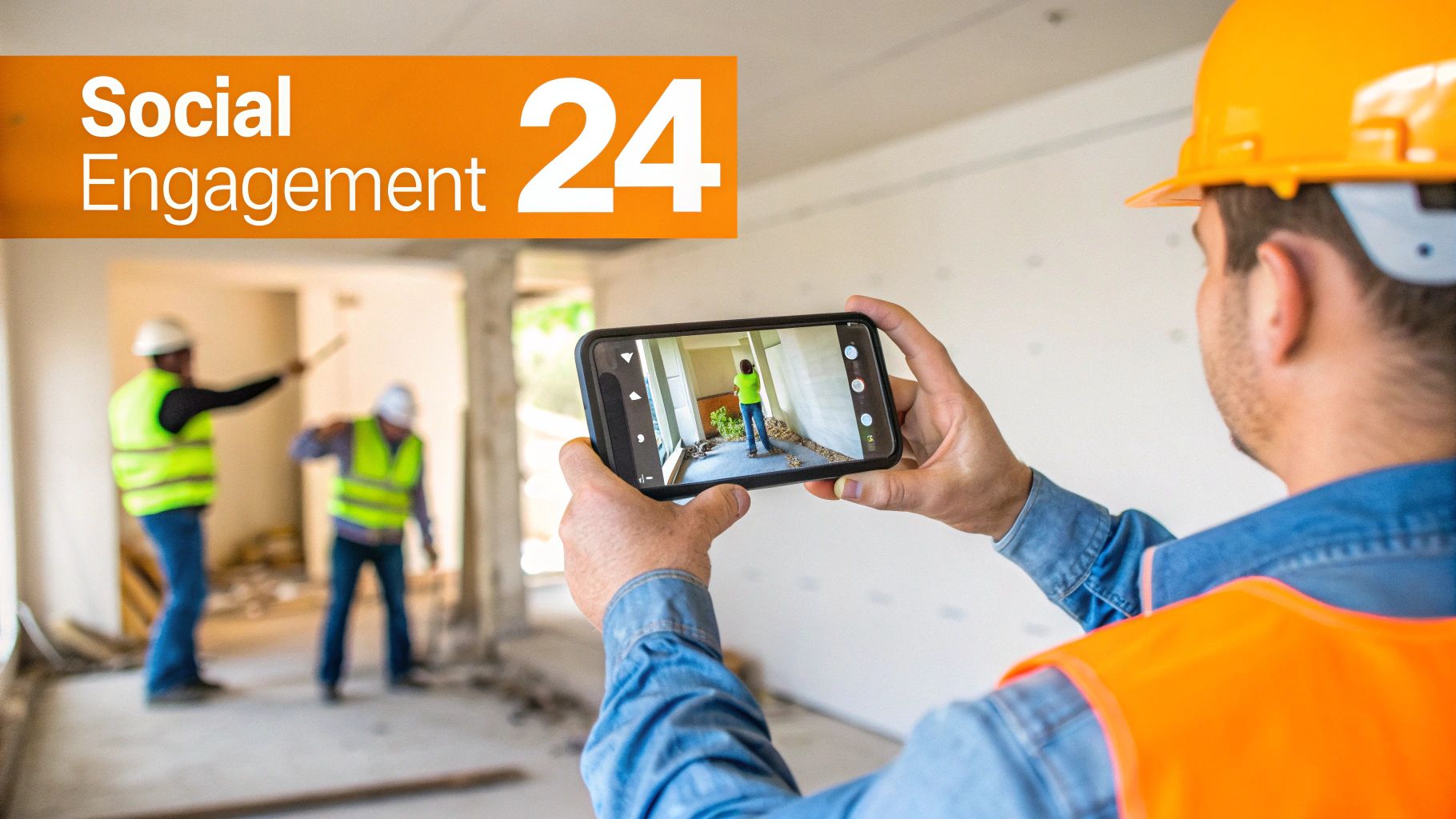
More than just a digital bulletin board, social media offers construction companies a direct line to their community, turning passive followers into engaged leads. This is one of the most visual and personality-driven construction company marketing strategies, allowing you to showcase project transformations, highlight your team's expertise, and build a brand that customers feel connected to. It’s about creating a narrative around your work, from the first groundbreaking to the final walkthrough.
Why It Works for Construction
Construction is inherently visual, making it a perfect fit for platforms like Instagram, Facebook, and even TikTok. A stunning before-and-after photo of a kitchen remodel or a time-lapse video of an ADU build in Pasadena can generate more genuine interest than a traditional ad. This strategy allows you to build trust and authority by showing, not just telling, what you can do.
For example, a home improvement contractor can use Instagram Reels to share quick tips on material selection, earning the trust of homeowners in areas like Sherman Oaks or Beverly Hills. Meanwhile, a commercial general contractor can use LinkedIn to post detailed project updates on a new build in Downtown Los Angeles, attracting B2B clients and potential partners. It transforms your portfolio into an interactive, ongoing story.
How to Implement This Strategy
Choose the Right Platforms: Focus your efforts where they matter most. Instagram and Facebook are ideal for residential projects (B2C), while LinkedIn is a powerhouse for commercial construction and B2B networking. TikTok can be effective for reaching younger demographics with short, engaging video content.
Prioritize Visual Storytelling: Your best assets are before-and-after shots. Create compelling carousel posts, time-lapse videos, and Reels that document the entire construction process. This content consistently receives the highest engagement.
Engage with Your Community: Social media is a two-way street. Respond to every comment and message promptly. Ask questions in your posts to encourage interaction and feature user-generated content, like a homeowner's photo of their new deck.
Use Hyperlocal Tagging: Maximize local visibility by always tagging the location of your projects (e.g., "Encino, CA") and using relevant local hashtags like or . This helps local prospects discover your work.
6. Strategic Partnerships & Referral Programs
No construction company operates in a vacuum. One of the most powerful and cost-effective construction company marketing strategies is to build a network of strategic partnerships and formalize a referral program. This approach transforms complementary businesses and satisfied clients into a proactive, external sales force, creating a consistent stream of high-quality, pre-qualified leads that require less convincing and have higher close rates.
Why It Works for Construction
The construction industry is an ecosystem. A client needing a general contractor for a home addition in Pasadena will also need an architect, an interior designer, and perhaps a specialized AV installer. By forming alliances with these non-competing professionals, you create a mutually beneficial referral loop. This strategy positions your company as a well-connected and trusted hub, solidifying your reputation within the local industry and generating business through established trust.
For example, a luxury home builder in Beverly Hills can partner with high-end real estate agents who represent clients looking to build or remodel. The agent refers their buyer to the builder, and the builder, in turn, refers clients looking to sell their newly renovated homes back to the agent. This symbiotic relationship provides immense value and a steady flow of ideal projects for both parties.
How to Implement This Strategy
Identify and Vet Potential Partners: Create a target list of 5-10 complementary businesses in your service areas, such as architects, interior designers, real estate agents, and specialized subcontractors. Focus on professionals whose quality of work and client base align with yours.
Formalize the Relationship: Don’t rely on handshakes. Create a simple referral agreement outlining the terms, expectations, and any incentives or referral fees. This professionalizes the arrangement and ensures clarity for both sides.
Equip Your Partners for Success: Provide your partners with high-quality marketing materials they can easily share. This could include co-branded brochures, a dedicated landing page on your website for their referrals, or a simple digital packet showcasing your best work.
Incentivize and Track Everything: Offer a compelling reason for people to refer you. This could be a flat fee, a percentage of the project profit, or a reciprocal referral. Use your CRM to meticulously track the source of every lead to measure the success of each partnership and ensure you properly reward your network.
7. Website Optimization & Conversion Rate Optimization (CRO)
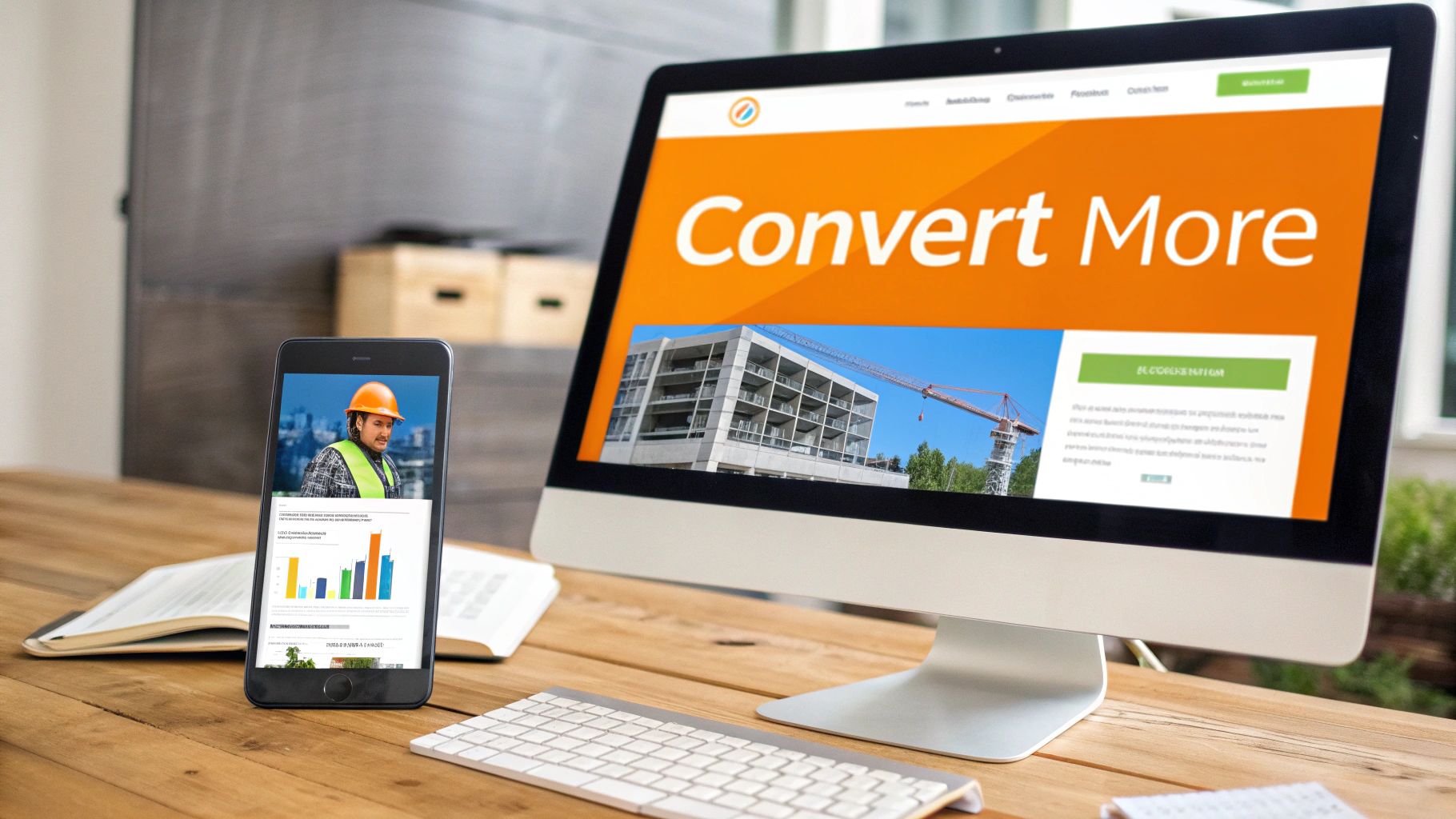
Your company website is more than a digital brochure; it's your most powerful lead-generation tool. Conversion Rate Optimization (CRO) is a systematic approach to improving your website's performance by increasing the percentage of visitors who take a desired action, such as requesting a quote or calling your office. This is one of the most critical construction company marketing strategies because it maximizes the value of the traffic you already have, turning passive browsers into active, qualified leads.
Why It Works for Construction
In construction, a potential client's decision is based on trust, credibility, and ease of contact. A clunky, slow, or confusing website creates friction and drives potential clients to competitors. CRO focuses on removing these barriers. It ensures that when a prospect lands on your site, they can easily find your portfolio, understand your services, see your credentials, and, most importantly, contact you without hassle. This strategy directly impacts your bottom line by converting more of your marketing spend into tangible project opportunities.
For example, a general contractor in Pasadena could A/B test their primary call-to-action button, comparing "Contact Us" against the more compelling "Get Your Free Estimate." This small change can significantly increase the number of quote requests, directly boosting their lead pipeline from website traffic generated in the San Gabriel Valley and surrounding Los Angeles areas.
How to Implement This Strategy
Prioritize Speed and Mobile Experience: Your site must load in under three seconds. Use Google's PageSpeed Insights to identify issues. Ensure your phone number is a "click-to-call" link on mobile devices, as this simple feature can increase inbound calls by over 20%.
Simplify Your Forms: Reduce the number of fields in your contact or quote request forms. A contractor who cut their form from ten fields down to four (Name, Email, Phone, Project Type) saw a 50% increase in submissions. Ask only for what is essential to start a conversation.
Use High-Impact Visuals & Trust Signals: Place large, high-quality photos of your best work "above the fold" on your homepage. Prominently display trust signals like your contractor license number, industry certifications (e.g., BBB, NARI), years in business, and client testimonials.
Craft Clear Calls-to-Action (CTAs): Use action-oriented language for your buttons, like "Schedule Your Consultation" or "View Our Portfolio." Make them visually distinct with contrasting colors. You can discover more powerful techniques by exploring these actionable CRO strategies to improve your website conversion rate.
8. Building Trust Through the Lens: A Video Marketing & YouTube Strategy
Video marketing is one of the most powerful construction company marketing strategies because it brings the tangible results of your work to life. It transforms static project photos into dynamic, engaging narratives that build trust and emotional connection. By showcasing your craftsmanship through project walkthroughs, time-lapses, and client testimonials, you offer prospects a transparent, behind-the-scenes look at your process and the quality you deliver. This strategy establishes authority and helps potential clients visualize their own project's success.
Why It Works for Construction
Construction is a visual industry, and video is the ultimate visual medium. It directly answers a prospect's biggest questions: "What does their work actually look like?" and "Can I trust them to build my vision?" A video walkthrough of a completed home addition in Pasadena or a time-lapse of a commercial build-out in Downtown Los Angeles provides undeniable proof of your capabilities in a way that text and photos cannot.
For example, a renovation company can document a 30-day kitchen remodel in a 10-minute highlight video, showing the transformation from demolition to the final reveal. This not only showcases their skill but also manages client expectations and builds excitement. Publishing this content on YouTube creates a permanent, searchable asset that attracts leads for years to come.
How to Implement This Strategy
Establish Your YouTube Channel: Create and professionally brand your YouTube channel with your company logo, a high-quality banner, and a keyword-rich description of your services and service areas. This is your video portfolio.
Create Diverse Video Content: Don't just show finished projects. Film short project update clips (60-90 seconds), educational videos on topics like roof maintenance, and heartfelt client testimonials. This variety appeals to different audiences at various stages of their buying journey.
Optimize for Search (Video SEO): Use relevant keywords in your video titles and descriptions (e.g., "Custom Home Build in Encino, CA | Project Walkthrough"). Organize videos into playlists by service type, like "Kitchen Remodels" or "ADU Construction," to improve user experience and watch time.
Promote Your Videos Systematically: Share every new video across your social media channels, in your email newsletter, and embed them on relevant pages of your website. A video on a "Bathroom Remodeling in the San Fernando Valley" service page can significantly boost engagement and conversion rates.
9. Reputation Management & Online Review Strategy
In today’s digital-first world, your online reputation is your most valuable asset. A proactive construction company marketing strategy focused on reputation management involves actively soliciting, monitoring, and responding to online reviews. It's about building a fortress of positive social proof that attracts new clients and insulates your brand from the occasional negative feedback. This strategy transforms satisfied customers into a powerful, always-on sales force.
Why It Works for Construction
Trust is the foundation of any construction project. Online reviews are the modern-day word-of-mouth referral, and prospects rely on them heavily to vet contractors before even making a call. A company with dozens of recent 5-star reviews on Google and Houzz will almost always get the lead over a competitor with a sparse or negative review profile. Strong, positive reviews directly impact lead generation and conversion rates by building immediate credibility.
For example, a residential contractor in Pasadena with a robust portfolio of positive reviews detailing their communication and craftsmanship can easily win projects over a seemingly equal competitor. Platforms like HomeAdvisor and Angie's List often highlight top-rated pros, giving them priority visibility and driving as much as 30% more quote requests. A positive reputation signals reliability and quality, which is paramount for high-stakes construction decisions.
How to Implement This Strategy
Systematize the Ask: Don't leave reviews to chance. Incorporate a review request into your project close-out process. The best time to ask is within 24-48 hours of project completion when the client's satisfaction is at its peak.
Make It Effortless: Provide a direct link to your preferred review platform (like your Google Business Profile) in a follow-up email or text. The fewer clicks required, the higher your success rate.
Engage with Every Review: Respond to all reviews, both positive and negative, within 24-48 hours. Thank happy clients for their feedback. Address negative reviews professionally by acknowledging their experience, taking the conversation offline, and offering to make it right.
Leverage Positive Feedback: Share your best 5-star reviews on your social media channels and feature them prominently on your website. This amplifies your social proof and reinforces your company's commitment to excellence.
10. Networking Events, Trade Shows & Community Involvement
In an industry built on trust and relationships, face-to-face interaction remains one of the most powerful construction company marketing strategies. While digital efforts are crucial, a strong in-person presence through networking, trade shows, and community involvement helps build the tangible credibility that clients seek. This strategy involves actively participating in industry and local events to forge genuine connections with potential clients, partners, and influential community members.
Why It Works for Construction
Construction is a high-trust, high-stakes business. In-person engagement allows you to move beyond a digital profile and establish genuine rapport. When a property manager in Encino or a developer in Downtown Los Angeles meets you at a Chamber of Commerce event, you become a familiar face, not just another company in a search result. This personal connection is often the deciding factor in securing large-scale projects.
For example, a general contractor exhibiting at a home and garden show can generate dozens of qualified leads in a single weekend. Similarly, sponsoring a local charity 5K in a community like Pasadena or Burbank builds brand goodwill and demonstrates a commitment to the areas you serve. Beyond direct outreach, showcasing your company's commitment to the community can be a powerful differentiator. Understanding how to leverage social value in public procurement can significantly enhance your chances of securing work and demonstrating positive community involvement.
How to Implement This Strategy
Engage with Industry and Local Groups: Join your local Chamber of Commerce or a dedicated networking group like BNI. Consistently attend meetings to build a reputation as a reliable and expert contractor in your field.
Maximize Trade Show ROI: Don't just show up. Set clear goals for lead generation, create a professional and engaging booth, and have a system for capturing contact information. Prepare a concise elevator pitch that clearly defines your ideal client and services.
Invest in Community Sponsorship: Sponsoring a local high school sports team or a community festival is a highly visible way to build brand affinity. It positions your company as a dedicated local partner, not just a service provider.
Systemize Your Follow-Up: Use a CRM to track every new contact. Send a personalized follow-up email or LinkedIn connection request within 24-48 hours of meeting someone to keep the conversation going and solidify the new relationship.
Top 10 Construction Marketing Strategies Comparison
Strategy | 🔄 Implementation complexity | ⚡ Resource requirements & speed | 📊 Expected outcomes | 💡 Ideal use cases | ⭐ Key advantages |
|---|---|---|---|---|---|
Local SEO Optimization — improve local search & Maps visibility | Medium — initial setup + ongoing maintenance (citations, reviews) | Low–Moderate — GBP tools, citation services, staff time; relatively fast setup | Increased local visibility and high-intent leads within 6–12 weeks | Service-area contractors targeting nearby customers and map-pack placements | High conversion intent; cost-effective; builds local trust via reviews |
Content Marketing & Blog Strategy — educational posts, case studies, videos | Medium–High — consistent content creation and editorial planning | Moderate — copywriting, media production, occasional agency support; slower ROI | Long-term organic traffic growth and inbound leads (3–6+ months) | Firms seeking thought leadership, SEO depth, and lead education | Improves SEO and trust; shortens sales cycle; provides shareable assets |
Strategic Google Ads, PPC & Retargeting — search & remarketing campaigns | Medium — setup plus continuous bid/creative optimization | Moderate–High — ad spend ($500+), management; delivers immediate results | Immediate visibility and measurable leads; optimized ROI in 2–4 weeks | Time-sensitive lead generation or markets with high search intent | Fast, highly measurable, scalable; re-engages warm audiences |
Email Marketing & Nurture Campaigns — automated sequences & newsletters | Low–Medium — automation setup and content cadence | Low–Moderate — email platform + content creation; efficient over time | High ROI; improved retention and repeat sales; measurable open/click metrics | Nurturing leads and reactivating past clients across long sales cycles | Extremely cost-effective and personalizable; strong lifetime value impact |
Social Media Marketing & Community Engagement — visual posts & interaction | Medium — consistent content schedule and community management | Low–Moderate — organic content with optional paid boosts; ongoing effort | Increased brand awareness, engagement, and referral traffic (indirect leads) | Visual project showcases, brand-building, and local community engagement | Excellent for visual storytelling and social proof; multiplies content utility |
Strategic Partnerships & Referral Programs — co-marketing & incentives | Medium–High — relationship building and program administration | Low–Moderate — time investment, potential commissions or rewards | High-quality, lower-cost leads over time; network-driven pipeline | Partner-dependent leads (architects, designers, suppliers, agents) | Trusted referrals with higher conversion rates; sustainable referral streams |
Website Optimization & CRO — UX, CTAs, forms, speed, A/B testing | Medium — design/dev changes and iterative testing | Moderate — development, analytics and testing tools; requires traffic to test | Higher lead conversion from existing traffic within weeks to months | Sites with traffic but low inquiry rates; firms wanting better ROI from current visitors | Increases lead yield without buying more traffic; improves user trust and SEO |
Video Marketing & YouTube Strategy — walkthroughs, time-lapses, tutorials | High — production, editing, and consistent publishing | Moderate–High — equipment, editing time or vendor costs; longer ramp | Strong engagement, SEO lift and long-term visibility; evergreen views | Visual transformations, complex projects, and audience-building goals | Highest engagement and shareability; builds emotional trust and search presence |
Reputation Management & Online Review Strategy — solicit & respond to reviews | Medium — process setup and ongoing monitoring/response | Low–Moderate — review tools and staff follow-up; timely effort required | Improved conversion rates and local rankings; increased trust signals | Competitive local markets where reviews influence choice | Directly boosts conversions and local SEO; low-cost trust builder |
Networking Events, Trade Shows & Community Involvement — in-person outreach | Medium–High — event planning, attendance, and follow-up | Moderate–High — booth fees, travel, materials, staff time | High-quality personal leads and partnership opportunities over months | Local B2B relationships, supplier/partner development, community visibility | Face-to-face trust building and deep relationship opportunities |
Constructing Your Marketing Future, One Strategy at a Time
Building a successful construction business requires the same precision, planning, and skilled execution as erecting a skyscraper. The blueprint for your growth is no longer just about your reputation on the job site; it's about the digital foundation you build online. Throughout this guide, we've laid out a comprehensive toolkit of modern construction company marketing strategies, each one a vital component in constructing a powerful, lead-generating machine for your business.
We moved beyond the abstract and dove into the tangible tactics that drive results. From establishing a dominant local presence through meticulous Local SEO and Google Business Profile optimization to showcasing your expertise with compelling content and project case studies, the goal is to build trust before the first consultation even happens. We explored how strategic Google Ads and geotargeted PPC campaigns can put your company in front of high-intent clients at the exact moment they’re searching for your services, whether they're in the bustling heart of Los Angeles or quieter surrounding neighborhoods like Pasadena or Sherman Oaks.
Your Blueprint for Actionable Growth
The path from reading about these strategies to implementing them can seem daunting, but progress is built one step at a time. The key is not to attempt everything at once but to choose a starting point that aligns with your most pressing business needs.
Here are the core takeaways to guide your next steps:
Foundation First: Your website is your digital showroom. Before investing heavily in driving traffic, ensure it’s professionally designed, mobile-responsive, and optimized for conversions. A fast, easy-to-navigate site with stunning portfolio galleries is non-negotiable.
Visibility is Key: You can be the best contractor in Southern California, but it won't matter if clients can't find you. Prioritize Local SEO to dominate search results in your specific service areas, from Santa Monica to the San Gabriel Valley. Actively managing your online reputation and gathering client reviews is an integral part of this process.
Build Relationships, Not Just Structures: Marketing is a long-term project. Use email automation to nurture leads, engage your community on social media with behind-the-scenes content, and build powerful referral networks with complementary businesses. These relationships are the steel framework that will support your business through any market condition.
Measure Twice, Market Once: Every strategy, from PPC to content marketing, must be tracked. Define your key performance indicators (KPIs), use analytics tools to measure what’s working, and be prepared to adjust your approach. Data-driven decisions are the difference between spending money and investing it wisely.
Ultimately, mastering these diverse construction company marketing strategies is about creating a predictable and sustainable pipeline of high-quality projects. It's about moving away from relying solely on word-of-mouth and taking firm control of your company's growth trajectory. By systematically implementing, testing, and refining these tactics, you transform your marketing from a recurring expense into your most valuable asset. The effort you invest today in building this marketing framework will pay dividends for years to come, ensuring your company not only survives but thrives in a competitive digital landscape.
Just as you are the expert in construction, we are the experts in building digital marketing frameworks that generate measurable results. If you’re ready to lay the foundation for sustainable growth, the team at DLL Studios is here to be your strategic partner. Visit us at DLL Studios to learn how we help construction companies across Los Angeles and Southern California build a dominant online presence.
