


.png)
A Winning Guide to RFP Website Design
A good website design RFP is so much more than a simple request—it’s the strategic blueprint for your entire project. It gets your team on the same page, clarifies what you’re trying to achieve, and ultimately helps you find an agency that can deliver a website that actually grows your business.
Why Your Website RFP Is a Strategic Blueprint
Long before a single line of code is written or a design is mocked up, your Request for Proposal (RFP) lays the groundwork for your digital future. The moment you start treating it as a strategic document instead of a bureaucratic formality, you’re on the right track to a successful partnership and a high-performing website.
A well-thought-out RFP forces you to get your internal house in order. It makes your team come together and turn vague ideas into solid, measurable goals. This internal alignment is invaluable. It bridges the gap between different departments—whether it’s marketing and sales in Downtown Los Angeles or operations out in the San Fernando Valley—and ensures everyone agrees on the website's real purpose. This simple act of planning ahead prevents the costly scope creep and mismatched expectations that can absolutely sink a project.
The Cost of a Vague RFP
Let's look at a real-world example. Imagine a professional services firm in Beverly Hills sends out a one-page RFP asking for a "modern website." What happens next is chaos. They get proposals with wildly different price tags and scopes because every agency is left guessing what "modern" actually means to them. The result? A project that completely misses the mark and requires expensive, frustrating changes after launch. This happens all the time, and it's totally avoidable.
Now, picture a different scenario. A healthcare provider in Pasadena sends out a detailed RFP specifying the need for a patient portal, full ADA compliance, and a user journey built around scheduling appointments. This clarity ensures they get accurate, comparable bids from agencies with the exact experience they need. The project runs smoothly, stays on budget, and delivers a tool that genuinely helps their patients and supports their business goals.
Attracting the Right Agency Partners
Here’s something most people don’t realize: a clear, comprehensive RFP signals to top-tier agencies that you are a serious, organized client. It shows you’ve already invested time in understanding your own needs, which instantly makes you a more attractive partner. Good agencies want to spend their time crafting a thoughtful solution for you, not playing a guessing game.
A great RFP isn't just a list of requirements; it's a compelling story about your business's future. It invites a potential partner to help you write the next chapter, ensuring they are as invested in your success as you are.
The financial stakes are surprisingly high. With around 37% of company revenue influenced by RFPs and average win rates hovering at 45%, the quality of your document has a direct impact on your bottom line. When your website is central to how your business operates, a formal RFP isn't just a good idea—it's essential for a transparent and successful vendor selection process. You can find more great stats on this from BrandVM's benchmark studies.
Ultimately, a strong website can level the playing field, putting your business at the top no matter its size. And your RFP is the first, most critical tool you have to build that digital advantage.
To help you get started, here's a quick rundown of what every effective RFP needs. Think of this as your cheat sheet for making sure you cover all the essential bases.
Key Components of an Effective Website Design RFP
Section | Purpose | Key Information to Include |
|---|---|---|
Project Overview | To give a high-level summary of your company and the project. | Company background, mission, current website issues, primary project goals. |
Scope of Work | To detail the specific deliverables and services you need. | Design, development, content migration, SEO, maintenance, required features. |
Technical Requirements | To outline any specific tech constraints or preferences. | CMS preference (e.g., WordPress, Wix), hosting, integrations, security needs. |
Budget & Timeline | To set clear expectations for cost and project duration. | Your budget range, key milestones, final deadline for launch. |
Submission Details | To explain how agencies should submit their proposals. | Contact person, submission deadline, required format, decision timeline. |
Evaluation Criteria | To show how you will score and select the winning bid. | Scoring breakdown (e.g., experience, portfolio, cost, technical approach). |
Each of these sections plays a crucial role in painting a complete picture for potential partners, ensuring you get proposals that are relevant, accurate, and aligned with your vision.
Defining Your Project From the Inside Out
The best website RFPs don't just tell an agency what to build; they explain why you need it built. Before you ever start writing for potential partners, you have to get crystal clear on what you're trying to achieve internally. This isn't busywork—it's the foundational step that turns a simple task list into a strategic brief that will guide the entire project.
It all starts by looking inward and getting the right people in the room. A website redesign is never just a marketing project. It touches sales, customer service, operations, and IT, so your internal team needs to reflect that. Bringing in people from each key department gives you the insights you need and builds champions for the project across the company.
Assembling Your Internal Project Team
First things first, you need to identify all the stakeholders. And I don't just mean department heads. Think about the people whose day-to-day work is actually impacted by your website. If you're a local business in Los Angeles, that might mean sitting down with the sales manager in your West Hollywood office, a customer service lead from Torrance, and an operations coordinator who’s shipping orders out of your warehouse in the San Gabriel Valley.
Once you have your team, interview each person. The goal here is to stitch their individual needs and frustrations into one coherent vision. These conversations are where you'll uncover the real pain points, find hidden opportunities, and, most importantly, head off the internal disagreements that can completely derail a project down the road.
A project without a unified internal vision is like a ship without a rudder. By aligning stakeholders from the start, you ensure everyone is steering in the same direction, preventing costly detours and ensuring you reach your desired destination.
This simple diagram shows how that internal clarity becomes a magnet for the right agency partner.
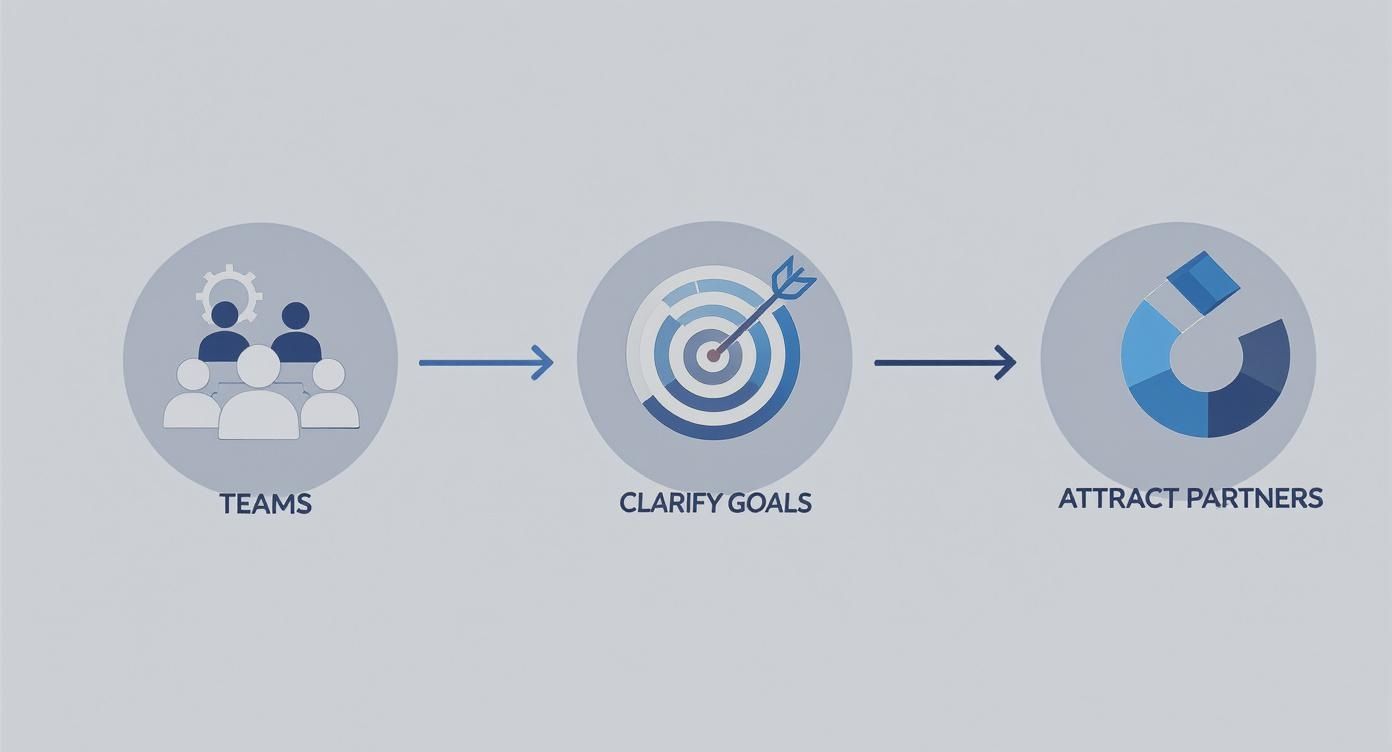
It’s a simple but powerful truth: when you know exactly what you need, you attract partners who know exactly how to deliver it.
Translating Business Goals into Measurable Outcomes
With your team aligned, you can start turning vague objectives into specific, measurable outcomes. "Improving our online presence" is a wish, not a goal. A strong RFP translates that wish into something you can actually track.
For example, instead of just saying you want "more leads," get specific:
Goal: Increase qualified leads from Southern California by 20% within six months of launch.
Goal: Reduce customer support calls related to online ordering by 30% by creating a more intuitive checkout process.
Goal: Achieve a top-three ranking on Google for "HVAC repair in Sherman Oaks" within one year.
Metrics like these give agencies a clear target to aim for. More importantly, they give you a clear benchmark to measure their success against. If you want more guidance on this early stage, our founder's guide to website development for startups is a great resource for essential planning steps.
Understanding Your Users and Content
Finally, you have to dig into who will be using your website and what they truly need from it. This comes down to two key exercises: creating user personas and doing a full content audit.
1. Define Target Audience Personas: Build out detailed profiles of your ideal customers. A property manager in Santa Monica has completely different needs and motivations than a homeowner in Pasadena. These personas should inform every single design and content decision you make.
2. Map Critical User Journeys: Walk through the steps a user currently takes to do something important on your site, like requesting a quote or finding a phone number. Where do they get stuck? Where do they get frustrated? Identifying these friction points helps you define exactly what the new site needs to fix. You can even use website survey tools to get direct feedback on what’s working and what isn’t.
3. Conduct a Content Audit: Go through every single page on your current site. For each one, decide if you need to keep it, update it, or get rid of it completely. This audit is crucial for preventing you from migrating outdated or irrelevant information and helps you plan for the new content your project goals demand.
This internal discovery work is, without a doubt, the most important part of the entire RFP process. It ensures your document reflects your real business needs, setting you up for a great partnership and a website that actually delivers results.
Building Out the Key Sections of Your RFP
Alright, let's move from the big picture to the nuts and bolts. This is where you actually start building the document, section by section, giving agencies the specific details they need to put together a thoughtful, accurate proposal. Think of it as translating all your internal planning into a clear roadmap for them to follow.
Every piece of this puzzle is designed to eliminate guesswork. When you submit a well-structured RFP, you're not just asking for a price—you're showing that you're an organized, serious partner. Believe me, that alone attracts a higher caliber of agency.
Company Background and Introduction
Kick things off with a quick, compelling overview of your business. This isn’t the time for a novel about your company's history. Instead, give them a snapshot: who you are, what you do, and who you serve.
For example, a professional services firm in Beverly Hills might talk about their niche in entertainment law. A family-owned restaurant in Pasadena would lean into its community roots and unique culinary style. The idea is to provide just enough context so an agency can immediately grasp your brand and where you sit in the market.
Wrap up this section by briefly explaining the "why now?" Are you in the middle of a rebrand? Pushing into new markets like the San Fernando Valley? Or is your current site just not cutting it anymore? That context is gold.
Project Goals and Objectives
This section flows directly from the discovery work you’ve already done. It’s where you lay out the specific, measurable results you expect from the new website. Vague goals like "we want to improve our online presence" are useless here.
You need to use concrete metrics that leave zero room for ambiguity. This gives potential partners a clear target to aim for when building their strategy.
Bad Example: "We want a better online presence."
Good Example: "We need to generate 25% more qualified leads through our contact forms from our service areas in Santa Monica and Malibu within six months of launch."
When you define success this clearly, you ensure every proposal you get back is focused on delivering real business value, not just a pretty design.
A Comprehensive Scope of Work
The Scope of Work (SOW) is the absolute heart of your RFP. This is where you itemize every single deliverable and technical requirement. The more detailed you get here, the more accurate and realistic the proposals will be.
Break it down into key areas to make sure nothing gets missed. Don't assume anything is "standard"—if you need it, write it down.
Think of your Scope of Work as the project's official rulebook. A detailed SOW is your best defense against scope creep. It manages expectations and gives both you and your agency a clear reference point for the entire project.
A solid SOW should always cover these key components.
Key SOW Components to Include
Design & User Experience (UX): Do you have an existing brand guide they need to follow, or are you looking for a complete branding overhaul? Mention your key audience personas and any critical user journeys you need to optimize.
Functional Requirements: This is a simple checklist of what the site must do. Will you need an e-commerce store? A secure client portal? Maybe an events calendar or a complex property search for a real estate agency serving Woodland Hills and Chatsworth? Be explicit.
Content Management System (CMS): If you have a preference—like WordPress, Wix, or Webflow—state it. If not, describe your team's technical skill level so agencies can recommend a CMS that you can actually manage.
Third-Party Integrations: Make a list of every single external tool the website has to talk to. We're talking about your CRM (like Salesforce), your email platform (like Mailchimp), payment gateways, you name it. Forgetting an integration is a surefire way to get hit with surprise costs down the line.
Accessibility: This is non-negotiable. Mandate compliance with Web Content Accessibility Guidelines (WCAG) 2.1 AA. It’s not just a best practice; for many businesses in California, it's a legal requirement that ensures your site can be used by everyone.
By being this thorough, you're empowering agencies to give you a realistic quote and a project plan that actually solves your problems.
Often-Missed but Vital Sections
Finally, a truly great RFP looks beyond launch day. Including sections that cover what happens after the site is live shows you’re thinking about the long-term health of your investment.
Ongoing Support and Maintenance: What happens when things break or need updating? Ask agencies to detail their support and maintenance plans. What do they cover (security updates, backups, performance checks), and what do they cost?
Team Training: Who on your team is going to be updating the site? Make it clear that the project must include training sessions for your staff on how to use the CMS to add blog posts, update pages, or manage products.
Hosting Requirements: Some agencies handle hosting, while others expect you to provide it. Clarify what you prefer. Do you want the agency to manage it completely, or does your IT team in Downtown Los Angeles have it covered?
Getting these details sorted out upfront prevents nasty surprises and helps you find a partner who can support your website for its entire lifecycle, not just build it and walk away.
Setting a Realistic Project Budget and Timeline
Let's talk about the two things that can make or break your project before it even starts: money and deadlines. It might feel a little awkward to lay your cards on the table, but trust me, being upfront about your budget and timeline is the single most important thing you can do in your RFP.
Complete transparency here acts as a powerful filter. It immediately weeds out agencies that are too expensive or can't meet your schedule, and it attracts partners who can actually deliver what you need within your real-world constraints.

If you don't provide a clear budget, you're essentially asking agencies to take a wild guess. You'll end up with a stack of proposals that are impossible to compare side-by-side. One firm might pitch a simple template-based site, while another quotes a fully custom-coded experience with all the bells and whistles.
By giving a budget range, you ensure every proposal is designed to solve your specific problems at a price point you can actually afford.
Demystifying Website Project Costs
So, what's a realistic number? The honest answer is: it depends entirely on your scope. A straightforward marketing site for a local Pasadena business will have a very different price tag than a complex e-commerce platform with a client portal for a large firm in Downtown Los Angeles.
Features like third-party API integrations, custom databases, and e-commerce functionality are the big-ticket items that drive costs up.
We've also seen a shift in the market. A few years ago, many projects were in the $70,000-$90,000 range. These days, it's more common to see budgets land between $30,000-$60,000. That shift doesn't mean quality has dropped; it means clients are demanding leaner budgets and providing more detailed RFPs. Many projects in this new range now include strategic SEO and conversion optimization—services that used to be line items on a separate invoice. You can get more perspective on this from these industry marketing experts.
When you state your budget, you aren't just naming a price; you're setting the guardrails for creativity. It empowers a good agency to propose the most valuable solution possible within your financial constraints, ensuring you get the best return on your investment.
When you're thinking about your budget, it's also helpful to understand the common pricing models. The two you'll see most often are Fixed-Bid and Time and Materials.
Fixed-Bid: You and the agency agree on a single, set price for the entire project as defined in the RFP. This gives you predictable costs, but it can be rigid if you need to make changes later on.
Time and Materials (T&M): You pay an hourly rate for the actual time spent, plus the cost of any materials. This model offers much more flexibility but less certainty on the final cost. It's best for projects where the scope is likely to evolve.
For most website RFPs, a fixed-bid approach based on a crystal-clear scope is the standard.
Building a Realistic Project Timeline
A solid timeline is just as crucial as a realistic budget. If you rush the schedule, you'll get cut corners, missed requirements, and a final product that just doesn't hit the mark. A well-thought-out timeline accounts for every single phase of the project, including the time your team needs to provide feedback and approvals.
Remember, a typical website project unfolds in several distinct phases. And whatever you do, build in some buffer time for unexpected delays. They always happen.
Sample Project Timeline Breakdown
To give you a starting point, here’s a sample schedule you can adapt. A standard project can take anywhere from 12 to 20 weeks, depending on how complex it is.
Discovery & Strategy (Weeks 1-2): The project kicks off with deep-dive meetings where the agency gets to know your business, goals, and audience inside and out. This phase is all about getting everyone perfectly aligned before a single pixel is designed.
Sitemap & Wireframing (Weeks 3-4): Next, the agency will create a blueprint for the site's structure (the sitemap) and basic page layouts (the wireframes). Your team’s feedback here is absolutely critical and needs to be timely.
UI/UX Design (Weeks 5-7): This is where the visual magic happens. Based on the approved wireframes, the agency will design the user interface and the overall look and feel of the site.
Development & Coding (Weeks 8-12): The approved designs get turned into a real, functional website. This is usually the longest and most heads-down phase of the entire project.
Content Population (Weeks 13-14): All of your text, images, videos, and other media get loaded into the new website's content management system (CMS).
Testing & Quality Assurance (Weeks 15-16): The agency puts the site through its paces, rigorously testing for bugs, checking browser compatibility, and making sure it works perfectly on every device.
Launch & Post-Launch Support (Week 17+): Go-live! The new website is launched to the world. A good agency will stick around to monitor its performance and squash any immediate issues that pop up.
By clearly defining your budget and mapping out a schedule that makes sense, your rfp website design will attract high-quality partners who are ready to hit the ground running.
How to Evaluate Proposals and Select the Right Partner
Proposals are rolling in. It's an exciting moment, but now the real work begins. Your goal is to look past the slick sales pitches and find a partner who truly gets your business, not just the one with the most attractive price tag. A structured process here is your best friend—it helps you make a confident, objective choice.
The first thing to do is level the playing field. It's so tempting to just flip through the proposals and gravitate toward the one that looks the best. Don't do it. You need a consistent way to stack each response up against the requirements you laid out in your RFP. This is how you keep personal bias out of the equation and make a decision based on substance, not just style.
Creating a Weighted Scoring Matrix
A weighted scoring matrix is the gold standard for a reason. It turns a subjective decision into something much more data-driven. It's essentially a spreadsheet where you list your key criteria, assign a "weight" to each based on its importance, and then score every agency's proposal against those criteria.
To get started, you can even use a strategic evaluation criteria matrix creator to help organize your thoughts and build a professional evaluation tool quickly.
Here’s a real-world example of what your criteria might look like:
Relevant Experience & Portfolio (Weight 25%): Have they done this before for a business like yours? Does their past work show the kind of quality and functionality you're after?
Technical Approach & Strategy (Weight 20%): Did they actually read your RFP and understand your goals? Or did they just send a generic, one-size-fits-all pitch?
Team & Project Management (Weight 15%): Who exactly will be working on your project? Do they have the right skills? Is their project management process clear and collaborative?
Cultural Fit & Communication (Weight 15%): Honestly, do they seem like people you can work with? Was their proposal professional, clear, and typo-free?
Cost & Value (Weight 25%): Does the price make sense for the scope of work they’re offering? Remember, the cheapest option is rarely the best value.
A scoring matrix isn’t just for picking a winner. It's about justifying your choice with a clear, documented rationale you can share with stakeholders. It gets everyone on the same page.
Digging Deeper with Finalist Interviews
Once your matrix helps you narrow the list to two or three top contenders, it’s time to talk to them. Interviews are where you go beyond the paper and get a feel for the people you might be working with. This is where you really gauge that all-important cultural fit.
Come prepared with specific, open-ended questions that push them beyond their written proposal.
"Walk me through a similar project. What was an unexpected challenge you ran into, and how did you solve it?"
"Based on our RFP, what do you see as the single biggest risk to this project's success, and how would you handle it?"
"How do you typically handle communication and feedback with your clients during a project?"
Pay attention not just to what they say, but how they say it. Do they seem genuinely engaged and passionate? Are they asking smart follow-up questions about your business? From our experience, we've found the best partners are always curious.
Red Flags to Watch Out For
While you’re reviewing proposals and interviewing candidates, keep your radar on for potential red flags. They're often subtle hints that an agency might not be the right fit.
A few common warning signs include:
Canned Responses: If the proposal feels like a copy-and-paste job that doesn’t speak to your specific goals, that’s a big problem.
No Clarifying Questions: A great agency will almost always have questions after reading an RFP. Silence could signal a lack of interest or attention to detail.
Overpromising: Be skeptical of anyone guaranteeing #1 search rankings or promising an impossibly fast timeline.
Poor Communication: If they’re slow or unclear in their communication now, imagine what it’ll be like after you’ve signed a contract.
Choosing a partner is a huge decision. For a deeper dive into this final step, check out our guide on how to choose a web design company. By combining a structured process with your own gut feeling, you can confidently find an agency that will not only build a fantastic website but become a true partner in your success.
Common Questions About Website Design RFPs
Going through the RFP process for the first time can feel a bit like you're flying blind. It's a big investment, and the pressure to get it right is real. To help you navigate the final stretch, I’ve put together answers to some of the most common questions that pop up.
Think of this as a final gut-check before you hit "send" on that RFP, so you can move forward with total confidence.
How Long Should Our RFP for Website Design Be?
There’s no magic number, but when it comes to RFPs, clarity beats brevity every time. Most solid rfp website design documents end up somewhere between 10 to 25 pages. Your goal is to give an agency enough meat to really understand your business, goals, and technical needs without burying them in fluff.
Give them everything they need to come back with a smart, accurate proposal. If your RFP is too short, you’ll get vague bids and a flood of follow-up questions. Too long, and you might scare off the best agencies who are too busy to read a novel.
Should We Include a Specific Budget in Our RFP?
Yes. Absolutely. I know the fear—if you name a number, every single bid will magically come in at the top of your range. But trust me, keeping your budget a secret usually does more harm than good.
Many of the best agencies won't even touch an RFP without a budget. To them, it signals you might have unrealistic expectations or, even worse, that the funding isn't actually secured.
Putting a realistic range in your RFP (something like "$40,000-$60,000") shows you’re serious. It also lets agencies design a solution that gives you the most bang for your buck, so you get proposals you can actually compare side-by-side.
How Many Agencies Should We Send Our RFP To?
This is all about quality over quantity. The sweet spot is inviting 3-5 well-researched agencies to the table. Blasting your RFP out to a dozen firms is a waste of your time and theirs. It also tells agencies you haven't done your homework, which means you’re likely to get half-hearted responses.
Do the legwork upfront. Find a shortlist of agencies whose work, reviews, and expertise feel like a good fit for you. This focused approach gets you high-quality proposals from people who are genuinely excited about the project.
When you send your RFP to a smaller, curated list of agencies, you’re showing them you value their expertise and are looking for a real partner. It’s a sign of respect that leads to more thoughtful proposals and, ultimately, a much better final product.
What Are the Biggest Mistakes to Avoid When Writing an RFP?
From what I've seen, the biggest blunders happen before a single word of the RFP is even written. They almost always come from a lack of internal clarity. If you can get your own house in order first, you’re way ahead of the curve.
Here are the mistakes that trip people up most often:
Vague Goals: Saying you want to "improve our online presence" is a recipe for scope creep and mismatched expectations. Get specific.
Unrealistic Timelines or Budgets: This is the quickest way to send experienced, qualified partners running for the hills. They know what it really takes.
Focusing on a Checklist of Features: Your RFP should be about solving business problems, not just listing every feature you think you need. Let the experts propose the how.
Choosing Based Solely on the Lowest Price: The cheapest bid almost always turns into the most expensive project. Think hidden costs, blown deadlines, and poor quality.
Failing to Involve Key Stakeholders: Forgetting to bring in people from sales, marketing, or operations early on is a classic mistake. You’ll inevitably miss critical requirements until it’s too late—and expensive—to add them.
Keep these common questions and missteps in mind, and you'll craft an rfp website design doc that is clear, professional, and attracts the perfect partner for your project.
Ready to create a website that not only looks great but also delivers real business results? At DLL Studios, we partner with businesses across Southern California to build high-performing digital experiences. Los Angeles is at the center of our service area, and we proudly support clients across a wide network of surrounding cities and neighborhoods throughout Southern California. Our reach includes every corner of L.A.—from Downtown Los Angeles, Hollywood, West Hollywood, Beverly Hills, and Santa Monica to the beach communities of Malibu, Venice, Marina del Rey, Hermosa Beach, Manhattan Beach, and Redondo Beach. We also extend service through the San Fernando Valley, including Sherman Oaks, Studio City, Encino, Van Nuys, North Hollywood, Burbank, Glendale, Pasadena, Woodland Hills, Chatsworth, Canoga Park, Reseda, Northridge, and Tarzana. In the San Gabriel Valley, we work with clients in Alhambra, Monterey Park, San Gabriel, Temple City, Rosemead, Arcadia, El Monte, South El Monte, West Covina, Covina, Baldwin Park, Azusa, Glendora, Duarte, and Monrovia. Farther southeast, we serve Whittier, Pico Rivera, Downey, Norwalk, La Mirada, La Habra, and Cerritos. We also support the South Bay—including Torrance, Carson, Gardena, Hawthorne, Inglewood, and Long Beach—as well as the Gateway Cities and communities throughout the I-10, I-5, 101, and 405 corridors. Whether you’re in a major metro area or a smaller surrounding neighborhood, our team delivers reliable, high-quality service anywhere in or around Los Angeles. Contact us today for a free consultation and let's discuss how we can bring your vision to life.

