


.png)
How to Choose a Web design Company: A Simple Guide
Choosing the right web design company really boils down to a simple, three-part approach. First, you need to get crystal clear on your own goals and budget. Then, you can start digging into an agency's portfolio to see if they've actually delivered results. Finally, you’ll want to ask the right questions to make sure you’re finding a true partner, not just a vendor.
Taking the time to do this groundwork is easily the most important part of the entire process. It means you’re walking into conversations with a clear vision of what success looks like for your business.
Defining What Your Business Truly Needs
Before you even glance at a single portfolio or hop on a discovery call, you've got to look inward. Seriously. Kicking off the search for a web designer without a clear vision is like starting a road trip with no destination in mind—you’ll burn through a lot of time and money, and you probably won’t end up anywhere you want to be.
Success starts with a plan. This initial prep work makes you an informed client, someone who can communicate goals clearly, evaluate proposals fairly, and confidently pick a partner who’s going to deliver real value.

Set Specific and Measurable Goals
Your website isn't just a digital brochure; it’s a business tool that should be working for you around the clock. So, what specific job do you need it to do? Fuzzy goals like "improve our online presence" just don't cut it. You need to focus on specific, measurable outcomes that actually hit your bottom line.
Think about what you really want to achieve. For example:
Generate Qualified Leads: Do you need your website to bring in new customers in areas like Sherman Oaks or Pasadena? A solid goal would be: "Increase monthly lead form submissions by 25% within six months."
Drive E-commerce Sales: If you're running a retail business in a place like Beverly Hills or Santa Monica, the mission is simple. Try something like: "Increase online revenue by 15% and cut cart abandonment by 10% this year."
Build Brand Authority: Maybe your main goal is to become the go-to expert in your field. In that case, you might aim to "Increase blog subscribers by 500 and land three guest post features through your new content hub."
A website without clear goals is an expense. A website with clear goals is an investment. Knowing the difference is the first step toward making a smart decision when you hire a web design company.
Establish a Realistic Budget
Your budget is going to shape the entire project, from the scope of work to the type of agency you can hire. Web design costs are all over the map, so it’s critical to have a realistic number in your head. Remember, you're not just buying a website; you're investing in a primary business asset.
Here’s a quick breakdown of what different budgets can typically get you:
Template-Based Sites: Lower-cost options usually mean customizing a pre-made template. It’s a great starting point for new businesses but doesn't offer a ton of flexibility.
Semi-Custom Designs: With a mid-range budget, you can get more customization that really integrates your branding and adds specific features you need.
Fully Custom Solutions: A higher investment gets you a completely bespoke design, unique functionality, complex integrations, and a deep-dive strategy. This is the way to go for established businesses ready to scale.
Identify Your Core Website Features
Finally, make a list of the must-have features your site needs to actually hit your goals. Put yourself in your customers' shoes and think about their journey on your site. What functionalities are non-negotiable for them to have a great experience?
One of the first things you should nail down is a commitment to accessibility. Taking the time for understanding what web accessibility truly entails is critical. It ensures your site can be used by everyone, including people with disabilities.
Here are some other core features you might need:
E-commerce Functionality: Shopping carts, secure payment gateways, and product management systems.
Booking or Appointment Systems: A must for service-based businesses in places like Glendale or Torrance.
Portfolio or Galleries: Absolutely essential for creative professionals, contractors, and anyone who needs to show off their work.
Blog or Content Hub: The engine for building authority and driving organic search traffic.
Lead Capture Forms: Think contact forms, quote requests, and newsletter sign-ups.
Once you have your goals, budget, and features sorted out, you’re officially ready to start the search. Now you can walk into those conversations with clarity, ready to evaluate potential partners from a position of strength.
How to Analyze Portfolios for Real Results
A web design company's portfolio is more than just a gallery of pretty websites. It’s your single best source of evidence for their ability to deliver actual business results. When you learn to look past the visual flair and analyze their work for strategic success, you can confidently separate the pros from the pretenders.
A great portfolio doesn't just show you what they built; it tells you why they built it and what it accomplished. It’s a showcase of their problem-solving skills and their commitment to client success. Anyone can make a site look good, but a skilled partner builds a site that truly works for your business.
Look Beyond the Homepage
First impressions matter, but a homepage alone doesn't tell the whole story. To really evaluate a portfolio, you need to dive deeper into the live websites they feature. Don't just glance at screenshots—click through the actual sites and experience them as a potential customer would.
As you explore, keep these things in mind:
User Experience (UX): Is the navigation intuitive? Can you find key info, like contact details or service pages, in just a few clicks? A confusing user journey is a huge red flag.
Mobile Responsiveness: Pull up the site on your phone. With over 60% of website traffic now coming from mobile devices, a clunky mobile experience is a dealbreaker. Does the layout adjust cleanly? Are buttons easy to tap? Is the text readable without pinching and zooming?
Performance and Speed: How fast does the site load? Slow-loading pages are a top reason visitors bounce. A good agency always prioritizes performance.
Find Proof of Industry-Specific Success
An agency that already gets your industry will deliver a better product, faster. They know the common challenges, customer expectations, and competitive landscape. For a local business in the San Gabriel Valley, for instance, finding a partner with experience designing for clients in Alhambra or West Covina can be a massive advantage.
As you review their portfolio, look for work they've done for businesses like yours. Do they have experience with e-commerce, service-based businesses, or whatever your model is? That kind of specific experience means they won't be learning on your dime.
A portfolio filled with diverse projects is good, but a portfolio with proven success in your niche is far better. It shows they can apply their skills to solve the unique problems your business faces.
Hunt for Tangible Results and Case Studies
This is where you separate the designers from the strategic partners. A truly effective web design company doesn’t just show off their designs; they showcase the results those designs generated. Look for detailed case studies that go beyond aesthetics.
A strong case study should break down:
The Client's Problem: What challenge was the business facing before they started?
The Agency's Solution: What specific strategies and design choices did they implement to solve it?
The Measurable Outcome: Did the new website lead to more leads, sales, or engagement? Look for real numbers and metrics.
Testimonials are great, but look for ones that speak to business impact, not just praise for the design. A comment like, "Our online leads have doubled since the new site launched," is infinitely more valuable than, "We love the new look and feel."
Ultimately, you’re not just buying a website; you’re investing in a tool designed to grow your business. Knowing how to create a website that converts visitors is a core skill any top-tier agency must have. Make sure you see evidence of it all over their portfolio.
Demystifying Web Design Pricing and Budgets
Trying to nail down web design costs can feel like you’re aiming at a moving target. The quotes you get can be all over the map, making it tough to figure out what a fair price actually is. Once you get a handle on the common pricing models and what really drives the final number, you can start comparing proposals with confidence.
The trick is to look past the sticker shock. Think of your website budget not as a one-time expense, but as an investment in a crucial business asset. A great website isn't just a digital brochure; it's a growth engine, whether you’re a local shop in Downtown Los Angeles or an online store with customers nationwide.
Common Pricing Models Explained
Most web design companies will price their work in one of three ways. Each has its pros and cons, and the best fit for you really depends on your project’s scope and how much flexibility you need down the road.
Project-Based Fees: This is the one you’ll see most often. The agency gives you a single, flat fee for the entire project based on a very clear scope of work. It’s perfect for projects with well-defined goals, like a standard five-page business website. The biggest plus here is cost predictability—you know exactly what you’re paying from day one.
Hourly Rates: Some agencies and freelancers charge by the hour. This works best for smaller tasks, ongoing maintenance, or projects where the scope is a bit fuzzy and might change as you go. It’s flexible, but it can be a nightmare to budget for since the final cost isn't set in stone.
Retainers: A retainer is a set monthly fee for an agreed-upon amount of work. This is a great setup for businesses needing continuous support, like regular content updates, security monitoring, or SEO tweaks. It basically keeps a dedicated partner in your corner.
Here's a quick breakdown to help you compare:
Web Design Pricing Models Compared
Pricing Model | Best For | Pros | Cons |
|---|---|---|---|
Project-Based | Clearly defined projects (e.g., a new 5-page site). | Predictable budget, clear deliverables, and a set timeline. | Less flexible; scope changes often cost extra. |
Hourly Rate | Small tasks, ongoing support, or evolving projects. | High flexibility to adapt as you go. | Unpredictable final cost; can be hard to budget. |
Retainer | Businesses needing consistent, ongoing work (e.g., SEO, content). | Dedicated support, predictable monthly costs, long-term partnership. | Can be more expensive if work needs fluctuate. |
When you get a proposal, don't just glance at the total. Dig into how they got to that number. A detailed, itemized quote that breaks down the costs for design, development, content, and SEO is a huge green flag. It shows transparency and professionalism.
Key Factors That Drive Your Website Cost
So, why does one agency quote $5,000 and another $25,000 for what looks like the same website? It all comes down to complexity and the level of custom work needed to hit your specific business goals.
Cost transparency is a huge deal. The average price for a basic business website can fall anywhere between $6,500 and $15,000, but that’s a massive range. Some studies show that 35.1% of agencies quote between $1,000 and $1,500 for a "standard" site, which just goes to show how wide the spectrum is. The biggest factor influencing the price, according to 61.5% of agencies, is the need for advanced features and custom functions.
Here are the main things that will move the needle on your budget:
Custom vs. Template Design: A fully custom design, built from the ground up just for you, is always going to cost more than a site based on a pre-made template. But with custom, you get a unique user experience that’s perfectly aligned with your brand and customers.
Number of Pages: It’s simple math—more pages mean more time for design, writing, and development. A 5-page website for a local service business in a place like Burbank will cost less than a 50-page site for a national company.
E-commerce Functionality: If you need to sell online, things get more complicated. Adding a shopping cart, payment gateways, and product management systems requires a lot more development work and adds to the final price tag.
Custom Integrations: Need your site to talk to your CRM, booking software, or some other third-party tool? Those custom API integrations are specialized work and will increase the budget.
Content Creation and Migration: Are you handing over all the text and images ready to go, or do you need the agency to write copy and source photos? Pulling content from an old website can also be a time-consuming task that adds to the scope.
When you understand these variables, you can have a much more productive chat with potential web design partners. You can also check out different website design plans and pricing to see how these factors get bundled into packages. This knowledge arms you to ask the right questions and make sure your investment is going to deliver real, measurable results.
The Interview Questions That Separate Contenders from Pretenders
You've looked through portfolios and you have a handle on what a new website might cost. Now comes the most important part: the initial meeting. This is your chance to get past the polished sales pitch and see if you’re talking to a genuine partner or just another vendor.
Think of this less like a formal interview and more like a discovery session. The goal isn't just to check boxes. You're listening for how they think, how transparent they are, and whether they seem genuinely interested in what you’re trying to achieve. The way they answer is often more telling than the answer itself. Are they really listening, or just waiting for their turn to talk?
Questions About Process and Communication
A project lives or dies by its process. Without a clear plan and open lines of communication, even the most brilliant design concept can fall apart. You need to know exactly how they operate and how you'll be kept in the loop.
Ask them to walk you through a typical project, from kickoff to launch day. A key thing to listen for is who your main point of contact will be. If they mention a dedicated project manager, that’s a fantastic sign. For a busy local business, like one we worked with in Hollywood, knowing there's one person to call cuts through so much confusion.
Here are the questions that get to the heart of their workflow:
Can you walk me through your entire process, from our first meeting to the day the site goes live? A real pro will have a structured, multi-step process: discovery, strategy, design mockups, development, testing, and launch. It shouldn't sound like they're making it up on the spot.
What tools do you use to manage projects and keep clients updated? Look for answers like Asana, Trello, or a dedicated client portal. It shows they're organized and value transparency.
How do you handle feedback and revisions? This tells you how collaborative they really are. A clear, structured revision process (e.g., "two rounds of revisions are included at the design stage") is standard practice and keeps the project from spiraling out of control.
A great web design partner doesn't just build what you ask for—they act as a strategic advisor. They should be confident enough to push back on an idea if they know from experience it will create a clunky user experience or hurt your business goals.
Questions About Technical Chops and Strategy
This is where you find out if they can actually build what they promise and if there's any strategic thinking behind their work. You don't need to be a coding genius yourself, but you do need to know they're building your site on a solid foundation that can grow with your business.
A good place to start is asking about their preferred technology. Whether it's WordPress, Wix Studio, or something else, they need to explain why it’s the right choice for your business—not just because it's the only tool they know how to use.
Dig a little deeper with these questions:
How do you approach mobile-first design? In 2024, "mobile-friendly" is table stakes. Their process should start with the mobile experience, not tack it on as an afterthought.
How is SEO factored into your design and development process? This is a big one. SEO isn't an "add-on" you sprinkle on at the end. It needs to be baked in from the very beginning, influencing everything from site architecture and page speed to the way content is structured. An agency that tries to upsell you on "basic SEO" later is a huge red flag.
What's your process for ensuring the website is ADA compliant and accessible? Accessibility is non-negotiable. A good partner should be able to speak confidently about following WCAG (Web Content Accessibility Guidelines) to make sure your site can be used by everyone.
Their answers here will tell you everything. A true partner connects every technical decision back to your business goals. They understand that a website isn't just a digital brochure; it's an engine for growth.
Finding the Right Agency Fit for Your Business
Okay, you know what you need. Now comes the big question: who are you going to partner with to build it?
The web design world is packed with options. Choosing between a massive, full-service firm, a small boutique agency, or a solo freelancer isn’t just about the price tag—it’s about finding the right cultural and operational fit for your business. The way they work will dramatically shape your experience.
The industry is huge. We’re talking over 203,000 active web design businesses in the U.S. expected by 2025. This sea of options includes giant agencies built for sprawling corporate projects and specialized boutique shops that offer a much more personal touch. Understanding the difference is the key to getting this decision right.
Large Agencies Versus Boutique Firms
Think of a large web design agency as a well-oiled machine. They have big teams with specialists for everything: design, development, SEO, content, project management—you name it. This structure is perfect for large-scale, complex projects that need a deep bench of experts and a ton of resources.
A boutique agency, on the other hand, offers a more hands-on, personal experience. You’re far more likely to work directly with the principal designers and developers. For a small business, that direct line of communication and close collaboration can be a massive advantage.
The bottom line is to match the agency's size and style to your project's needs. If your project has a lot of moving parts and requires a small army of specialists, a larger firm might be the answer. But if you value a close partnership and a single, dedicated team, a boutique agency is almost always the better fit.
This decision tree helps visualize the core questions to ask about any potential partner—you need to dig into their process, communication style, and tech stack.
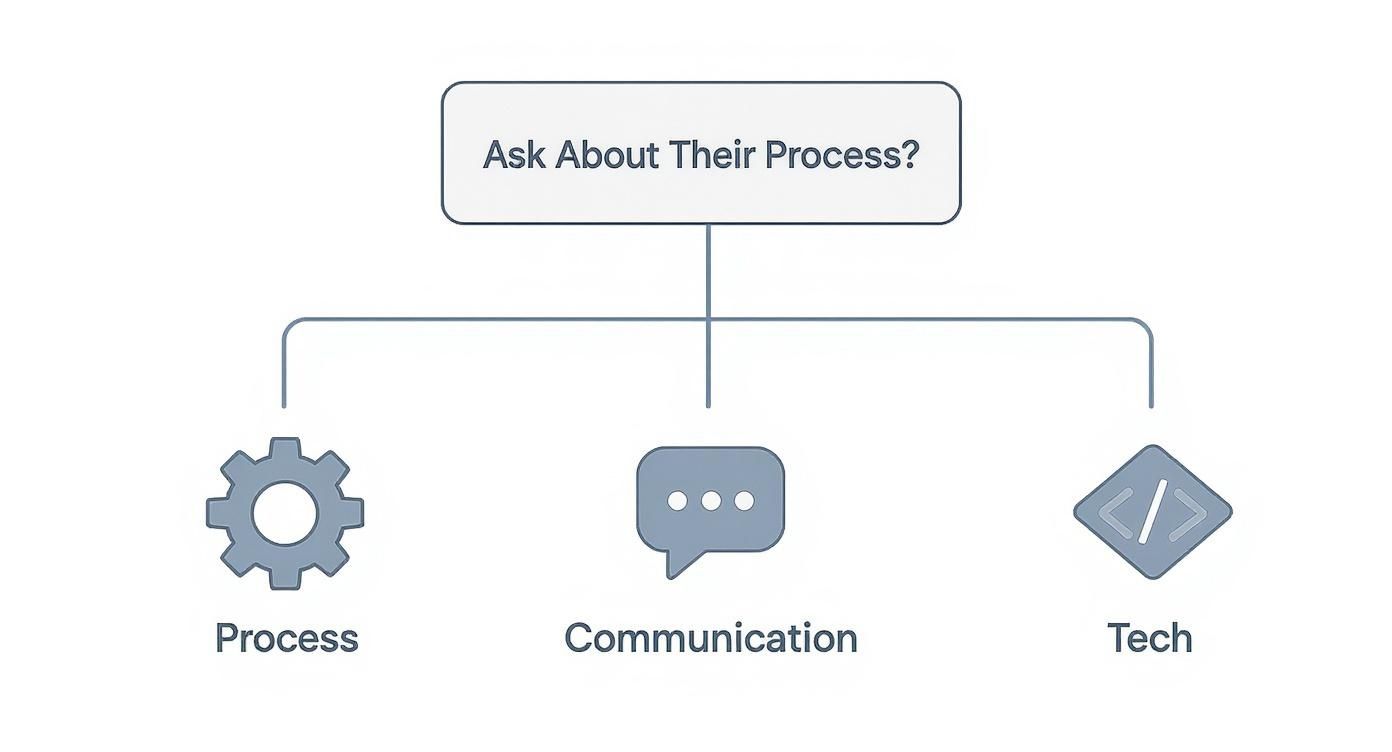
The real insight here? Your evaluation should focus just as much on how an agency works, not just what they build.
The Freelancer Advantage and Its Tradeoffs
Going with a freelancer can be a fantastic move, especially for startups or businesses with more straightforward projects. Freelancers often bring deep expertise in one specific area—say, WordPress development or UX design—and their lower overhead usually means more competitive pricing. Plus, you can't beat that direct line of communication. You’re talking to the person actually doing the work.
But there’s always a tradeoff, and with freelancers, it’s bandwidth. A solo operator is just one person. That can mean longer timelines, and if your project suddenly needs skills outside their wheelhouse (like a custom API integration or advanced SEO), you’ll have to find and manage other contractors yourself.
Key Factors to Consider When Choosing Your Partner
When you're vetting potential partners, understanding what a dedicated web development agency brings to the table can really clarify your decision. Here’s a quick rundown of what to weigh:
Communication Style: Do you prefer a single point of contact or access to a full team of specialists? Some business owners love the efficiency of a dedicated project manager, while others want to talk directly to the designer or developer.
Project Scope: Is this a simple brochure site, or are you building a complex e-commerce platform with tons of third-party integrations? The more complex the job, the more you'll benefit from a team with a diverse skillset.
Technology Stack: Make sure their go-to platforms align with your business needs. Their expertise can make or break your site's performance and ability to scale down the road. This is a huge factor when you’re comparing platforms like Wix Studio, WordPress, and Shopify.
Long-Term Goals: Are you just looking for a one-and-done build, or do you need a partner for ongoing support, maintenance, and marketing? Agencies are typically better set up for long-term retainer relationships than a freelancer who might be on to the next gig.
Common Questions To Ask Before You Hire
As you get closer to making a decision, a few critical questions always seem to pop up. Don't gloss over them. Getting straight answers here is what separates a smooth project from a future headache.
These are the questions that take you beyond the pretty portfolio and into the practical, day-to-day reality of owning and running your new website. Any transparent, professional agency will have solid answers ready to go.
Who Actually Owns the Website When It's Done?
This is the single most important question you can ask, and there's only one right answer: you do.
Once the final invoice is paid, you should have 100% ownership of everything—your website files, domain name, content, and all the accounts associated with it. Before you even think about signing a contract, get it in writing that the agency will hand over full admin access and every last source file when the project wraps up.
Be very, very careful if an agency gets cagey about this. If they insist on keeping ownership or lock you into their own special system that you can't move, that's a massive red flag. It’s a hostage situation, plain and simple. You won't be able to make updates, switch hosts, or hire someone else without their permission, which always leads to surprise costs down the road.
What Happens After My Website Goes Live?
Launch day feels like the end, but it's really the beginning. A website isn't a brochure you print and forget; it's a living tool that needs regular care to stay secure, fast, and effective. You need to know exactly what kind of support to expect after the project is officially "done."
Bring up post-launch support and maintenance plans early. Los Angeles is at the center of our service area, and we proudly support clients across a wide network of surrounding cities and neighborhoods throughout Southern California. Our reach includes every corner of L.A.—from Downtown Los Angeles, Hollywood, West Hollywood, Beverly Hills, and Santa Monica to the beach communities of Malibu, Venice, Marina del Rey, Hermosa Beach, Manhattan Beach, and Redondo Beach. We also extend service through the San Fernando Valley, including Sherman Oaks, Studio City, Encino, Van Nuys, North Hollywood, Burbank, Glendale, Pasadena, Woodland Hills, Chatsworth, Canoga Park, Reseda, Northridge, and Tarzana. In the San Gabriel Valley, we work with clients in Alhambra, Monterey Park, San Gabriel, Temple City, Rosemead, Arcadia, El Monte, South El Monte, West Covina, Covina, Baldwin Park, Azusa, Glendora, Duarte, and Monrovia. Farther southeast, we serve Whittier, Pico Rivera, Downey, Norwalk, La Mirada, La Habra, and Cerritos. We also support the South Bay—including Torrance, Carson, Gardena, Hawthorne, Inglewood, and Long Beach—as well as the Gateway Cities and communities throughout the I-10, I-5, 101, and 405 corridors. Whether you’re in a major metro area or a smaller surrounding neighborhood, our team delivers reliable, high-quality service anywhere in or around Los Angeles.
Typically, these plans cover the essentials:
Security Monitoring: Actively watching for and blocking malicious attacks.
Software Updates: Keeping your CMS, themes, and plugins up-to-date to fix security holes.
Regular Backups: Making copies of your site so it can be restored quickly if something breaks.
Performance Checks: Making sure your site stays zippy and doesn't slow down over time.
Ask them to clarify what's covered in their standard warranty period right after launch versus what's part of a paid monthly plan. A great partner won't just disappear once the site is live; they’ll have a clear plan to keep it healthy for years.
How Important Is SEO in Your Design Process?
Here's a little secret: SEO isn't just something you sprinkle on at the end. It should be baked into the web design process from the very first conversation. A stunning website that nobody can find on Google is just an expensive piece of art. The best web designers think about SEO from day one.
This means search engine strategy should shape key decisions, like:
Site Architecture: Building a logical site map that's a breeze for users and search engines to follow.
URL Structure: Creating clean, descriptive URLs for every page.
Mobile-First Design: Building for the phone first, which is a huge Google ranking factor.
Page Speed Optimization: Making sure the site loads lightning-fast to keep visitors from bouncing.
On-Page SEO Basics: Using proper heading tags (H1, H2), writing meta descriptions, and adding alt text to images.
Ask potential agencies how they build SEO into their workflow. If they treat it like an afterthought, they aren't setting you up for long-term growth, whether your customers are in Long Beach or anywhere else in Southern California.
What Red Flags Should I Watch Out For?
Knowing what to avoid is just as critical as knowing what to look for. As you talk to different web design companies, keep your radar up for these classic warning signs.
"Guaranteed #1 Rankings": Nobody can guarantee a top spot on Google. It’s an old, dishonest sales pitch.
Suspiciously Low Prices: A rock-bottom quote usually means they're cutting corners on strategy, quality, or support. If a price seems too good to be true, it is.
Ghosting and Poor Communication: If they're slow or unclear before they have your money, just imagine what it’ll be like after you’ve paid the deposit.
No Clear Process: A real pro will have a documented process they can walk you through for discovery, design, development, and launch.
"We Don't Give Out References": A confident agency with happy clients will have no problem letting you speak to them.
Ultimately, you have to trust your gut. A true professional partner is strategic, transparent, and focused on delivering real business results—not just a pretty design.
Choosing the right web design partner is one of the most important decisions you'll make for your business. At DLL Studios, we combine creative design with strategic thinking to build high-performing websites that drive real results for businesses across Los Angeles and beyond. Schedule a free consultation today to see how we can help you grow.

