.png)
Website Conversion Rate Optimization: Boost Conversions with Proven Strategies
Website conversion rate optimization (CRO) is all about getting more from the traffic you already have. It’s the process of systematically improving your site to turn more visitors into customers, whether that means making a purchase, filling out a form, or taking another key action.
Instead of just chasing new visitors, CRO focuses on perfecting the user experience to boost your results.
Establishing Your CRO Starting Point
Before you start tweaking buttons and rewriting headlines, you have to know where you stand. Driving more traffic to a site that doesn’t convert is like pouring water into a leaky bucket—you're just wasting time and money. The whole point of CRO is to patch those leaks first.
This all begins with establishing a baseline. You need hard numbers to measure your efforts against; otherwise, you're just guessing. Think of it like a fitness journey—you wouldn't start a new workout plan without weighing yourself first to see if it's actually working.
What Is a Good Conversion Rate?
It’s the question everyone asks: "What's a good conversion rate?" The honest answer is, it depends. Your industry, traffic source, and specific business goals all play a huge role. Still, there are some helpful benchmarks to give you a sense of where you are.
Across all industries, the average website conversion rate is around 2.9%. But that number hides a lot of nuance. For example, direct traffic (people who type your URL right into their browser) converts at a higher rate of 3.3%. They already know you and came with a purpose.
Even more telling, data from Unbounce shows that dedicated lead-gen landing pages have an average conversion rate of 11.9%. That huge jump shows just how powerful a focused, uncluttered page can be compared to a general homepage. You can discover more conversion rate optimization statistics to see where you stack up.
This chart really drives the point home, showing the massive difference between general sites and highly focused pages.
The big takeaway here is that context is everything. A landing page for a law firm in Downtown Los Angeles is going to perform differently than a general e-commerce homepage for a boutique in Santa Monica.
To help you set some realistic goals, here's a quick look at how conversion rates vary by industry and where your visitors are coming from.
Key Conversion Rate Benchmarks By Industry And Traffic Source
This table gives you a snapshot of typical conversion rates. Use it to get a feel for what’s possible in your space, but remember these are just averages. Your own performance will depend on your unique audience and strategy.
Category | Average Conversion Rate | Top Performer Rate (Approx.) |
|---|---|---|
Industry | ||
E-commerce | 2.8% | 5.3% |
B2B Services | 2.5% | 5.0% |
Healthcare | 2.6% | 5.1% |
Legal | 2.3% | 4.6% |
SaaS | 3.0% | 7.0% |
Traffic Source | ||
Direct Traffic | 3.3% | 6.2% |
Organic Search | 2.8% | 5.5% |
Paid Search (Google) | 2.9% | 6.0% |
Social Media (Organic) | 1.1% | 2.5% |
Email Marketing | 3.1% | 5.9% |
As you can see, traffic from email and direct visits tends to convert well because those users are already familiar with your brand. Social media, on the other hand, often has a lower conversion rate because people are there to browse, not necessarily to buy.
Finding Your Baseline Metrics
Okay, time to get your hands dirty. Your first job is to jump into your analytics platform (most likely Google Analytics) and find your current, overall conversion rate. This number is your starting line.
But don't stop there. The real magic happens when you start segmenting that data to see the story behind the numbers.
Ask yourself these questions:
By Traffic Source: Do visitors from organic search convert better than those from our paid ads?
By Device: Are mobile users bouncing while desktop users sail through checkout?
By Page: Which pages are acting like dead ends with high exit rates? Those are your biggest leaks.
By New vs. Returning Visitors: Are loyal customers converting more easily than first-timers? (They should be!)
Answering these questions gives you the context you need to build a smart optimization plan. For example, if you see high organic traffic but low conversions, there might be a mismatch between what people searched for and what your page delivers. A deep dive can uncover these kinds of issues; for more on that, check out our guide on conducting a comprehensive SEO audit.
Macro vs. Micro Conversions
Finally, it's crucial to understand that not all conversions are created equal. To get the full picture of how people engage with your site, you need to track two different types.
Macro-conversions are the big ones—the primary goals that directly affect your bottom line.
Making a purchase
Requesting a quote
Submitting a lead form
Micro-conversions are the smaller steps a user takes that show they're on the right path. They're indicators of engagement and a precursor to a macro-conversion.
Signing up for a newsletter
Downloading a PDF guide
Watching a product demo video
Adding an item to the cart
By tracking both, you can see where users are successfully engaging and where they’re dropping off. For instance, a high number of micro-conversions (like adding to cart) but low macro-conversions (like completing a purchase) is a classic sign of friction in your checkout process.
Finding Where Users Get Stuck
Alright, you've got your baseline metrics. Now it's time to put on your detective hat.
Effective conversion optimization isn't about throwing spaghetti at the wall to see what sticks. It's about gathering real evidence to find the exact spots where your visitors get confused, frustrated, or just give up and leave.
Think of these friction points as leaks in your digital bucket. Plugging them is where you'll see the biggest wins. We're going to use a mix of hard data and real human feedback to figure out where people are dropping off and, more importantly, why.
Uncovering Problem Areas with Quantitative Data
First stop: your analytics platform. Something like Google Analytics is perfect. This is where you get the hard numbers—the "what" and "where" of user behavior. Don't just glance at your overall conversion rate; you need to dig into the reports that scream "trouble ahead!"
Start by zeroing in on these key areas:
High-Exit Pages: Which pages are waving goodbye to the most users? If a key product page or a step in your checkout process has a sky-high exit rate, that's a massive red flag. Something on that page is pushing people away.
User Flow Reports: These reports are gold. They show you the actual paths people take through your site. Look for weird, unexpected loops where users bounce back and forth between pages. Also, keep an eye out for huge drop-offs between critical steps, like from the cart page to the actual checkout.
Landing Page Performance: Not every page people land on is created equal. If a specific landing page gets tons of traffic but has a dismal conversion rate, you might have a messaging mismatch. The ad or link that brought them in promised one thing, but the page delivered another. This is where understanding the difference between a homepage and a dedicated landing page is critical. You can get the full rundown in our guide on landing page vs. homepage strategies.
This kind of report from Google Analytics, for example, shows user engagement across different pages, helping you spot the underperformers at a glance.
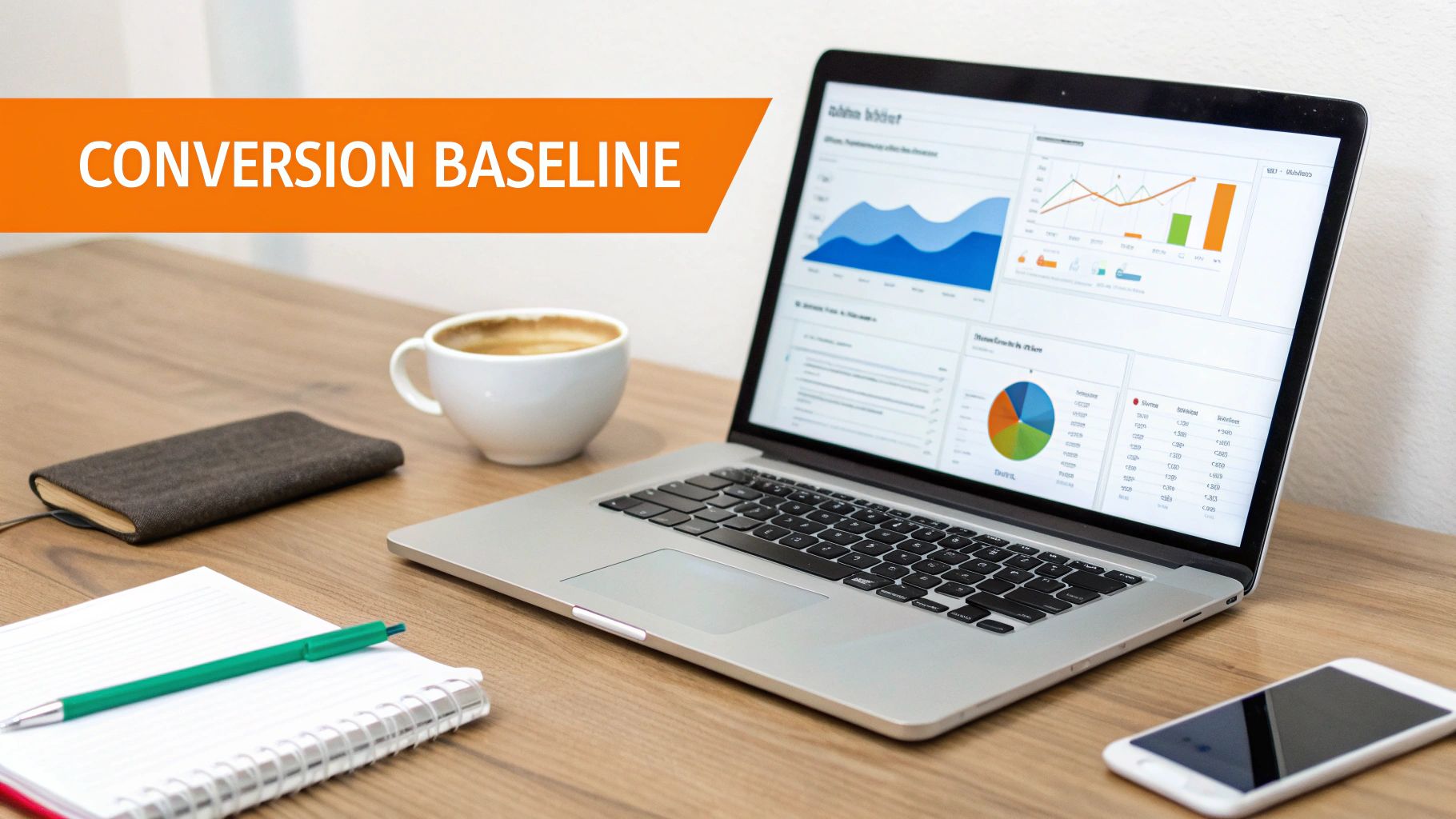
The data here might show that your "Services" page has an unusually high bounce rate. That's a strong signal that visitors aren't finding the info they need to take the next step.
Seeing Through Your Users' Eyes with Qualitative Tools
Analytics tells you what's happening. Qualitative tools tell you why. They give you the human story behind the cold, hard numbers and let you see the experience through your users' eyes.
Tools like Hotjar or Lucky Orange are fantastic for this, offering a few killer features:
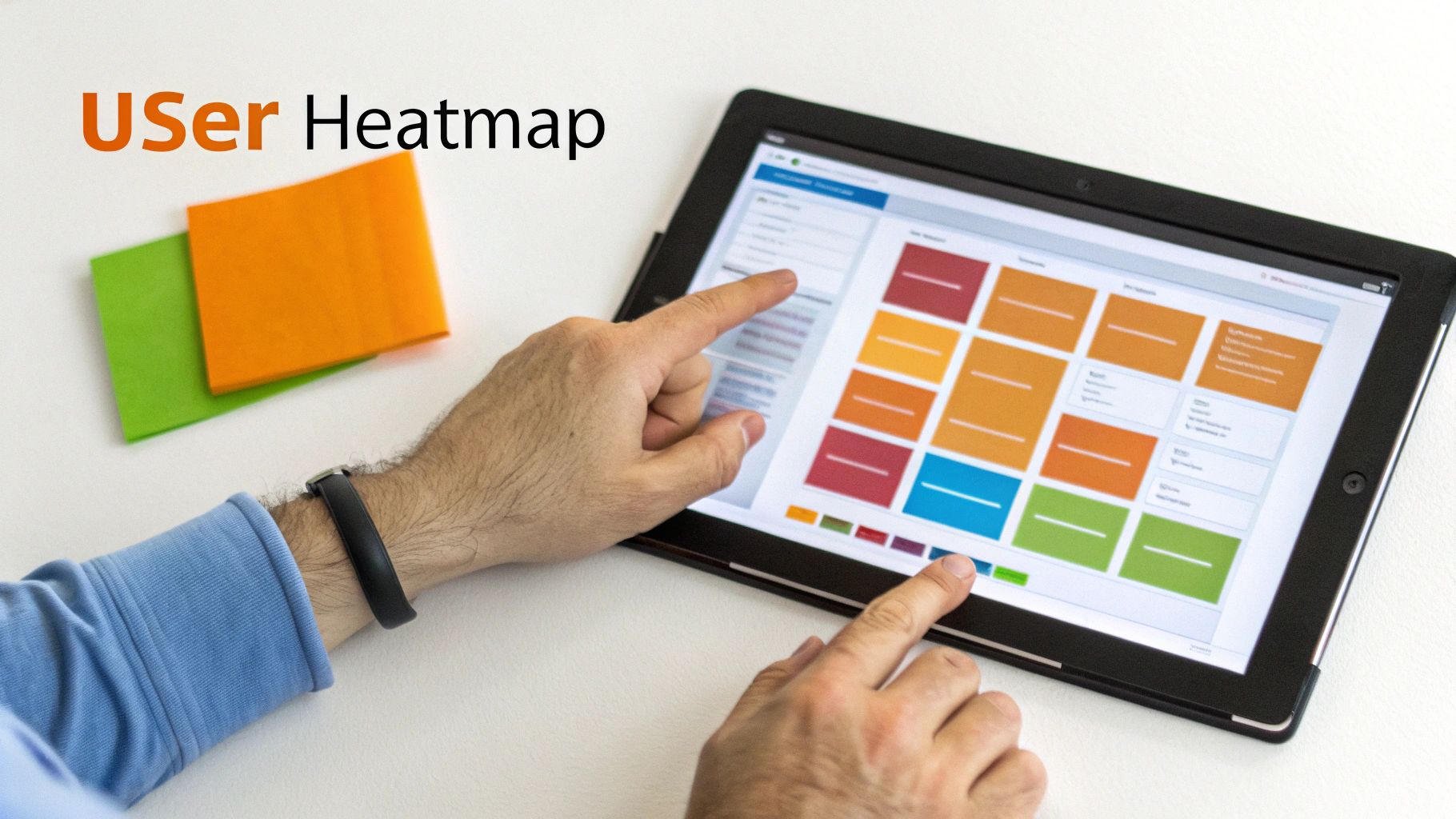
Heatmaps: These are visual gold. They show you exactly where people click, how they move their mouse, and how far they scroll down a page. Are they clicking on things that aren't actually links? Are they completely ignoring your main call-to-action? A heatmap reveals all.
Session Recordings: This is my personal favorite. It's like having a DVR for every visitor's session. You can watch their mouse movements, see where they hesitate, and even witness the infamous "rage-click" when something goes wrong. Watching just a handful of these can give you more "aha!" moments than hours of staring at spreadsheets.
Here's where it gets powerful: Combine the two. Your analytics show a huge drop-off on your contact form. A session recording might reveal that on mobile, a pesky chat widget is covering the "Submit" button. Boom. Problem solved.
Gathering Direct User Feedback
Sometimes, the easiest way to figure out what's wrong is to just... ask. You don't need a fancy lab or a huge budget to get incredibly valuable feedback.
Try these simple but crazy-effective methods:
User Testing: Just grab someone and ask them to complete a task on your site. It could be a friend in Pasadena trying to book a consultation or a family member in Whittier trying to find your return policy. The key is to watch them without helping. Take notes on every stumble and confused look.
On-Site Surveys: Use a simple pop-up survey to ask a direct question at the point of friction. On a high-exit page, you could ask, "What were you looking for that you couldn't find?"
Simple Feedback Forms: A little "Feedback" tab tucked away on the side of your site can be a goldmine. It collects unsolicited comments from users who are actively having a problem and want to tell you about it.
Let's say a law firm in Downtown Los Angeles sees very few people submitting their contact form. They could add a tiny survey asking, "Was anything preventing you from submitting this form?" They might quickly discover that a required "Case Number" field is scaring away potential clients who don't have one yet. That one tiny insight, straight from the source, can lead to a simple fix that completely changes their lead flow.
Turning Problems Into Testable Ideas
Alright, so you’ve done the detective work. You've pinpointed the leaks in your digital bucket—the high-exit pages, the forms nobody wants to fill out, the buttons collecting digital dust. But here’s the thing: a raw list of problems isn't a strategy. It's just a to-do list that can feel pretty overwhelming.
The real magic happens when you shift from being a detective to a scientist. It’s time to turn those raw observations into clear, testable ideas that can actually move the needle. This is where we formulate a powerful optimization hypothesis. It sounds technical, but it’s just a structured way of saying what you plan to change, what you expect to happen, and why you think it will work.
Crafting a Strong Hypothesis
A solid hypothesis isn't a wild guess. It’s an educated prediction grounded in the evidence you’ve already gathered. It should be specific, measurable, and follow a simple but powerful formula: "If we [implement this change], then [this metric] will improve because [this is the reason]."
Let's make this real. Imagine an e-commerce store in Malibu is seeing a painful 70% cart abandonment rate on mobile. After digging into session recordings, they watch user after user fumbling to enter shipping details into a tiny, multi-field form on their phones.
A weak idea: "Make the checkout form better." (Too vague!)
A strong hypothesis: "If we replace the six-field checkout form with a single-field autofill address lookup, then we expect to decrease mobile cart abandonment by 20% because it will drastically reduce typing and friction for users on small screens."
See the difference? This hypothesis is rock-solid. It defines the exact change, sets a measurable goal, and explains the user-centric logic. This structure gives you a clear pass/fail outcome for your test.
How to Prioritize Your Tests With a Simple Framework
Once you have a list of strong hypotheses, you’ll hit another common roadblock: which one do you test first? A startup in the San Fernando Valley can't afford to burn weeks testing low-impact tweaks. You need a system to prioritize effectively.
This is where a framework like PIE (Potential, Importance, Ease) becomes your best friend. It’s a simple scoring system that forces you to evaluate each idea objectively. You just score each hypothesis on a scale of 1 to 10 for three criteria:
Potential: How much room for improvement is there? A high-traffic page with a dismal conversion rate has huge potential.
Importance: How valuable is the traffic to this page? Your main checkout page is obviously far more important than an old blog post from three years ago.
Ease: How difficult will this be to implement? Changing a headline is easy (a "10"), but a full checkout redesign is a complex beast (a "1").
Score each hypothesis, then average the three numbers to get its PIE score. The ideas with the highest scores bubble up to the top of your list. This ensures you’re focusing your limited resources on tests that promise the biggest return for the least amount of heavy lifting.
A common mistake is tackling the easiest tasks first, regardless of their potential impact. The PIE framework forces you to balance effort with value, ensuring you're always working on what truly matters for your bottom line.
Connecting Your Hypotheses to Business Goals
Every test you run should tie back to a larger business objective. For a B2B professional services firm, a hypothesis might be laser-focused on increasing qualified leads. For a B2C e-commerce store, it’s all about ringing the register with completed sales.
For example, a mere 1-second improvement in page load speed can triple B2B conversions and boost B2C sales by 2.5x compared to a 5-second load time. That’s because many CRO tests focus on dedicated landing pages, which can achieve conversion rates between 5-15%—far above the site-wide average. You can discover more stats on conversion rate benchmarks to see how you stack up.
By translating user friction into clear hypotheses and prioritizing them smartly, you create a focused roadmap for your website conversion rate optimization efforts. This methodical approach ensures every test is a calculated move designed to improve user experience and drive real business growth.
Running Tests That Actually Move The Needle
Alright, you’ve got your prioritized list of ideas. Now comes the fun part: moving from theory to action. This is where you stop guessing and start letting your audience's behavior show you what actually works. Running structured experiments is the heart and soul of website conversion rate optimization because it replaces assumptions with cold, hard data.
This isn't about just throwing random changes at a page and hoping for the best. It’s a methodical process. By testing one specific change against the original, you can prove, without a doubt, which version drives more of the actions you care about. Every change you implement from here on out should be backed by this process, ensuring it directly contributes to your bottom line.
Choosing Your Testing Method
You'll mainly be working with two types of tests: A/B testing and multivariate testing. They might sound similar, but they serve very different functions. Picking the right one is crucial for getting clear, actionable results.
A/B Testing (or Split Testing) is the absolute workhorse of CRO. It’s a clean, simple comparison between two versions of a single element to see which one performs better.
Version A (The Control): This is your current page or element.
Version B (The Variant): This is the page with the one change you’re testing.
You simply split your website traffic, sending half to Version A and the other half to Version B. Once enough people have seen both, the data will tell you if you have a statistically significant winner. This method is perfect for testing focused changes with a clear hypothesis, like trying out a new headline or changing the color of your main call-to-action button.
Multivariate Testing is a much more complex beast. Instead of testing a single change, it tests multiple combinations of changes all at once to find the ultimate winning formula. For example, you could test two different headlines, two hero images, and two button texts simultaneously. The testing tool creates every possible combination and distributes traffic among them to find out which mix performs best.
While powerful, this method requires a massive amount of traffic to get statistically valid results. For most small and local businesses, the clarity and simplicity of A/B testing is the far more practical and effective approach.
What Elements Should You Test First?
You can test just about anything on your website, but some elements pack a much bigger punch than others. You want to focus your initial efforts on these high-leverage areas where even a small tweak can lead to significant gains.
Headlines and Subheadings: Does your main headline instantly communicate your value in a compelling way? Test it.
Call-to-Action (CTA) Buttons: Experiment with the text ("Buy Now" vs. "Add to Cart"), color, size, and where you place it on the page.
Hero Images and Videos: Is the main visual on your page resonating with your target audience? Does it support the message in your copy?
Page Layout and Design: Could a cleaner, more focused layout reduce distractions and better guide users toward your conversion goal?
Form Design and Fields: Are you asking for too much information upfront? Reducing the number of fields in a form almost always reduces friction and increases completions.
Social Proof: Try different placements and types of testimonials, reviews, or client logos to see what builds the most trust.
For a boutique e-commerce shop in Long Beach, a great first test would be on their product page buttons. Version A keeps the standard "Add to Cart," while Version B tries out "Buy Now." By tracking which one leads to more completed purchases, they get a data-backed answer that directly impacts sales.
Or think about a medical practice in Burbank. They could test two different hero images on their homepage. Version A might show their modern, high-tech facility, while Version B features a warm, friendly photo of the doctors. The version that drives more appointment requests is the clear winner, telling them exactly which visual best builds trust with potential patients.
Deploying Your Winning Variation
Once your test has run its course and you have a statistically significant winner, the final step is to make that change permanent. The exact technical process will depend on your website platform, but this is the crucial moment where you lock in your gains.
On platforms like WordPress, Webflow, or Wix Studio, this might be as simple as using a built-in testing tool or a plugin that lets you push the winning version live to 100% of your audience with a click. If you ran the test with an external tool like Google Optimize or VWO, you’ll just end the experiment and then manually update the page on your site’s backend to match the winning design.
Making these data-driven improvements is absolutely essential. Research shows that landing pages designed for clicks achieve a median conversion rate of 11.3%, crushing form-based pages which average just 4.1%. This approach is especially powerful in sectors like legal services (19%) or restaurants (21.2%). Of course, none of this matters if your page is slow; a 1-second load time can yield up to 3x more conversions for B2B sites than a 5-second delay. You can discover more insights on CRO statistics at Crazy Egg.
The key is to always follow through. A successful test is worthless until the winning change is fully implemented, allowing every single future visitor to benefit from the newly optimized experience.
Implementing High-Impact Website Improvements

While targeted A/B tests are fantastic for fine-tuning, some improvements are so foundational they lift conversions across your entire website. These are the big-picture upgrades that create a better experience for every single visitor, no matter how they landed on your site. We're moving beyond tweaking a single button to strengthening the whole platform.
This holistic approach to website conversion rate optimization is about making sure the journey from a landing page in Hollywood to a checkout page in Hermosa Beach feels seamless and trustworthy. For any business in Southern California that's serious about online growth, these are the non-negotiables.
Double Down on Mobile and Accessibility
Let's be blunt: more than half of all web traffic now comes from mobile devices. If your site is a pain to use on a smartphone, you're actively turning away most of your potential customers. This isn't just about a responsive design that shrinks to fit a screen; it's about creating a truly mobile-first experience.
Think bigger tap targets for thumbs, simplified navigation, and forms that don't make you want to throw your phone. Mobile optimization stopped being optional years ago—it's the price of entry.
Just as critical is making your site accessible to everyone, which is where ADA (Americans with Disabilities Act) compliance comes into play. An accessible website isn't just about sidestepping legal issues; it’s about creating a better user experience for all visitors, including those using screen readers or other assistive technologies. Simple tweaks like adding alt text to images and ensuring high color contrast open your site up to a much wider audience, which can only mean more potential conversions.
Many business owners see accessibility as a technical chore. But think of it this way: an ADA-compliant site is an inherently user-friendly site. Clear structure, descriptive links, and readable text benefit absolutely everyone, boosting engagement and conversions across the board.
Win the Race with Page Speed
In our hyper-impatient world, speed is everything. A slow website is probably the fastest way to lose a sale. The data is clear: even a one-second delay in page load time can send conversion rates into a nosedive. Your visitors expect instant gratification, whether they’re in Downtown Los Angeles or a coffee shop in Pasadena.
The good news is you don't always need a massive site overhaul to see improvements. You can score some major wins by tackling a few key areas:
Compress Your Images: Large, unoptimized images are the #1 killer of page speed. Use a tool like TinyPNG or ImageOptim to shrink those file sizes way down without losing visual quality.
Minimize Your Code: Clean up your site’s CSS, JavaScript, and HTML. Removing unnecessary characters, spaces, and comments can make a real difference. Most platforms, like WordPress, have plugins that can automate this for you.
Enable Browser Caching: Caching tells a visitor’s browser to save parts of your site, so it doesn't have to reload everything from scratch on their next visit. It makes the experience much zippier for returning users.
Reduce Friction and Build Unshakable Trust
Every unnecessary step or moment of doubt in the user journey is friction—another chance for a visitor to bail. Your job is to make the path to conversion as smooth and reassuring as possible. A great place to start is your forms. Only ask for what you absolutely need. Each extra field is another reason for someone to give up.
Beyond making things simpler, you have to actively build trust. This is where social proof is pure gold. Strategically placing testimonials, customer reviews, case studies, or logos of clients you’ve worked with provides that crucial third-party validation. A glowing review from a happy client in Studio City could be the final nudge a new prospect from Encino needs.
For a deeper dive on this, check out our guide on how to create a website that converts visitors. To see how these principles apply directly to online stores, take a look at a practical guide to increasing ecommerce conversion rates.
Your Top CRO Questions, Answered
Diving into website conversion rate optimization always sparks a few questions. We get it. Below, we’ve tackled some of the most common ones we hear from business owners across Los Angeles, from retailers in Santa Monica to service providers in Beverly Hills.
How Much Traffic Do I Need To Start CRO?
This is a fantastic question because it gets right to the heart of statistical significance. While there’s no single magic number, you do need enough visitors to get reliable test results. If your site only gets a few hundred visitors a month, an A/B test could drag on forever without a clear winner.
But that absolutely doesn't mean you can't do CRO.
Instead of getting hung up on A/B testing, shift your focus to qualitative feedback. User testing, session recordings, and just talking to your customers are incredibly valuable, especially early on.
For example, a small business in Pasadena with low traffic can still gain immense insight by watching just five users try to complete a task on their site. This approach almost always uncovers major friction points that don't require high traffic to validate.
How Long Should I Run an A/B Test?
The length of a test isn't about a fixed number of days; it's about reaching statistical significance—typically around a 95% confidence level. Running a test for only a day or two is a recipe for disaster, as user behavior can vary wildly depending on the day of the week.
A good rule of thumb is to run a test for at least one full business cycle, which for most businesses is one to two weeks. This helps smooth out any daily fluctuations and gives you a more accurate picture.
Most testing tools like VWO or Optimizely will tell you when you’ve gathered enough data to make a reliable call. The key is to resist the urge to end the test early just because one version pulls ahead. Patience is what makes your results trustworthy.
Cutting a test short is one of the biggest mistakes in CRO. You need enough data to be confident that your "winner" wasn't just a random fluke. Let the numbers—not your gut—decide when the test is over.
What's The Difference Between CRO And SEO?
Let’s break it down with an analogy:
SEO (Search Engine Optimization) is all about getting people to your party. It focuses on earning visibility in search results to attract qualified traffic.
CRO (Conversion Rate Optimization) is about making sure your guests have a great time once they arrive and actually do something.
SEO gets visitors from search engines; CRO convinces them to take action once they're on your site.
Think of a law firm in Downtown Los Angeles. They might use SEO to rank for "personal injury lawyer," getting people to click through to their site. CRO is what they use to ensure the landing page is persuasive enough to turn those visitors into actual phone calls. The two work hand-in-hand. A site with a great user experience (a CRO focus) often sees lower bounce rates and higher engagement, which are positive signals that can boost your SEO.
Can Small Changes Really Make a Big Difference?
Absolutely. And honestly, it's where most of the magic happens. While a complete redesign can sometimes be necessary, you'd be amazed at the impact of small, strategic tweaks.
Changing the text on a call-to-action button from a generic "Submit" to a value-focused "Get Your Free Quote" can dramatically increase clicks. Why? Because it tells the user what they get.
Similarly, we've seen clients boost form completions by 20% or more just by removing one unnecessary field. For a contractor serving the San Gabriel Valley, that small change could mean dozens of new leads every single month.
The real power of CRO is that these small, data-backed improvements compound over time, leading to significant growth without a massive investment. Every bit of friction you remove makes it that much easier for a customer to say "yes."
At DLL Studios, Los Angeles is at the center of our service area, and we proudly support clients across a wide network of surrounding cities and neighborhoods throughout Southern California. Our reach includes every corner of L.A.—from Downtown Los Angeles, Hollywood, West Hollywood, Beverly Hills, and Santa Monica to the beach communities of Malibu, Venice, Marina del Rey, Hermosa Beach, Manhattan Beach, and Redondo Beach. We also extend service through the San Fernando Valley, including Sherman Oaks, Studio City, Encino, Van Nuys, North Hollywood, Burbank, Glendale, Pasadena, Woodland Hills, Chatsworth, Canoga Park, Reseda, Northridge, and Tarzana. In the San Gabriel Valley, we work with clients in Alhambra, Monterey Park, San Gabriel, Temple City, Rosemead, Arcadia, El Monte, South El Monte, West Covina, Covina, Baldwin Park, Azusa, Glendora, Duarte, and Monrovia. Farther southeast, we serve Whittier, Pico Rivera, Downey, Norwalk, La Mirada, La Habra, and Cerritos. We also support the South Bay—including Torrance, Carson, Gardena, Hawthorne, Inglewood, and Long Beach—as well as the Gateway Cities and communities throughout the I-10, I-5, 101, and 405 corridors. Whether you’re in a major metro area or a smaller surrounding neighborhood, our team delivers reliable, high-quality service anywhere in or around Los Angeles. Ready to turn more visitors into customers? Learn more at https://www.dllstudios.com.