.png)
Landing Page vs Homepage The Ultimate Guide to Conversions
So, what’s the real story when you put a homepage and a landing page head-to-head? The simplest way to think about it is this: a homepage is your digital storefront, the front door to your brand, inviting everyone in to look around. A landing page, on the other hand, is a specific, single-purpose destination built to get a visitor from a particular campaign to take one specific action.
Your homepage is made for browsing; a landing page is made for business.
Understanding the Core Difference
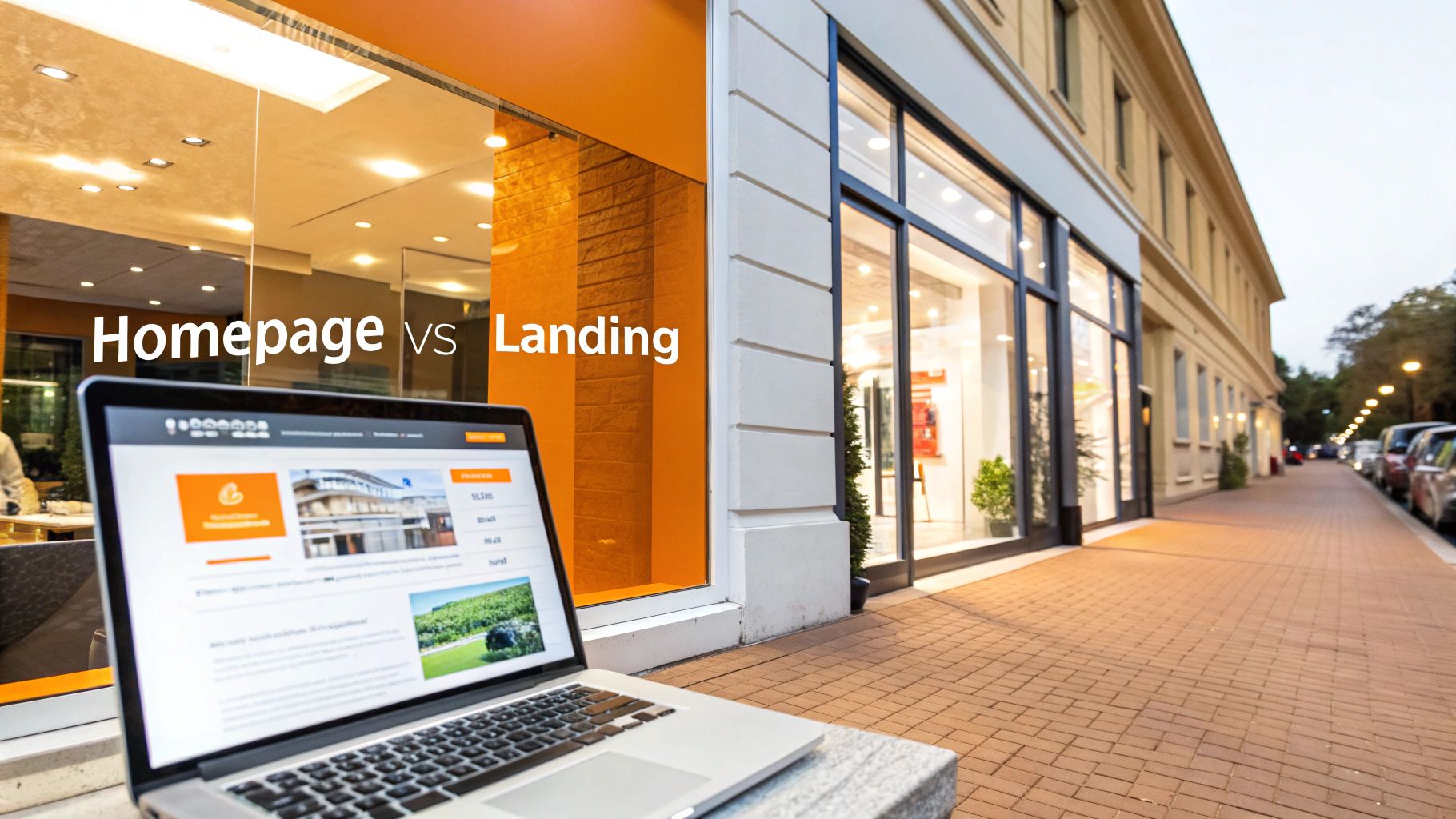
Imagine your homepage is the main lobby of your corporate headquarters. It’s polished, welcoming, and gives a clear overview of who you are and what you do. From the lobby, visitors can find their way to different departments, whether that's "About Us," "Services," or "Contact." It’s designed to serve a wide-ranging audience, from potential customers to job seekers, guiding them wherever they need to go.
A landing page is completely different. Think of it as a private conference room set up for a single, high-stakes meeting. If you’re running a Facebook ad campaign targeting a specific demographic with a special offer, the page they click through to is built only for that offer. There's one message, one goal, and one clear call-to-action (CTA). All the usual distractions—like the main navigation menu or links to other services—are stripped away to keep the visitor laser-focused.
The core principle is focus. A homepage is designed for exploration and serves many goals. A landing page is engineered for conversion and serves only one.
This distinction is absolutely critical for any effective marketing strategy. Sending targeted ad traffic to your homepage is a classic mistake. Why? Because you're dropping a visitor with a specific interest into a busy lobby filled with options, diluting your message and killing your conversion rates.
A landing page creates a seamless journey. The promise made in your ad is perfectly matched by the page they land on, creating a direct path to action. Ultimately, understanding this difference helps you build a smarter marketing funnel where every click has a clear, measurable purpose. The two pages work together: your homepage builds broad brand authority, while your landing pages drive tangible results from your marketing campaigns.
Homepage vs Landing Page At a Glance
To make the differences even clearer, here’s a quick side-by-side comparison that breaks down the essential attributes of each page type.
Attribute | Homepage | Landing Page |
|---|---|---|
Primary Goal | Brand introduction, navigation, exploration | Lead generation, sales, specific action |
Audience | General visitors, diverse interests | Targeted traffic from a single campaign |
Number of CTAs | Multiple (e.g., "Learn More," "Contact Us") | One primary call-to-action |
Navigation | Full navigation menu and footer | Minimal or no navigation links |
Traffic Source | Direct, organic search, referrals | Paid ads, email marketing, social media |
Content Focus | Broad overview of the entire business | Narrow focus on a single offer or topic |
This table neatly sums it up. A homepage is your brand’s hub, designed for discovery. A landing page is your campaign’s closer, built for a single, decisive action.
Comparing Strategic Purpose and Audience Intent
To get to the heart of the landing page vs homepage conversation, you have to start with the "why." Every single design choice, from the navigation bar to the call-to-action button, flows directly from the page's core purpose and the mindset of the person visiting it.
Think of your homepage as your brand's digital front door. It’s there to welcome everyone—curious prospects, loyal customers, potential partners, even job applicants. People land here with all sorts of goals. Some are trying to figure out who you are, others need your phone number, and many are just clicking around to see what you offer. Because of this, a homepage is built for exploration.
A landing page, on the other hand, is a specialist. It’s a precision tool with one job: get a visitor from a specific campaign to take one specific action.
The Generalist Homepage
A homepage has to serve a diverse crowd with a dozen different interests. It’s designed to answer the big, broad questions: "Who is this company?" and "What can they do for me?" The intent of someone landing here is usually navigational or investigatory.
Take a law firm in Los Angeles. Their homepage needs to project authority across multiple practice areas. A visitor might find it by searching "top law firms in Downtown Los Angeles." That homepage has to be ready for them with:
Clear navigation to different legal services like family law, business litigation, or personal injury.
An "About Us" section to showcase the firm's history and build trust.
General contact info and links to individual attorney profiles.
Its entire purpose is to orient visitors and help them find what they need, guiding them deeper into the site. The content is intentionally broad, casting a wide net to reach clients across a wide network of surrounding cities and neighborhoods throughout Southern California. Los Angeles is at the center of this service area, with a reach that includes every corner of L.A.—from Downtown Los Angeles, Hollywood, West Hollywood, Beverly Hills, and Santa Monica to the beach communities of Malibu, Venice, Marina del Rey, Hermosa Beach, Manhattan Beach, and Redondo Beach.
The Specialist Landing Page
A landing page is completely different. It’s built for a specific person arriving from a single, known source—like a Google ad or an email campaign. Their intent is transactional. They saw a specific promise, clicked on it, and now they expect a direct payoff.
Let’s go back to that L.A. law firm. If they run a Google Ad campaign targeting the keyword "car accident lawyer near me," they would never send that traffic to their general homepage. That would be a waste of money. Instead, they’ll build a dedicated landing page with a headline like, "Hurt in a Car Wreck? Get a Free Consultation Now." This approach works whether the client is in a major metro area or a smaller surrounding neighborhood.
A landing page operates on the 'Rule of One': one message, for one audience, with one clear goal. It eliminates choices to drive a single, desired action.
This page strips away all distractions. There’s no main menu, no links to other legal services, and no long-winded company history. Every word, image, and form field is focused on one thing: converting that visitor into a car accident lead. Whether they are searching from the San Fernando Valley—including Sherman Oaks, Studio City, Encino, Van Nuys, or North Hollywood—or the San Gabriel Valley, the page's focus remains singular.
This singular focus works wonders. Data shows that businesses see a 55% increase in leads when they increase their number of landing pages from 10 to 15. Another report found that campaign-specific landing pages converted 115% better than sending ad traffic to a generic homepage, proving just how powerful they are for direct-response marketing. If you want to dive deeper, you can explore more data on why landing pages excel at conversions.
Diving Into Design and User Experience

When you compare a landing page vs homepage, the biggest differences are staring you right in the face: their design and user experience (UX). They’re built on completely different philosophies. A homepage is your friendly, comprehensive guide, while a landing page is your laser-focused persuader. Each one caters to a totally different user mindset, and that dictates every single design choice.
A homepage is designed for discovery. Think of it as the lobby of your digital headquarters. You’ll see prominent navigation menus, beefy footers, and links branching out everywhere. The goal is to welcome a casual browser and give them clear paths to learn about your services, company story, or how to get in touch.
Landing pages, on the other hand, embrace a kind of strategic minimalism. The design is ruthlessly efficient. It's common to see them stripped of all navigation—no main menu, no footer links, nothing. This isn't an accident. It's a deliberate move to create a "walled garden," sealing off all the exits so the user's attention stays locked on the one and only conversion goal.
Homepage UX: The Art of Exploration
The user experience of a homepage is all about orientation and building trust. It has to immediately answer three critical questions for anyone who drops in, whether they’re from Whittier, Pico Rivera, Downey, Norwalk, La Mirada, La Habra, or Cerritos:
Who are you? The design must instantly convey your brand identity.
What do you do? Visitors need to get the gist of your core business in seconds.
Where do I go next? Navigation has to be intuitive and make sense.
Because a homepage serves such a broad audience, its UX needs to be flexible. It juggles multiple calls-to-action (CTAs) of varying importance—things like "Learn More," "View Our Services," or "Read Our Blog." Each one is a signpost for a different type of visitor. And of course, the design has to be fully responsive, since you never know what device people are using. You can dig deeper into why that matters with these responsive web design best practices for 2025.
A homepage UX wins when it makes exploration effortless and builds brand credibility. A landing page UX wins when it makes a single decision feel inevitable.
Landing Page UX: The Science of Persuasion
The user experience of a landing page is linear and persuasive, designed from the ground up for a decision-making mindset. When someone clicks a targeted ad—whether they’re in a nearby community like Burbank, Glendale, or Pasadena—they arrive with a specific intent. The landing page has to honor that intent by creating a straight shot to the desired action.
Every single element is there to drive the conversion. The headline echoes the ad copy. The hero image is directly related to the offer. The body copy sells the benefits, while social proof like testimonials builds instant trust. The whole layout is a deliberate visual flow, guiding the user's eye right to the main CTA—the form, the button, the one thing you want them to do. This is why following the 10 Landing Page Best Practice Rules is so crucial for creating pages that actually convert.
At the end of the day, the design trade-off is crystal clear. A homepage sacrifices singular focus for breadth. A landing page sacrifices breadth for singular focus. That fundamental choice is what shapes user behavior and drives completely different business outcomes.
Evaluating SEO and Traffic Acquisition Strategies
When you pit a landing page vs homepage, their roles in search engine optimization (SEO) and getting eyes on your site couldn't be more different. Think of one as a long-term asset for building authority and attracting a wide audience, and the other as a specialized tool for laser-focused, often short-lived campaigns. Getting this distinction right is the key to a smart digital strategy that makes the most of both organic and paid traffic.
Your homepage is the anchor of your website's SEO authority. It's the go-to destination for anyone who types your company name into Google—what we call a branded search. Over time, it naturally collects backlinks and builds credibility, which helps it rank for the big, high-volume keywords in your industry. For a business in Southern California, that might mean ranking for terms like "digital marketing agency Los Angeles" or "web design services." This wide reach can support clients throughout the South Bay—including Torrance, Carson, Gardena, Hawthorne, Inglewood, and Long Beach.
Landing pages, on the other hand, play a completely different game when it comes to SEO. Their primary job isn't to rank organically for years; it's to directly support paid ad campaigns or specific marketing pushes.
Keyword Targeting and Intent Matching
The keyword strategy for each page type reflects its fundamental purpose. A homepage casts a wide net, targeting general terms that suggest someone is still in the exploration or information-gathering phase. The content is built to introduce your brand and point visitors in the right direction, whether they're looking for services in Alhambra, Monterey Park, or San Gabriel.
Landing pages are all about precision. They are built around very specific, long-tail keywords that perfectly match the intent behind a paid ad. For instance, a campaign might target the phrase "emergency plumbing repair San Fernando Valley." The landing page would be meticulously optimized for that exact term, ensuring the message from the ad flows seamlessly onto the page, targeting users from Woodland Hills, Chatsworth, Canoga Park, Reseda, Northridge, and Tarzana. This continuity is vital for earning a high Quality Score in Google Ads.
A homepage’s SEO strategy is a marathon, focused on building broad authority over years. A landing page’s SEO is often a sprint, designed for immediate relevance and conversion within a specific campaign.
The Critical Role of Indexing
One of the biggest strategic decisions you'll make is whether to let search engines index your landing pages. Indexing simply means allowing a page to show up in organic search results. The right call depends entirely on the page's mission.
Evergreen Landing Pages: If a landing page promotes a core service that's always on offer—like "Free SEO Audits for Small Businesses"—then indexing it is a great move. Over time, it can pull in highly qualified organic traffic from people with clear commercial intent, whether they're in the Gateway Cities or along the I-10, I-5, 101, and 405 corridors.
Campaign-Specific Landing Pages: For short-term promotions like a "24-Hour Flash Sale" or a webinar registration, you should absolutely use a "noindex" tag. This tells search engines to skip over the page. Indexing these temporary pages just clutters up search results with expired offers and can water down your site's overall SEO strength.
This decision directly shapes how you manage your different traffic sources. When you're running paid campaigns, you need a clean line between your organic and paid efforts. Our guide on organic SEO vs PPC digs into how to strike the right balance between these two powerful channels for the best results.
Ultimately, your homepage is your SEO foundation, building long-term brand equity and drawing in a broad audience. Your landing pages are your agile marketing instruments, designed to convert highly targeted traffic into measurable leads and sales, with an SEO approach tailored to that single, focused goal.
Measuring Success and Optimizing for Conversions
When it comes to figuring out if a landing page vs. homepage is actually working, you can't use the same yardstick for both. A homepage's success isn't about one specific action. Its job is to be the friendly, helpful front desk of your digital presence, guiding people where they need to go.
So, for a homepage, you’re looking for signs of healthy exploration. Think low bounce rates, longer session times, and more pages viewed per visit. You want to see that visitors are easily finding their way to critical spots like your services, about page, or contact form.
A landing page, on the other hand, plays by a much stricter set of rules. Its success comes down to a single, make-or-break metric: the conversion rate.
Defining Conversion Metrics for Each Page
The key performance indicators (KPIs) for each page are a direct reflection of their very different jobs. A homepage is all about broad engagement, while a landing page is built for a single, focused outcome.
Homepage Success Metrics:
Bounce Rate: A low bounce rate is a great sign. It tells you that when people arrive, they see something relevant and feel compelled to click deeper into your site.
Pages Per Session: If this number is high, it means users are successfully navigating your site and engaging with your content. They aren't just hitting a dead end.
Average Session Duration: Longer visits suggest your brand's story and what you offer are interesting enough to hold someone's attention.
Goal Completions: This involves tracking how many users actually make it from the homepage to key destinations, like a "Contact Us" or "Services" page.
Landing Page Success Metrics:
Conversion Rate: This is the big one. It's the percentage of visitors who do the one thing you asked them to do, whether that's filling out a form, signing up, or making a purchase.
Cost Per Conversion: For any paid campaign, this tells you exactly how much you're spending to get that one lead or sale. It's a direct measure of your ROI.
Lead Quality: It’s not just about getting conversions; it’s about getting the right conversions. Are the leads you're generating actually a good fit for your business?
A homepage succeeds by being a great starting point for a journey. A landing page succeeds by being the final destination for a specific campaign goal.
The Power of A/B Testing for Optimization
While you can certainly test elements on a homepage, landing pages are the perfect laboratory for serious A/B testing. Because they have such a singular focus, you can easily isolate different variables and get crystal-clear data on what drives people to act. You create two versions of a page—an 'A' and a 'B'—split your traffic, and let the numbers tell you which one works better.
Common elements to test on a landing page include:
Headlines: Does a headline focused on benefits outperform one that asks a question?
Call-to-Action (CTA) Button: Test everything—the color, the size, and the text. "Get Started" might work differently than "Claim Your Free Trial."
Form Fields: Will you get more submissions by cutting your form from five fields down to three?
Images and Videos: Put a product video up against a static hero image and see which one keeps users more engaged.
Choosing the right testing strategy is crucial for both page types. To get a better handle on the different approaches, you can check out this guide on Multivariate Testing vs. A/B Testing. By constantly testing and refining, you can dramatically improve your results and turn more visitors into customers. For a deeper look at the fundamentals, check out our guide on how to create a website that converts visitors.
The data is pretty clear that this focused approach gets results. In a real-world test, Instapage sent paid search traffic to both their homepage and a dedicated landing page. The difference was stunning: the landing page had a conversion rate nearly three times higher, brought in more than double the total conversions, and cut the cost per conversion by two-thirds. It worked because the landing page delivered exactly what the ad promised with a matching headline and a single CTA, stripping away all the distracting elements of the homepage. You can discover more insights about these landing page findings on landingi.com.
Choosing the Right Page for Your Campaign
Deciding between a landing page and a homepage boils down to a single, critical question: what do you want your visitor to do next? Your answer determines whether you need a broad, welcoming hub for exploration or a laser-focused tool built for one thing—conversion.
Sending traffic to the wrong page doesn't just hurt your stats; it can waste your ad spend and kill a campaign's momentum before it even gets started.
Your homepage is the front door to your brand. It’s the right place to send traffic that’s already familiar with you or just wants to browse and learn more. When someone types your company name directly into a search bar, the homepage is exactly what they expect to find.
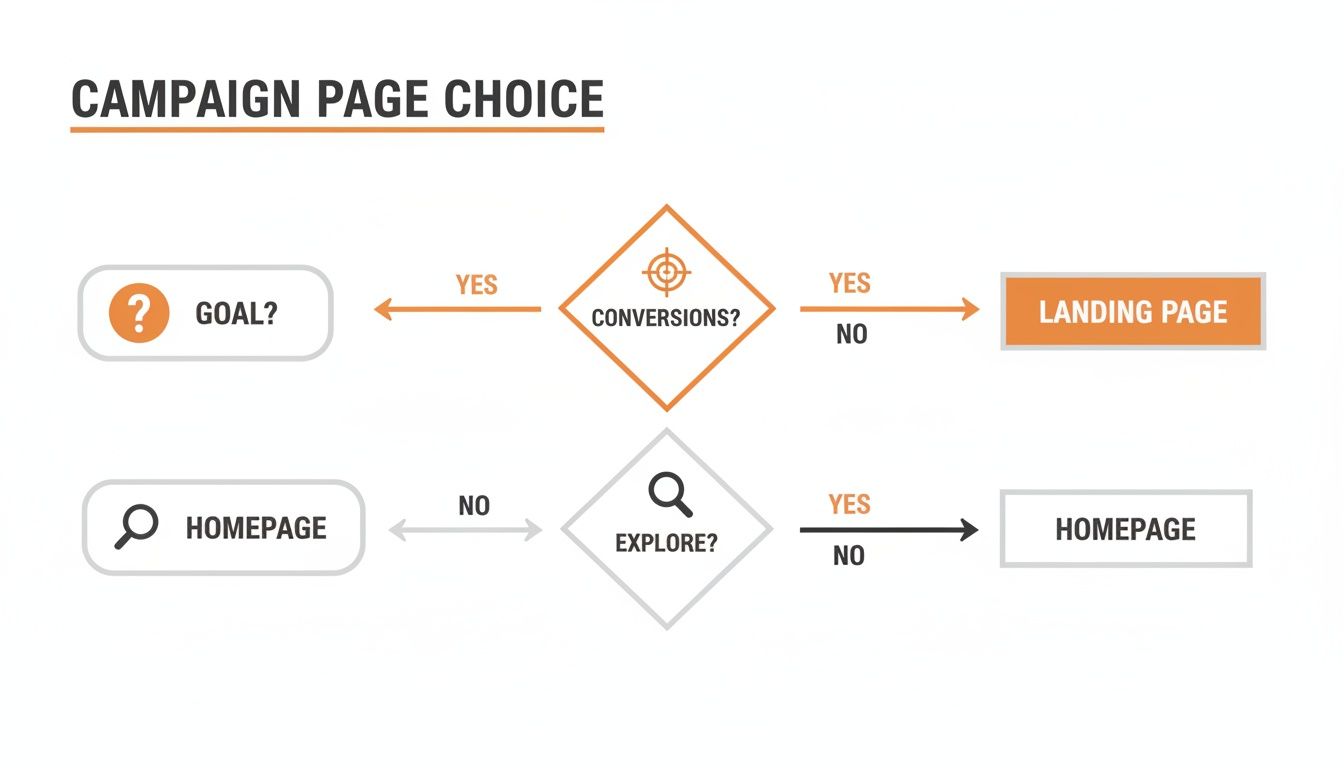
This decision tree cuts right to the chase. It visualizes the choice based on your campaign’s core objective: are you driving a specific action, or are you encouraging general exploration? The takeaway is simple—if your goal is a measurable action, a landing page is the only way to go.
When to Use Your Homepage
While landing pages are the undisputed champions of direct-response marketing, your homepage is still the anchor of your entire digital presence. It’s the right choice for any traffic that isn't tied to a specific, action-oriented campaign. Think of it as the default destination for general interest.
Directing traffic to your homepage is the right move in a few key scenarios:
Organic Brand Searches: Someone searching for "DLL Studios" or your company name should land squarely on your homepage. It validates who you are and gives them the full picture.
PR and Media Mentions: If a news article or industry blog gives your company a shout-out, linking to the homepage provides essential context for curious new visitors.
Social Media Profiles: The main link in your Instagram bio or LinkedIn company page should almost always point to your homepage, inviting followers to get to know your brand better.
Networking and Business Cards: When you meet someone in the real world, the URL on your business card should lead them to the central hub of your digital operations—your homepage.
For any local business, say one covering Los Angeles and nearby neighborhoods from Temple City, Rosemead, Arcadia, El Monte, and South El Monte to West Covina, Covina, Baldwin Park, Azusa, Glendora, Duarte, and Monrovia, the homepage is crucial for establishing your regional credibility and broad reach.
When a Landing Page Is Essential
A landing page becomes non-negotiable the moment your campaign has a single, specific conversion goal. It’s built for action, not browsing. If you’re putting money behind ads to get a specific outcome, sending that paid traffic anywhere else is a rookie mistake.
A homepage asks visitors, "What would you like to do?" A landing page tells them, "Here is what you should do next." This fundamental difference in direction is the key to conversion.
Here’s a definitive checklist for when you absolutely must use a dedicated landing page:
Paid Advertising Campaigns (PPC): For every Google Ad or social media ad, you need a matching landing page. The message has to align perfectly from the ad copy to the on-page call to action to maximize your ROI.
Lead Magnet Offers: Offering an ebook, whitepaper, or checklist? A landing page with a simple form is the only effective way to capture those valuable leads.
Webinar or Event Registrations: To drive sign-ups, you need a page that sells the value of the event and makes registration the one and only focus, stripping away all other distractions.
Specific Email Promotions: When you email your list about a new product or a limited-time sale, the link should go directly to a page built exclusively for that offer.
For example, a Pasadena-based e-commerce store running a holiday sale for customers in the San Gabriel Valley needs a landing page. This page would showcase only the sale items, highlight the discount, and feature a clear "Shop Now" button. This ensures a focused user journey that turns shoppers into buyers.
The data backs this up. For lead generation, dedicated landing pages can achieve an average 23% conversion rate, crushing other methods. You can learn more about what makes landing pages so effective on involve.me.
Frequently Asked Questions
When you get down to the brass tacks of the landing page vs homepage debate, a few key questions always pop up. Getting these answers straight is the first step toward building a digital strategy that actually works.
Let's clear up some of the most common points of confusion for marketers and business owners.
Can a Landing Page Replace a Homepage?
In almost every scenario, the answer is a hard no. Your homepage and landing page are built for entirely different jobs, and trying to merge them is a recipe for failure.
Think of your homepage as the lobby of your business—it’s designed to welcome everyone, offer directions, and let people explore at their own pace. It has to serve multiple audiences with different needs. A landing page, on the other hand, is like an express checkout lane. It's built for one very specific purpose: to get a visitor to complete a single action, like signing up for a webinar or downloading an ebook.
Forcing one page to do both jobs just creates a confusing experience for everyone involved. It won’t serve your general audience well, and it definitely won't convert your campaign traffic effectively.
While a brand new startup might launch with a simple, one-page site that feels like a landing page, a true homepage is built to support many different user journeys. A landing page is intentionally stripped down to support only one.
How Many Landing Pages Should a Business Have?
There's no single magic number here, but the real answer is probably "more than you have right now." The best practice is to have a dedicated landing page for every single marketing campaign, audience segment, or special offer.
Running three different Google Ads campaigns for three different services? You should have three distinct landing pages, each one perfectly matching the ad that brought the visitor there.
The data backs this up. Businesses that jump from 10 to 15 landing pages see, on average, a 55% increase in leads. Why? Because more pages mean more opportunities for hyper-relevant messaging. That kind of personalization is what gets people to convert. The goal isn't just to have a lot of pages; it's to have a lot of highly focused pages.
What Are the Must-Have Elements of a High-Converting Landing Page?
A great landing page is an exercise in ruthless focus. While the exact look can vary, the most successful ones all share a core set of elements that work together to guide a visitor toward one specific goal.
Here’s what you can’t skip:
A Compelling Headline: It’s the first thing people read and must perfectly match the promise of the ad or link they clicked.
A Clear Subheading: This quickly expands on the headline, spelling out the offer’s biggest value proposition in a single sentence.
Benefit-Driven Copy: Forget features. The text needs to scream, "Here's what's in it for you."
Engaging Visuals: A high-quality image or short video that shows the offer in action or helps the visitor visualize success.
Social Proof: Nothing builds trust faster. Show off testimonials, star ratings, case study snippets, or logos of companies you’ve worked with.
A Single, Unmistakable Call-to-Action (CTA): One button. One clear command. No ambiguity. Tell the user exactly what you want them to do next.
Ready to build a website that not only looks great but also drives measurable results? The team at DLL Studios specializes in creating high-performing websites and targeted landing pages that turn visitors into customers. https://www.dllstudios.com