.png)
How to Choose a Web Design Agency: Expert Vetting Tips
Choosing the right web design agency feels less like hiring a vendor and more like finding a business partner. You need someone who gets your vision, has the chops to build a website that actually works, and can prove they’ve done it before. The best way to start? Forget about fancy portfolios for a minute. First, get crystal clear on your own goals and budget.
Define Your Website Goals Before You Start Searching
Before you type a single search into Google, the most important work happens internally. You have to move past vague ideas like “I want a modern website.” The agencies that deliver real, tangible value are the ones that build sites to solve specific business problems.
This process is a lot like learning how to find the best full-service agency for something as specialized as an Amazon store—clear goals are everything. Without a target to aim for, you’re just paying for aesthetics.
Set Clear and Measurable Objectives
Your website needs to be a workhorse, not just a pretty digital brochure. To make that happen, you have to translate your business needs into specific, measurable goals. This simple framework turns your website from a sunk cost into a strategic investment that pays for itself.
Try framing your needs with questions like these:
Lead Generation: Do we need to increase qualified leads from our contact forms by 30% over the next six months?
E-commerce Sales: Is the goal to boost online sales for our new product line by 20% this quarter?
Operational Efficiency: Can a new site cut down on customer support tickets by featuring a smarter, more intuitive knowledge base?
Brand Authority: Should the website establish us as an industry leader through a high-quality blog and resource hub?
Giving a potential agency concrete numbers provides a clear benchmark for success. It immediately shifts the conversation from "How will it look?" to "What will it achieve?" This is the bedrock of a strong, results-driven partnership.
A website's success isn't measured in compliments; it's measured in conversions, leads, and revenue. Your goals provide the map, and the right agency builds the road to get you there.
Establish a Realistic Budget
With your goals in hand, it’s time to talk money. Website costs can swing wildly depending on the platform, custom features, and the agency’s level of involvement. Getting a handle on the main cost drivers will help you sort through proposals and spot the difference between a great value and an empty promise.
A few key factors will shape your budget:
Platform Choice: A WordPress project has a totally different cost structure than one built on Webflow or Wix Studio.
Custom Features: Need a booking system, a private client portal, or full e-commerce functionality? Every custom feature adds complexity and cost.
Content & SEO: Is the agency handling content creation and search engine optimization, or are you bringing that to the table?
For any business in a competitive market—whether you’re in the tech scene of Santa Monica and Venice or running a professional services firm in Beverly Hills—investing in a well-built site is non-negotiable. A clear budget helps you find a partner who can deliver the quality you need without overpromising.
Ultimately, building a site that actually converts is a specialized skill. That’s why we even wrote a guide on how to create a website that converts visitors. Doing this homework upfront ensures you can start your search with confidence, ready to find an agency that truly gets what you're trying to build.
How to Evaluate Portfolios for Real-World Results
Your first real glimpse into an agency’s skill set comes from their portfolio. But don’t let glossy visuals fool you. A top-notch showcase proves the agency can tackle genuine business challenges, not just create pretty layouts.
Decoding their past projects as mini case studies reveals if they know how to drive growth. When you flip through those screenshots, pause to ask how each design serves strategic goals, underscores technical chops, and delivers measurable gains.
Go Beyond The Visuals To Find Strategic Thinking
Great sites do more than look good—they have clear intentions. As you scan a portfolio piece, zero in on how the design matches the client’s objectives.
E-Commerce Stores: Is the checkout journey fuss-free? Do product pages encourage clicks and conversions?
Professional Services: Can you tell at a glance what the firm offers? Are contact forms or resource downloads laid out to capture leads?
Local Spots (Pasadena boutiques or Hermosa Beach eateries): Does the homepage immediately spell out location, hours, and reservation options?
A designer who grasps that layouts are tools for communication will guide visitors gently toward the next action—be it a purchase, a booking, or a newsletter sign-up.
Verify Technical Excellence And User Experience
A beautiful site that crawls on mobile or falls apart when you resize is more liability than asset. According to KissMetrics, 40% of users will abandon a website if it takes longer than three seconds to load.
You don’t have to code to spot issues. Fire up their past projects on your phone and desktop, then inspect:
Mobile-First Adaptability: Does it load swiftly? Are menus and buttons touch-friendly?
Page Speed: Run tests with Google’s PageSpeed Insights. How do mobile and desktop scores compare?
User Journey: Can you find key details in two or three taps? Is the navigation obvious or frustrating?
An agency that nails responsiveness and slick UX is serious about quality. Those fast, reliable builds also set the stage for better search rankings and happier visitors.
Expert Takeaway: The standout portfolios don’t just show the final look. They map out each phase—from initial user research through development to launch. The best teams can explain not only what they built, but why they chose that path.
Hunt For Proof Of Tangible Results
At the end of the day, ROI is your North Star. The portfolios that impress most will include case studies loaded with hard figures showing how design moved the needle.
When vetting potential partners, give extra weight to documented wins. Research from McKinsey reveals organizations with mature design practices grew revenues up to twice as fast as peers. And 73% of businesses now actively invest in website design to stand out from rivals.
Look for real-world numbers such as:
Jumps in organic traffic
Higher search rankings
Spikes in qualified leads
Stronger conversion percentages
Revenue gains or e-commerce sales boosts
If a portfolio brags only about visuals, but omits any performance data, take a closer look. A complete design process ties back to business goals every step of the way. For a deeper dive on connecting strategy to outcomes, check out our guide on mastering the 6 steps of the design process for your Los Angeles business.
You've narrowed down your list of potential web design agencies. Now comes the most important part: vetting them to find a true partner.
It’s easy to be wowed by a slick portfolio, but moving from a promising first impression to a signed contract requires a bit of detective work. This is where you dig deep to separate the real experts from the ones who just talk a good game. Your discovery calls are the perfect place to start.
By asking sharp, specific questions, you can quickly get a feel for their process, communication style, and technical chops. This isn't just about ticking boxes; it's about confirming they have the strategic depth to build a website that actually grows your business.
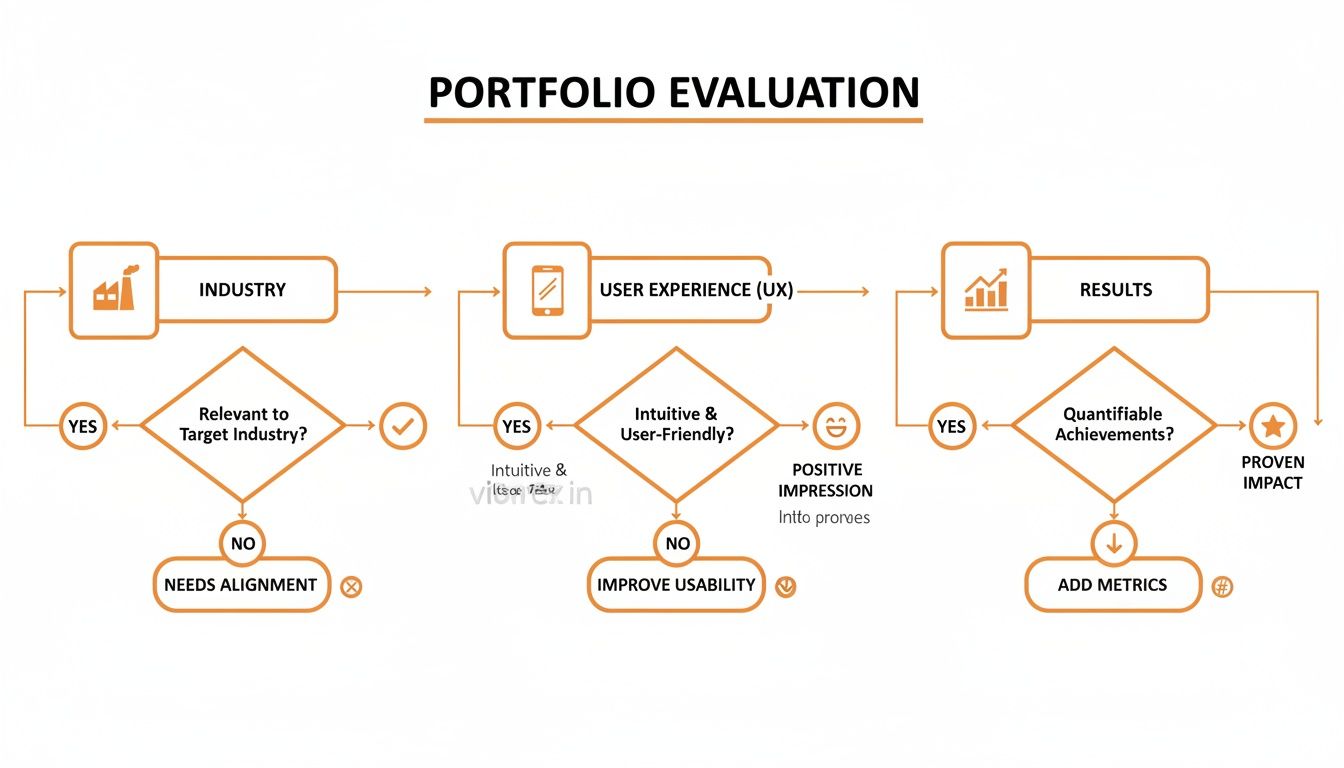
A great portfolio is more than just pretty pictures. It needs to show a clear understanding of your industry, a commitment to user-friendly design, and a history of delivering real, tangible business results.
The Essential Questions for Your Discovery Call
Don't go into a discovery call unprepared. That's a surefire way to end up with a vague conversation that doesn't tell you anything useful. You need to arm yourself with a list of questions that cut right through the sales pitch.
The goal here is to understand how they work. Think process, communication, and problem-solving. A good agency will have clear, confident answers. Evasive or overly general responses? That's your first warning sign.
To get the conversation rolling, I've put together a table of essential questions. These are designed to give you a comprehensive picture of what it would be like to work with the agency.
Essential Questions for Vetting Web Design Agencies
Category | Essential Question |
|---|---|
Process & Workflow | Can you walk me through your typical project timeline from discovery to launch? What specific milestones and deliverables should we expect at each stage? |
Project Management | What tools do you use to manage projects and communicate with clients? How often will we have check-in meetings, and who will be my primary point of contact? |
Technical Approach | What's your process for ensuring the website is mobile-responsive, fast, and secure? How do you approach on-page SEO during the build process? |
Post-Launch Support | What happens after the site goes live? Do you offer maintenance plans, and what do they include? |
Strategy & Goals | How will you ensure the new website aligns with our specific business goals, like lead generation or online sales? |
Past Performance | Could you share a case study of a project similar to ours, and what were the measurable results? |
Team & Expertise | Who exactly will be working on our project, and what is their experience? |
Scope & Revisions | How do you handle scope creep or requests for revisions that fall outside the original agreement? |
These questions give you a solid framework for any discovery call. An agency that can answer them clearly and confidently likely has its act together. This vetting process is universal—many of the same principles apply when you're trying to figure out how to find content marketing agencies that deliver results, where proof and process are everything.
A great agency welcomes tough questions. They see it as an opportunity to showcase their expertise and build trust. A weak agency will get defensive or change the subject.
Spotting the Red Flags Before It’s Too Late
Just as important as asking the right questions is knowing which warning signs to look out for. Overlooking these red flags can lead to blown deadlines, budget overruns, and a website that just doesn't work.
Given that more than 60% of clients have ended or considered ending a relationship with an agency due to poor practices, it pays to be vigilant.
Keep an eye out for these classic red flags:
Aggressive Sales Tactics: If they’re pushing you to sign a contract right now with a “special limited-time offer,” run. A good partner will give you the time and space you need to make a smart decision.
Refusal to Provide References: An agency that’s proud of its work will be happy to connect you with past clients. If they hesitate, deflect, or claim NDAs prevent them from sharing any contacts, be extremely skeptical.
Vague Answers and Buzzword Overload: When you ask about their process and get a stream of jargon with no real substance, it’s often a sign they don’t have a clear strategy.
The "One-Size-Fits-All" Approach: Does their portfolio look like the same template with a different logo slapped on it each time? They probably aren’t equipped to solve your unique business challenges.
They Don’t Ask About Your Business Goals: The best agencies always start by asking about your business, your customers, and your goals. If they jump straight into design mockups without understanding what you're trying to achieve, their priorities are all wrong.
How to Check References the Right Way
When an agency gives you references, don’t just ask if they were “happy” with the work. You need to dig deeper to uncover what the partnership was really like. A quick, focused phone call can tell you more than a portfolio ever will.
Try asking the reference these direct questions:
"How was the agency's communication throughout the project? Were they responsive?"
"Did the project stay on schedule and within the agreed-upon budget? If not, how did they handle it?"
"Did the final website actually meet the business goals you set out at the beginning?"
"What was one thing you wish the agency had done differently?"
That last question is often the most revealing. Even in a great project, there are always things that could be improved. An honest answer here will give you a balanced view of the agency's real strengths and weaknesses, helping you find a partner who is truly committed to your success long after launch.
Decoding Proposals, Pricing Models, and Timelines
You've done the hard work, narrowed down your list, and now the proposals are rolling in. This is where the magic happens—where vague promises turn into a concrete plan. Think of the proposal not as a sales pitch, but as the architectural blueprint for your project. Getting these details right from the start is what separates a smooth project from a nightmare.
It’s about knowing exactly what you’re paying for. In the United States, web design is a massive industry, pulling in around $43.5 billion in revenue and on track to hit $47.4 billion soon. With over 203,000 agencies competing for your business, a clear, transparent proposal is your first and best sign that you’re dealing with a professional. You can dig deeper into these numbers and discover what defines the web design market on Hostinger.
A well-structured proposal isn't just a formality—it shows the agency is organized, thoughtful, and respects your investment.
Understanding Common Pricing Models
Web design pricing isn't one-size-fits-all. Agencies usually lean on one of three models, and the right one for you really depends on how well-defined your project is and how much flexibility you need.
Here’s a quick rundown of what you’ll likely see:
Fixed-Price Projects: This is the most straightforward approach. You get a single, all-in price for a very specific scope of work. It’s fantastic for budgeting because there are no surprises. The downside? It’s rigid. If you want to add a new feature halfway through, get ready for a new quote and a change order.
Hourly Rates (Time & Materials): Here, you pay for the actual hours worked. This model is incredibly flexible, making it a great fit for projects that might evolve or where the scope isn't perfectly clear from day one. Be warned, though—costs can climb if the project drags on, so it requires a lot of trust and communication.
Monthly Retainers: This is your go-to for long-term partnerships. A retainer is perfect for ongoing needs after your site launches, like regular content updates, SEO, or performance tuning. You pay a set amount each month for a block of hours or specific deliverables, keeping your website a living, breathing part of your marketing strategy.
The best pricing model lines up with your project’s needs. If you have a clear vision for a standard website, a fixed-price model gives you peace of mind. But if you’re focused on continuous growth and optimization, a retainer is the smarter play.
What to Expect in a Typical Project Timeline
A professional agency won't just throw a random launch date at you. They'll give you a detailed project timeline with key phases and milestones. This keeps everyone accountable and the project moving forward. While every project is unique, most follow a pretty standard flow.
A Standard Web Design Project Flow
Discovery & Strategy (1-2 Weeks): This is the deep-dive phase. The agency gets to know your business, customers, and competition inside and out. The goal is to create a strategic brief that will guide every decision that follows.
Design & UX/UI (2-4 Weeks): From that strategy, the creative work begins. You’ll see wireframes (the site's skeleton) first, followed by full-color visual mockups. This is your chance to weigh in on the look, feel, and user flow before a single line of code is written.
Development & Content Implementation (3-6 Weeks): This is where your website comes to life. Developers build out the approved designs on your chosen platform and start plugging in your content. It's usually the longest part of the process.
Testing & Quality Assurance (1-2 Weeks): Before launch, the team puts the site through its paces. They’ll check for bugs, test it on different browsers, and make sure it looks great on every device.
Launch & Training (1 Week): Go-live day! Once the site is live, the agency should walk you through the backend and show you how to manage your content.
Key Clauses to Scrutinize in the Contract
Don’t just skim the contract—read it. This document is your only real protection if things go sideways. If something feels unclear, ask for it to be reworded. A good partner will have no problem doing that.
Pay special attention to these parts:
Detailed Scope of Work: This section needs to be crystal clear. It should list out every single deliverable, like the exact number of pages, specific features (blog, e-commerce, contact form), and any integrations. If it’s not in writing, it’s not included in the price.
Intellectual Property Ownership: This one is non-negotiable. The contract must explicitly state that you own 100% of the final website design, code, and content once the final bill is paid.
Payment Schedule: This breaks down when payments are due. It's usually a deposit to start (typically 30-50%), followed by payments at key milestones, and a final payment right before launch.
Handling Scope Creep: Ideas happen. A good contract will have a clear process for handling requests that fall outside the original agreement. This usually involves a "change order" document that outlines the new work and any additional costs.
Seeing how different scopes of work can impact cost is a huge help. You can see some transparent examples by looking over our web design plans and pricing. Getting clear on these details now is the key to a successful partnership without any frustrating surprises down the road.
Planning for Success After Your Website Launches

Popping the champagne on launch day feels great, but the work isn't over. Not even close. The moment your site goes live, it stops being a project and starts being a living, breathing marketing asset—one that needs ongoing care to actually deliver a return on your investment.
One of the biggest mistakes you can make is choosing an agency that vanishes after launch day. A true partner sees the "go-live" date as the starting line, not the finish. They get that a static site quickly becomes an outdated one, leaving you vulnerable to security risks, performance dips, and the whims of search engine algorithms.
Why Ongoing Support Is Non-Negotiable
Your website is a complex piece of software. You wouldn't skip oil changes for your car or ignore updates on your phone, right? Your site needs that same consistent maintenance to keep running smoothly. Without it, you're leaving your digital storefront unprotected and underperforming.
A solid post-launch plan has to cover a few key areas:
Security Updates: Platforms like WordPress, along with their themes and plugins, are constantly releasing security patches. Ignoring them is like leaving your front door wide open.
Performance Monitoring: Is your site still loading in the blink of an eye? A good agency will keep a close watch on your Core Web Vitals and server response times to make sure slow speeds aren't causing visitors to bounce.
Regular Backups: If something goes sideways—a bad plugin update, a server glitch—having recent, reliable backups can be the difference between a minor hiccup and a complete catastrophe.
This kind of ongoing care ensures the investment you just made continues to pay dividends, whether you’re a local business serving Downtown Los Angeles or an e-commerce store with customers across Southern California.
A great website isn't a "set it and forget it" tool. It's a garden that needs consistent tending. The right agency provides the expertise to keep it healthy, secure, and growing.
Partnering With a Growth-Focused Agency
Beyond just keeping the lights on, the best agencies offer services designed to actively grow your business. They don't just fix what's broken; they hunt for opportunities to improve performance and drive better results over time. This is where a real partnership truly shines.
It’s also crucial to pick an agency that keeps up with technology. Employment for web developers in the U.S. is projected to grow 8–13% in the next decade, and about 93% of designers now use AI in their workflow. That means you need to vet an agency's technical chops—can they build responsive, ADA-aware sites on modern platforms like Wix Studio, Webflow, or WordPress? You can discover more about these web design industry trends on WPBeginner.
Key Services for Long-Term Growth
Look for an agency that presents a clear roadmap for success with services that go way beyond the initial build.
Search Engine Optimization (SEO): An amazing website is useless if nobody can find it. Ongoing SEO—from keyword tracking in competitive markets like Beverly Hills to technical optimization—is what gets you climbing the search rankings and pulling in organic traffic.
Content Strategy: An agency that helps you plan and create valuable blog posts, case studies, or service pages is one that understands how to keep your site fresh and relevant for both users and search engines.
Conversion Rate Optimization (CRO): Using analytics and user behavior data, a growth-focused agency can run tests to make your site better at turning visitors into leads or customers. It could be as simple as tweaking a call-to-action button or as involved as redesigning a landing page for better flow.
When you choose a web design agency, you’re not just buying a product; you’re investing in a relationship. A partner who sticks around after launch is one who is genuinely committed to helping your business win for years to come.
Common Questions About Hiring a Web Designer
Even after you've done your homework, a few last-minute questions always seem to pop up. Getting straight answers to these is the final gut check before you sign on the dotted line. Here are some of the most common things business owners ask us.
How Much Should a Small Business Website Cost?
There’s no one-size-fits-all answer, but you can generally expect a professional website for a small business to land somewhere between $3,000 for a simple brochure site and upwards of $25,000 for something completely custom.
What pushes the price up or down? The platform is a big one—whether it's built on Wix Studio, Webflow, or WordPress makes a difference. The final cost also depends on how much custom design work is involved, the number of pages, and any special features you need, like a booking system or third-party software integrations.
Always ask for an itemized proposal. And if you get a quote that seems too good to be true? It probably is. Rock-bottom prices often mean shoddy work, hidden fees, or outsourced teams that just don't get your vision.
What Is the Difference Between a Web Designer and a Web Developer?
Think of it like building a house: you have an architect and a construction crew.
A web designer is the architect. They’re obsessed with the look, feel, and overall user experience (UX/UI). They map out the site’s layout, choose the color palette, and figure out exactly how visitors will move through each page. It's all about the blueprint.
The web developer is the builder. They take that beautiful design and bring it to life with code. They handle all the technical, behind-the-scenes work—from database connections to making sure the server runs smoothly.
Full-service agencies have both experts under one roof, which is a huge plus. It means the architect and the builder are constantly talking, ensuring your stunning design is also a high-performing, technically sound website. No dropped balls or communication gaps.
How Long Does It Take to Build a New Website?
For a standard small business site, a realistic timeline is anywhere from 6 to 12 weeks. This gives a professional agency enough breathing room to do things right without cutting corners.
That timeframe usually breaks down into a few key stages:
Discovery & Strategy: 1-2 weeks
Design (UX/UI): 2-3 weeks
Development: 3-5 weeks
Testing & Launch: 1-2 weeks
Of course, a simple template site can be faster, while complex custom features will stretch the timeline. But the biggest variable? Honestly, it’s usually client feedback. Getting your content, approvals, and input to the agency on time is the single best way to keep your project on schedule.
Does My Business Need a Local Web Design Agency?
You can work with an agency anywhere in the world, but there's a real advantage to partnering with someone who gets your local market—especially in a place as unique as Los Angeles and Southern California. A local team has a built-in understanding of regional customer behavior, the competitive scene, and what actually works for local SEO.
Los Angeles is at the center of our service area, and we proudly support clients across a wide network of surrounding cities and neighborhoods throughout Southern California. Our reach includes every corner of L.A.—from Downtown Los Angeles, Hollywood, West Hollywood, Beverly Hills, and Santa Monica to the beach communities of Malibu, Venice, Marina del Rey, Hermosa Beach, Manhattan Beach, and Redondo Beach. We also extend service through the San Fernando Valley, including Sherman Oaks, Studio City, Encino, Van Nuys, North Hollywood, Burbank, Glendale, Pasadena, Woodland Hills, Chatsworth, Canoga Park, Reseda, Northridge, and Tarzana. In the San Gabriel Valley, we work with clients in Alhambra, Monterey Park, San Gabriel, Temple City, Rosemead, Arcadia, El Monte, South El Monte, West Covina, Covina, Baldwin Park, Azusa, Glendora, Duarte, and Monrovia. Farther southeast, we serve Whittier, Pico Rivera, Downey, Norwalk, La Mirada, La Habra, and Cerritos. We also support the South Bay—including Torrance, Carson, Gardena, Hawthorne, Inglewood, and Long Beach—as well as the Gateway Cities and communities throughout the I-10, I-5, 101, and 405 corridors. Whether you’re in a major metro area or a smaller surrounding neighborhood, our team delivers reliable, high-quality service anywhere in or around Los Angeles.
This isn't just about name-dropping local spots on your website. It's about tapping into the local culture to build a digital presence that feels authentic and truly resonates with the community you’re trying to reach.
Choosing the right web design agency is one of the most important investments you can make in your business's growth. If you’re looking for a partner who combines stunning design with data-driven strategy to deliver measurable results, DLL Studios is here to help. We build high-performing websites on Wix Studio, Webflow, and WordPress that are secure, fast, and designed to convert.