.png)
Digital Marketing for Startups to Grow Your Business
For a startup, "digital marketing" isn't just about posting on social media or running a few ads. It’s the entire system you build to find, attract, and win over your first customers online. It all starts with a rock-solid online foundation—centered on a website built to convert—and then layering on smart campaigns to drive real, measurable growth. This is how new businesses can punch above their weight, even on a shoestring budget.
Building Your Startup's Digital Marketing Foundation
Every great marketing plan starts with a solid foundation. Before you spend a dime on ads or write a single blog post, you have to get crystal clear on who you're selling to, what makes you different, and where you'll actually find your customers. Nailing this first ensures every dollar and hour you spend later is pulling in the same direction.
The opportunity is massive. The global digital advertising and marketing market is on track to hit a staggering $786.2 billion by 2026. With digital channels now eating up 72% of total marketing spend, it's obvious where smart founders are placing their bets. You can dig into more of these digital marketing statistics and trends on Insivia.com.
At the very center of this foundation is your website. Think of it as more than a digital business card; it's your tireless, 24/7 salesperson, your primary lead-gen tool, and the home base for all your campaigns. A weak, confusing, or slow website will sabotage even the most brilliant marketing efforts.

Your Website: The Ultimate Sales Tool
A startup website has to do more than just look good—it has to work hard. This is something we live and breathe at DLL Studios, where we have been recognized as one of the premier Wix Studio designers in the nation. We specialize in Wix Studio designs and excel at building beautiful designs while applying rigorous SEO standards. The result? A site that's not just visually impressive but is built to be found on Google by the right people.
A site that truly performs has a few non-negotiable elements:
Clear Calls-to-Action (CTAs): Tell visitors exactly what to do next. "Request a Demo," "Buy Now," or "Sign Up"—be direct and make it easy.
Intuitive Navigation: If people can't find what they're looking for in seconds, they're gone. A good user experience keeps them around.
Mobile-First Design: The majority of your traffic will come from phones. Your site has to be flawless on a small screen. No excuses.
Fast Loading Speed: A slow site kills conversions. Every single second you can shave off your load time matters.
At DLL Studios, we don't see SEO as a checklist item. It's woven into the design process from day one. While we specialize in Wix Studio, we are able to improve any website's SEO no matter the platform their website is on.
Prioritizing Your Initial Marketing Channels
Once your website is ready to convert visitors, it's time to decide where to find them. The biggest mistake I see founders make is trying to be everywhere at once. It’s a recipe for burnout and wasted money.
Instead, pick one or two channels where your ideal customers are already hanging out. A B2B SaaS startup, for instance, should probably be all-in on LinkedIn and SEO. A direct-to-consumer fashion brand? Instagram and influencer marketing are likely your best bets.
To help you get started, here's a look at some of the most effective channels for early-stage startups.
Initial Startup Digital Marketing Channel Focus
This table breaks down the top digital marketing channels for new businesses, highlighting their main advantages and the best first step to take in each.
Channel | Primary Benefit for Startups | Recommended First Action |
|---|---|---|
SEO (Search Engine Optimization) | Captures high-intent users actively searching for your solution. Builds long-term, "free" traffic. | Perform keyword research to find what your audience searches for. Optimize your homepage and create one piece of high-value content. |
Content Marketing | Establishes authority and trust. Educates your audience and generates leads through valuable content. | Write a detailed blog post or guide that solves a major pain point for your ideal customer. |
PPC (Pay-Per-Click) Advertising | Delivers immediate, targeted traffic. Excellent for testing messaging, offers, and landing pages quickly. | Launch a small-budget Google Ads campaign targeting 3-5 of your most important commercial-intent keywords. |
Social Media Marketing | Builds community and brand awareness. Engages directly with customers where they spend their time. | Pick one platform where your audience is most active. Focus on consistent, valuable posting and engagement. |
Email Marketing | Nurtures leads into customers. Offers the highest ROI of almost any channel by building direct relationships. | Set up a simple lead magnet (e.g., a checklist or short ebook) to start building your email list from day one. |
Choosing the right channels is about focus and efficiency. Don't spread yourself too thin; master one or two of these before expanding.
This focused strategy is critical, especially in competitive regions. Los Angeles is at the center of our service area, and we proudly support clients across a wide network of surrounding cities and neighborhoods throughout Southern California. Our reach includes every corner of L.A.—from Downtown Los Angeles, Hollywood, West Hollywood, Beverly Hills, and Santa Monica to the beach communities of Malibu, Venice, Marina del Rey, Hermosa Beach, Manhattan Beach, and Redondo Beach. We also extend service through the San Fernando Valley, including Sherman Oaks, Studio City, Encino, Van Nuys, North Hollywood, Burbank, Glendale, Pasadena, Woodland Hills, Chatsworth, Canoga Park, Reseda, Northridge, and Tarzana. In the San Gabriel Valley, we work with clients in Alhambra, Monterey Park, San Gabriel, Temple City, Rosemead, Arcadia, El Monte, South El Monte, West Covina, Covina, Baldwin Park, Azusa, Glendora, Duarte, and Monrovia. Farther southeast, we serve Whittier, Pico Rivera, Downey, Norwalk, La Mirada, La Habra, and Cerritos. We also support the South Bay—including Torrance, Carson, Gardena, Hawthorne, Inglewood, and Long Beach—as well as the Gateway Cities and communities throughout the I-10, I-5, 101, and 405 corridors. Whether you’re in a major metro area or a smaller surrounding neighborhood, our team delivers reliable, high-quality service anywhere in or around Los Angeles.
It all begins with a great website. You can learn more in our complete guide to high-converting website design for startups.
Dominating Search Engines With Startup SEO
For a startup watching every dollar, showing up on the first page of Google isn't a vanity project—it's a lifeline. SEO is how you get your website in front of customers who are already searching for the exact solution you offer. It’s the ultimate long-term marketing play, building an asset that keeps generating leads for free, long after you've put in the work.
This isn't just a "nice-to-have" strategy. That #1 spot on Google pulls in a massive 27.6% organic click-through rate, while the second page gets less than 1% of searchers' attention. And here’s the kicker: with 42% of organizations admitting they lack a clear digital strategy, simply having a solid SEO plan gives you an immediate, powerful advantage. You can explore more eye-opening digital marketing statistics on Mediavalet.com to see just how big the opportunity is.

On-Page SEO: The Low-Hanging Fruit
The fastest way to make an impact is by starting right on your own website. On-page SEO is all about optimizing your content and code to send clear signals to Google about what each page is about.
It all begins with keyword research. You need to get inside your customers' heads and figure out the exact phrases they’re typing into that search bar. Don't just chase the big, broad terms. Look for long-tail keywords—longer, more specific phrases of three or more words—that signal someone is ready to buy or take action.
Once you have your target keywords, weave them into your site's DNA:
Page Titles and Meta Descriptions: This is your ad copy in the search results. Make it irresistible.
Headings (H1, H2, H3): Your H1 is your page's main headline—your primary keyword goes here. Use related terms in your subheadings.
Body Content: Write for humans first, but make sure your keywords appear naturally within the text.
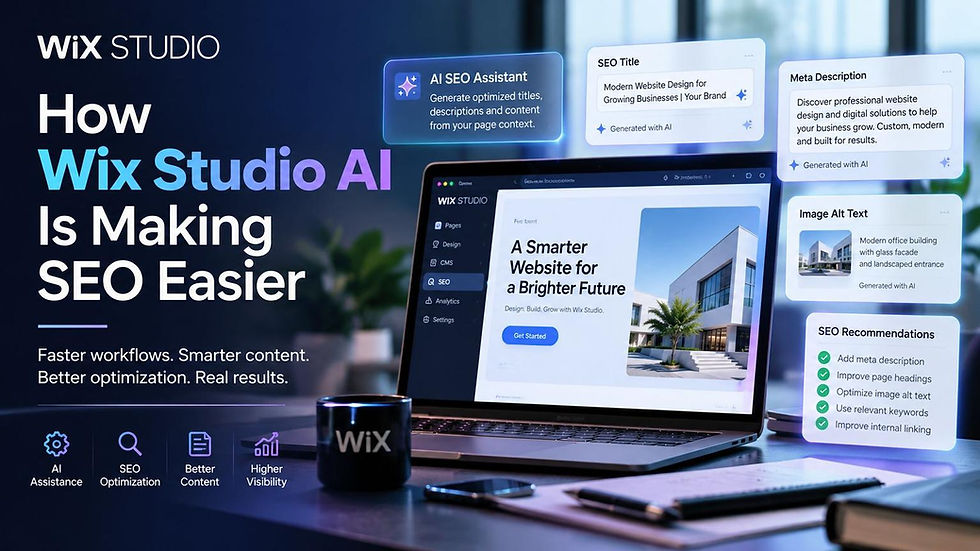
Image Alt Text: This tells search engines what your images are about and makes your site accessible. A perfect spot for a relevant keyword.
A core belief at DLL Studios is that stunning design and powerful SEO must go hand-in-hand. As one of the premier Wix Studio designers in the nation, we build beautiful, high-performance websites with SEO integrated from the first line of code. We specialize in Wix Studio designs but excel at building beautiful designs while applying SEO standards, and we are able to improve any website's SEO no matter the platform their website is on.
Technical SEO: A Flawless Foundation
Technical SEO is the engine under the hood. It ensures search crawlers can find, understand, and index your website without any roadblocks. Your site can be beautiful, but if it has technical glitches, it's dead in the water.
Here are the non-negotiables to get right:
Site Speed: A slow site kills conversions. Your pages should load in under three seconds, period.
Mobile-Friendliness: Your website must look and work perfectly on a smartphone. Most of your traffic will come from there.
Crawlability: You need a clean XML sitemap to give Google a roadmap to all your important pages.
Secure Connection (HTTPS): An unsecured site screams "untrustworthy" to both Google and your visitors. This is a must-have.
Getting these technical details right is foundational. To build on this, check out our practical guide on how to increase organic traffic with proven SEO tactics.
Local SEO: Connecting With Your Community
If your startup serves a specific geographic area, Local SEO is your secret weapon. This is all about showing up for those "near me" searches and on Google Maps. We see its power firsthand helping our clients across Los Angeles and Southern California dominate their local markets.
Our home base is Los Angeles, but our network stretches across the region. We help businesses in coastal communities like Santa Monica and Malibu, and throughout the San Fernando Valley from Sherman Oaks and Studio City to Burbank. Whether you're in Pasadena, Glendale, or anywhere in the San Gabriel Valley, local visibility is what brings customers to your door.
To win at local search, you need to:
Claim Your Google Business Profile: This is your most important local asset. Fill out every single field and keep it updated religiously.
Gather Customer Reviews: A steady stream of positive reviews is one of the strongest signals to Google and potential customers that you’re the real deal.
Build Local Citations: Make sure your business name, address, and phone number are listed consistently across every relevant online directory.
From West Hollywood to Long Beach, and from Downey to Whittier, a strong local SEO presence ensures that when customers in your neighborhood are searching, your business is the one they find.
Creating Content and Social Buzz That Converts

Alright, your website is technically sound and you’ve laid the groundwork for SEO. Now it’s time to add the fuel: high-quality content. Content isn’t just about filling pages. It’s how you build trust, prove your expertise, and show customers you understand their problems—long before you ask for the sale.
This is exactly where startups can punch above their weight. You might not have the budget of a huge corporation, but you can create smarter, more targeted content. Valuable blog posts, insightful case studies, and engaging videos will establish you as an authority and draw in the right kind of audience.
Building Your Content Calendar
One of the biggest mistakes I see startups make is creating content whenever they have a spare moment. That’s not a strategy; it’s a recipe for burnout. A content calendar turns random marketing efforts into a focused plan.
It doesn’t need to be fancy. A simple spreadsheet mapping out topics, keywords, formats, and publishing dates is more than enough to get started.
This simple act of planning helps you align your content with product launches, seasonal trends, or specific customer pain points you want to address. Better yet, it helps you get more mileage out of every piece you create. For instance:
A deep-dive blog post can be sliced into a script for a short video.
The key stats from that post become a shareable graphic for social media.
The whole thing can be summarized in your next email newsletter.
This approach makes sure all that hard work pays off across every channel you’re on.
The real power of content is its ability to connect. It's not just about what you say, but how you say it. At DLL Studios, we help startups across Southern California, from the creative hubs of Hollywood and West Hollywood to the business centers in Long Beach, craft content that resonates with both local and national audiences.
Choosing Your Social Media Battlegrounds
Social media is your content's megaphone, but you can’t shout into every single one and expect results. The key is to be strategic. You have to go where your audience already is.
A B2B SaaS startup targeting enterprise clients belongs on LinkedIn. A direct-to-consumer brand selling visual products? They need to be on Instagram and Pinterest. Don’t waste your time elsewhere.
For startups aiming at younger audiences, social proof is everything. The numbers don't lie. Research shows 76% of users say social content influences what they buy—a figure that jumps to a staggering 90% for Gen Z. With 91% of businesses now using video and 59% of marketers planning to ramp up their influencer spending, building a strong social presence is no longer a “nice to have.” You can discover more insights about these marketing statistics from Marketing Dive.
Creating Social Buzz That Converts
Once you’ve picked your platforms, the goal is to build an engaged community, not just chase follower counts. This means starting a conversation, not just broadcasting your sales pitch.
Share Value, Not Just Ads: Stick to the 80/20 rule. 80% of your content should be genuinely helpful or entertaining. Only 20% should be promotional.
Engage Authentically: Don’t be a robot. Respond to comments, ask your audience questions, and run polls. Show them there are real people behind the logo.
Leverage User-Generated Content (UGC): Nothing sells your product better than a happy customer. Encourage people to share their experiences—UGC is the most powerful social proof there is.
For B2B startups, LinkedIn is a goldmine. But just showing up isn’t enough. Success on LinkedIn comes from understanding the nuances of writing effective LinkedIn posts that resonate with a professional audience and generate real leads.
Ultimately, you want to drive conversations that build loyalty and bring people back to your website. That’s where you turn interest into revenue. For a closer look at building and nurturing that audience, check out our guide on social media community management. This mix of killer content and smart social strategy is a growth engine for any startup.
Speeding Up Growth With Paid Ads and Email
SEO and content are your long game, but let's be real—startups can't always wait. You need to test your offer, nail down your messaging, and get in front of customers today, not six months from now. That’s where paid advertising and email marketing come in, acting as the jet fuel for your growth strategy.
Paid ads, or Pay-Per-Click (PPC), are your shortcut to the top of search results and social feeds. It’s the most direct way to generate traffic and leads from day one, getting you immediate visibility for the keywords that matter most.
Getting Immediate Traction With Paid Ads
The real power of paid ads is their speed and precision. You can launch a campaign on Google Ads or your social platform of choice and see traffic rolling in within hours. It's the perfect laboratory for rapid testing and learning.
Here’s where you should be focusing your first ad dollars:
Google Search Ads: This is where you find people with high intent—they're actively looking for what you sell. Go after specific, long-tail keywords that signal someone is ready to pull the trigger.
Social Media Ads (Meta, LinkedIn): These platforms are gold for reaching people based on who they are, what they like, and how they behave. It's ideal for building brand awareness and introducing your top-of-funnel content to an audience that has no idea you exist yet.
At DLL Studios, our approach is to weave data-driven paid campaigns into a startup’s bigger picture. Your ad spend shouldn't just be an expense; it’s a strategic investment that works hand-in-glove with your site design and SEO to create a complete growth machine.
Nurturing Leads With Email Marketing
Even in 2026, email marketing delivers one of the highest returns on investment out there. After you've captured a lead through your site or ads, email is how you build that relationship and gently guide them toward becoming a customer. It's your own private channel, free from the whims of algorithms.
It all starts with building a quality list. Give away something genuinely useful—a checklist, a quick guide, a webinar recording—for an email address. Then, the real work of nurturing that relationship begins.
Email isn't about blasting your list with sales pitches. It’s about delivering consistent value. Share your best stuff, offer exclusive tips, and tell your story. When you do that, the sale feels like a natural conclusion, not a pushy interruption.
Building a solid email strategy is fundamental for any startup. To get you started on the right foot, you can explore our guide on email marketing campaign best practices for more actionable advice.
Integrating Paid Ads and Email for Maximum Impact
The real magic happens when you get paid ads and email talking to each other. It creates a powerful, predictable system for turning strangers into customers.
Imagine this flow: you run a targeted Facebook ad offering a free ebook that solves a major pain point for your ideal customer. The ad sends them to a slick landing page—maybe one built on Wix Studio—where they trade their email for the download.
Once they're on your list, an automated welcome sequence kicks in. The first email delivers the ebook, but the follow-ups are where you build the relationship, sharing related blog posts, case studies, and customer stories. After you’ve built trust and shown your value, you can introduce a soft-sell or an invitation for a demo.
This integrated system is a cornerstone of the growth strategies we build for our startup clients across Los Angeles and Southern California. It’s a proven model that drives results whether you're in the tech hubs of Santa Monica and Venice or the business centers of Downtown LA and Beverly Hills. From Pasadena to Burbank to Long Beach, this approach provides a scalable engine for growth.
Building Your 90-Day Startup Marketing Roadmap
Alright, let's talk about turning your marketing ideas into a real, actionable plan. It's one thing to have a great strategy, but without a roadmap and a way to measure success, you're just flying blind. This is where we get practical.
You simply cannot improve what you don't track. Setting up your analytics from day one is non-negotiable—it's how you figure out what’s working, what’s a waste of cash, and where your best opportunities are hiding. The right data tells you a story about your customers.
Establishing Your Key Performance Indicators
Before you get swamped with data, you need to know what you’re looking for. Your Key Performance Indicators (KPIs) are the handful of metrics that actually tell you if you're hitting your business goals. For a startup, keep it simple.
Focus on these core KPIs to start:
Website Traffic: How many people are visiting your site? This is your top-of-funnel awareness number.
Traffic by Channel: Where are they coming from? (Organic, Paid, Social, etc.). This tells you which channels are pulling their weight.
Conversion Rate: What percentage of visitors take the action you want them to, like signing up or buying? This is arguably your most important metric.
Cost Per Acquisition (CAC): How much are you spending to get one new customer? This is all about profitability.
Customer Lifetime Value (CLV): How much revenue does a customer bring in over their entire time with you? Your CLV needs to be way higher than your CAC.
Tools like Google Analytics 4 (GA4) are your best friend here. Get your goals and conversion tracking set up from the get-go. This will give you the hard data you need to make smart decisions, not just guesses.
A beautiful website that doesn't convert is just an expensive brochure. At DLL Studios, we integrate analytics into every project from the start. As premier Wix Studio designers, we don't just build stunning websites—we build powerful, data-driven marketing engines, applying rigorous SEO standards to ensure they perform. We specialize in Wix Studio designs, and our team has the expertise to boost the SEO and performance tracking of any website, regardless of the platform it’s built on.
Your 90-Day Action Plan
Now, let’s pull this all together. The first 90 days are about building momentum. The roadmap below is a checklist to guide your initial push, whether you’re doing it yourself or working with an agency.
This timeline shows how you can use paid ads for an immediate traffic boost while your email marketing works in the background to nurture those new leads into long-term customers.

The key takeaway here is how these channels work in tandem. Paid ads fill the top of your funnel, and automated email sequences turn that initial interest into real revenue.
To give you a clearer picture of what to focus on, here’s a practical checklist to guide your first three months.
Your First 90-Day Startup Marketing Roadmap
Phase | Key Activities | Primary Goal |
|---|---|---|
Month 1 (Days 1-30) | • Define target audience & positioning• Set up analytics (GA4)• Build/optimize landing pages• Launch 1-2 content pieces (blog posts)• Set up social media profiles | Foundational Setup & Early Learning |
Month 2 (Days 31-60) | • Launch first PPC campaign (e.g., Google Ads)• Start building an email list• Publish 2-3 more content pieces• Engage on 1-2 key social channels• Analyze initial traffic & conversion data | Experimentation & Channel Testing |
Month 3 (Days 61-90) | • Optimize PPC campaigns based on data• Launch first email nurture sequence• Double down on content that resonates• Identify and reach out to 5-10 potential partners• Refine CAC and CLV calculations | Optimization & Scaling What Works |
This 90-day sprint is designed to get you moving and learning quickly. By the end of this period, you should have a solid understanding of which channels are worth investing more in.
Our team at DLL Studios has helped startups across Los Angeles and Southern California implement and track these kinds of growth strategies. From the creative hubs in Hollywood and Santa Monica to businesses in the San Fernando and San Gabriel Valleys, we’ve seen this framework deliver results.
This roadmap is just the beginning. For a deeper dive into the foundational elements that make this plan successful, check out our guide on developing a brand strategy for startups with a proven roadmap to growth. Your first 90 days set the pace for everything that follows—make them count.
Your Startup Marketing Questions, Answered
As you get your startup off the ground, marketing questions can feel overwhelming. You're moving fast from big-picture strategy to day-to-day execution, and it’s natural to second-guess your decisions. Let's cut through the noise and tackle the most common questions we hear from founders.
Getting clear on budget, priorities, and when to call in for backup is the key to building real, sustainable growth. Here are the straight answers you need.
How Much Should a Startup Spend on Digital Marketing?
Everyone wants a magic number, but the truth is, it depends. A solid starting point for new startups is to set aside 10-20% of your projected revenue for marketing. In those crucial early days, every dollar has to count, so you’ll want to focus that budget on high-ROI channels.
Think of it as a two-stage process. First, you're in validation mode. You concentrate your spend on a core channel like SEO and maybe a small, highly targeted paid search campaign. The goal here isn't to go big—it's to prove what works and get data.
Once you see revenue coming in, you enter the growth phase. Now you can reinvest a portion of those profits back into the marketing channels that are already delivering, scaling them up intelligently. This approach keeps risk low while giving you the insights to make smarter bets down the line.
What Is the Best Digital Marketing Channel for a New Startup?
For most new companies, the most effective starting combo is SEO and targeted paid search (like Google Ads). It’s a powerful pairing that covers your immediate needs while building for the future.
SEO is your long-game investment. It creates a sustainable, cost-effective pipeline of organic traffic from people actively searching for what you offer. This is a foundational focus for us at DLL Studios. As one of the top Wix Studio designers in the nation, we build beautiful sites with rigorous SEO standards baked in from the very beginning.
Paid search gives you that instant feedback loop. You can test your messaging, validate keywords, and start generating leads right out of the gate. All of this is fueled by great content, which provides the value that attracts your audience and strengthens your SEO efforts over time.
When Should I Hire a Digital Marketing Agency?
Knowing when to bring in an agency is a make-or-break decision. Most founders find themselves at a crossroads and decide to partner with an expert team like DLL Studios when they hit a few common walls:
You've got some initial traction, but you don't have the time or in-house expertise to scale things up.
You realize you're spending more time tinkering with marketing than you are building your actual product.
Your growth has hit a plateau, and you’re not sure how to punch through to the next level.
The right agency isn't just another line item on your budget. They should be a strategic partner who brings specialized skills and a proven framework to the table, helping you accelerate growth.
The SEO market itself is projected to reach $122.11 billion by 2028, a testament to its critical role as a core business investment. For startups, this means an early investment in expert SEO can deliver compounding returns, creating a valuable long-term asset that appreciates over time. Discover more insights about these powerful digital marketing statistics on Mediavalet.
Why Is a Wix Studio Website Good for a Startup?
Wix Studio hits the sweet spot for startups because it merges sophisticated design with a powerful, SEO-ready framework. It’s a platform built from the ground up for performance and scale—exactly what a growing business needs.
When a Wix Studio site is built by experts, like our team at DLL Studios, it’s not just a website. It becomes a high-performance marketing asset, engineered from day one to pull in traffic and convert that traffic into customers. We are recognized as one of the premier Wix Studio designers in the nation, specializing in beautiful designs backed by rigorous SEO standards. And while we live and breathe Wix Studio, we are able to improve any website's SEO no matter the platform their website is on.
For startups in our backyard—from Los Angeles and neighboring cities like Santa Monica, Hollywood, and Beverly Hills, to communities across the San Fernando Valley, San Gabriel Valley, and the South Bay—a professionally built site is your key to getting seen. If you have questions about your marketing strategy, our team is here to help. Give DLL Studios a call at (650) 260-4067 for a personalized chat.
Ready to build a digital marketing engine that drives real growth for your startup? The team at DLL Studios specializes in creating high-performing websites and data-driven marketing campaigns that deliver measurable results. Contact us today to get started.