


.png)
How to Increase Organic Traffic: A Practical SEO Guide
Driving organic traffic isn't about finding some secret hack. It boils down to a simple, proven formula: combine sharp keyword targeting with high-quality content and solid technical SEO. This is the engine that makes your website more visible to search engines, turning people who are just searching into actual customers—all without a hefty ad spend.
Understanding the Foundations of Organic Growth
Growing your site's visibility isn't a one-and-done task; it’s about building a sustainable system. Think of it like constructing a house. You need a solid blueprint (your strategy), quality materials (your content), and a flawless structure (your technical SEO) to attract visitors and convince them to stay.
The core principle is just to provide value. Search engines are really just massive answer machines, designed to connect people with the best, most relevant solutions to their problems. Your job is to be that solution for your audience.
This process breaks down into three key stages: targeting the right people with the right keywords, creating content that genuinely helps them, and making sure your website is technically sound so search engines can easily find and understand it.
This simple diagram shows how these pieces fit together to create a powerful growth loop.
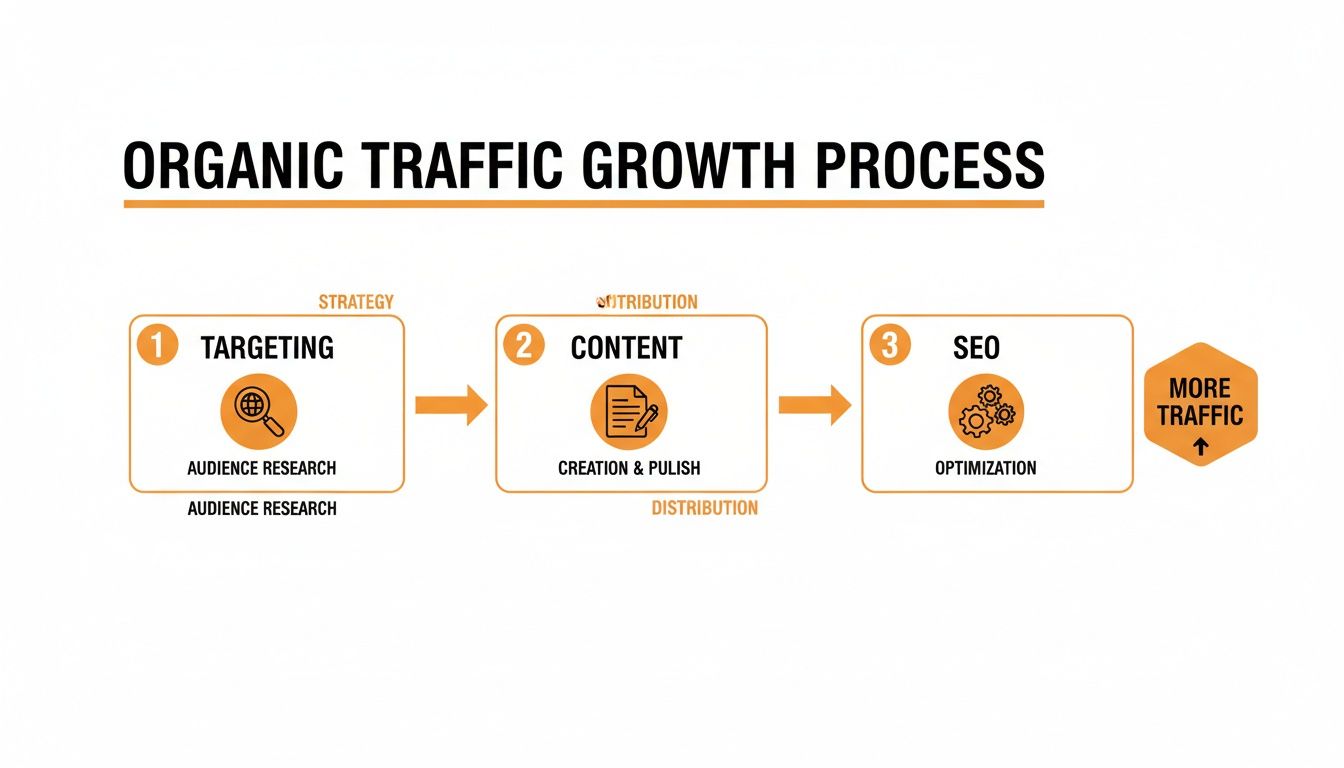
As you can see, it all starts with precise targeting, flows into valuable content, and is supported by ongoing technical optimization.
Why Organic Traffic Matters More Than Ever
Investing in organic growth is no longer a "nice-to-have"—it's a business necessity. Unlike paid ads, which vanish the second you stop paying, organic visibility is a true asset that builds on itself over time. It creates a level of trust and authority that paid campaigns just can't replicate.
I saw this firsthand with a professional services firm centered in Los Angeles that was burning through cash on PPC ads. They shifted their focus to an organic strategy, creating in-depth content that spoke directly to client pain points in specific neighborhoods. Their reach included every corner of L.A.—from Downtown Los Angeles, Hollywood, West Hollywood, Beverly Hills, and Santa Monica to the beach communities of Malibu, Venice, Marina del Rey, Hermosa Beach, Manhattan Beach, and Redondo Beach. The result? Within a year, they doubled their qualified client inquiries and cut their marketing budget by 40%.
The data backs this up. Organic search is projected to account for a massive 53% of all website traffic by 2025, leaving paid ads and social media in the dust for many industries. Getting to the first page of Google is critical, as it captures 71% of all clicks. Even moving up a single spot in the rankings can increase your click-through rate by 2.8% on average.
The Four Pillars of a Winning SEO Strategy
To really move the needle on organic traffic, you need to get good at a few interconnected disciplines. Each one plays a vital role in how search engines see your website and how much they trust it.
We can break this down into four core pillars that form the foundation of any successful organic growth plan.
Pillar | Core Focus | Key Activities |
|---|---|---|
Audience & Keyword Research | Understanding user intent and language. | Identifying valuable keywords, analyzing searcher intent, and mapping keywords to the customer journey. |
High-Quality Content | Being the best answer for a query. | Creating comprehensive guides, blog posts, and landing pages that solve specific problems. |
Technical SEO | Ensuring search engine accessibility. | Optimizing site speed, ensuring mobile-friendliness, implementing schema markup, and fixing crawl errors. |
Authority Building | Establishing trust and credibility. | Earning backlinks from reputable sites, managing online reviews, and building a strong brand presence. |
Mastering these four areas is what separates sites that get a trickle of traffic from those that become dominant players in their niche.
The ultimate goal is to create a seamless experience where a user finds you easily, loves your content, and sees you as the go-to authority. This approach doesn't just boost rankings; it drives real business results.
While this guide focuses on traditional SEO, these principles apply everywhere. For instance, learning how to increase TikTok video views organically also hinges on understanding audience behavior and platform algorithms. The fundamentals of delivering value and earning relevance are universal.
Finding Keywords That Drive Real Business Results
Good keyword research is the compass for your entire SEO strategy. It’s never been about chasing the highest search volumes; it’s about finding the exact phrases your ideal customers are typing into Google when they need what you sell. Nail this, and you’re on your way to getting organic traffic that actually converts.
The whole process boils down to understanding searcher intent—the "why" behind every search. Someone looking for "best commercial builders Los Angeles" is worlds away from someone searching "what is concrete curing." The first person is a hot lead, ready to talk business. The second is just kicking tires, looking for information.
Your job is to have content ready for both, mapping keywords to every stage of their journey, from that initial curiosity to the final decision to hire you.
Moving Beyond Basic Keyword Tools
Look, tools like Google Keyword Planner are a decent starting point, but if you're serious about growth, you need to dig deeper. This is where platforms like Ahrefs and SEMrush come in. They give you the competitive intelligence to spot untapped opportunities and truly understand the search landscape. You get to see what’s already working for your competition, find gaps in their strategy, and focus your efforts where they'll have the most impact.
I remember working with a boutique e-commerce startup in Southern California that was getting crushed trying to compete on broad terms like "women's fashion." We jumped into Ahrefs, analyzed their competitors, and found a goldmine: a whole cluster of long-tail keywords around "sustainable beachwear for Venice Beach." The search volume was lower, sure, but the intent was off the charts.
They built a targeted landing page and a couple of blog posts around those specific phrases. The result? A 75% jump in qualified organic traffic and a 30% lift in sales in just six months. It’s a perfect illustration of how getting specific drives real business.
Understanding Keyword Metrics in Context
When you fire up a tool like Ahrefs, you’ll get hit with a bunch of metrics. Knowing what they mean helps you make smarter choices instead of just guessing.
Here’s a pretty standard view from Ahrefs' Keywords Explorer, showing the data for a keyword you’re analyzing.
This screenshot shows you the vital signs of a keyword, helping you decide if it's worth going after.
Keyword Difficulty (KD): A score that estimates how tough it’ll be to crack the top 10. Lower is usually easier.
Search Volume: The average number of times a keyword gets searched per month. It's an important piece of the puzzle, but you have to weigh it against intent and difficulty.
Traffic Potential (TP): This is a big one. It estimates the total traffic the #1 page gets from all the keywords it ranks for, not just the one you looked up.
Parent Topic: This tells you if your keyword is part of a bigger, higher-volume topic that you could target with the same page.
Pro Tip: Stop obsessing over exact-match search volume. Google is smart enough to understand context. Your goal should be to create a comprehensive piece of content around a "parent topic" instead of just hammering a single keyword. This signals your authority and helps you rank for hundreds of related long-tail variations you didn't even know existed.
How to Find High-Intent Keywords
The real game-changer is identifying keywords that signal someone is ready to pull out their wallet. We call these commercial or transactional keywords, and they are pure gold.
Here’s a simple, practical way to find them:
Start with "Seed" Keywords: Brainstorm the basic terms for what you do. Think "Pasadena plumber" or "Glendale web design."
Add Buying Modifiers: Tack on words that scream "I'm ready to buy!" to your seed list. Try words like "buy," "services," "quote," "near me," or "for hire."
Spy on Your Competitors: Use the "Content Gap" tool in Ahrefs. It shows you all the keywords your competitors rank for that you don't. It's like being handed a list of proven opportunities.
Look for Questions: Phrases starting with "how to," "what is," and "why" are perfect for top-of-funnel content. Answering these questions builds trust early on and naturally guides people toward your paid solutions.
When you shift your focus from just attracting visitors to attracting future customers, everything changes. For an even deeper dive into these tactics, check out our guide on building an effective keyword optimization strategy.
Getting Your On-Page and Technical SEO Right
Once you've mapped out your keywords, it's time to roll up your sleeves and put them to work. This is where on-page and technical SEO come in—it's how you take direct control, fine-tuning your website from the inside out so both users and search engines understand what you’re all about.
Think of it this way: these optimizations are essential for anyone serious about learning how to increase organic traffic. They make your content crystal clear to search engine crawlers and far more engaging for actual human beings. It’s a win-win, ensuring your site is both technically solid and contextually spot-on.

From writing compelling title tags that grab attention in the search results to making sure your pages load in the blink of an eye, every little tweak adds up to a much stronger organic presence.
Perfecting Your On-Page Elements
On-page SEO is all about optimizing the stuff people actually see and interact with—the content and the HTML source code behind it. These elements send powerful signals to Google about the topic and quality of your page.
Your first job is to craft a killer title tag. This is the clickable headline in the search results. Keep it under 60 characters, make sure it includes your primary keyword, and write it in a way that makes people want to click.
Next up is the meta description. While it's not a direct ranking factor, this 150-character snippet is your ad copy in the SERPs. A well-written meta description can seriously boost your click-through rate, and Google definitely pays attention to that.
Header Tags (H1, H2, H3): Use one—and only one—H1 tag for your main title. H2s should break up the major sections, and H3s organize the smaller points within them. This creates a clean, logical structure that’s easy for both people and crawlers to follow.
Internal Linking: Don't just let your pages sit in isolation. Link them together where it makes sense. This helps spread authority (often called "link equity") throughout your site and keeps visitors clicking around, which is always a good thing.
Image Alt Text: Always add descriptive alt text to your images. It’s not just for SEO; it makes your site accessible to visually impaired users and gives search engines another clue about your page’s content.
Conquering the Technical Fundamentals
Technical SEO is all the behind-the-scenes work that creates a strong foundation for your website. You could have the best content in the world, but if your site is slow, broken, or impossible for Google to crawl, you're not going to get very far.
Site speed isn't just a nice-to-have anymore. It's a confirmed ranking factor. A slow website bleeds visitors and tanks conversions. Use tools like Google's PageSpeed Insights to see where you stand. The usual suspects are massive image files, clunky code, and slow server response times.
A medical practice in the San Fernando Valley we worked with saw a significant boost in local rankings after focusing on one thing improving their Core Web Vitals. By optimizing images and streamlining code, their page load time dropped by over two seconds, leading to a 15% increase in organic traffic from patients in nearby areas like Sherman Oaks, Studio City, Encino, Van Nuys, and Burbank.
It's also absolutely critical that your site is mobile-friendly. Google now uses mobile-first indexing, which means it ranks your site based on its mobile version. A responsive design that looks and works great on any device isn't negotiable.
Advanced Optimizations for a Competitive Edge
Once you’ve nailed the basics, you can start layering in more advanced tactics to get a leg up on the competition. One of the most impactful is implementing Schema markup, also known as structured data.
Schema is a bit of code you add to your site to help search engines understand your content on a deeper level. This can qualify your pages for "rich snippets"—those extra little features in the search results like star ratings, event info, or FAQ dropdowns. Getting these can dramatically increase your click-through rate without you even moving up in the rankings.
Getting these on-page and technical elements right is foundational. For a deeper dive, our post on 10 SEO tips to boost your website rankings offers a more detailed checklist. It’s an ongoing process, but this constant refinement will keep your site in prime shape to attract and convert organic traffic.
Creating Content That Ranks and Converts

Your keywords give you the blueprint, but content is the engine that actually powers your SEO strategy. If you're serious about increasing organic traffic, creating high-quality, genuinely valuable content is non-negotiable. It’s how you prove your expertise, build trust with an audience, and, ultimately, turn casual searchers into paying customers.
This isn’t about just pumping out generic blog posts to fill a quota. We're talking about creating comprehensive, long-form articles that completely nail your audience's questions. Google rewards depth and expertise, and your content needs to show that you're committed to providing the best answer out there.
Building Your Content Production Plan
A solid content strategy always starts with a plan. A content calendar is your best friend here—it helps you organize all those topics you brainstormed during keyword research and keeps you on a consistent publishing schedule.
Your calendar doesn't have to be some complex beast; a simple spreadsheet often does the trick. Use it to map out your primary topics (pillar content) and all the related subtopics (cluster content) you plan to write about. This structured approach is what builds that all-important topical authority over time.
Don't forget to schedule time to go back and refresh your older posts, too. An article that’s a year or two old can often get a huge boost in rankings just by updating it with new information and re-optimizing it.
Choosing the Right Content Formats
Not all content is created equal, and different formats work for different situations. The trick is to match the format to what the user is actually looking for and what you want to achieve.
How-To Guides and Tutorials: These are perfect for informational keywords. They solve a specific problem for the user with no strings attached, which is a fantastic way to establish yourself as a helpful expert.
Case Studies: For any B2B or service-based business, nothing builds credibility quite like a detailed case study. They show off your results and speak directly to potential clients who are facing the same challenges.
Comparison Articles: When your customers are weighing their options, a comparison post (think "Product A vs. Product B") can be incredibly effective at capturing high-intent traffic right before a purchase.
Real-World Example: We worked with a Los Angeles construction company that was getting buried by competitors for high-value commercial keywords. Instead of writing generic blog posts, they created detailed project case studies for jobs they completed in specific areas like Downtown L.A. and along the I-10 corridor. These case studies, packed with project details and specific keywords, started ranking and proved that great content doesn't just build trust—it directly drives conversions.
Creating Comprehensive, Long-Form Content
The data doesn't lie: longer content tends to perform better in search. Nailing the #1 spot on Google brings in a 28% average click-through rate (CTR), and comprehensive content is one of the biggest factors in getting there. In fact, Google's average first-page result is 1,447 words, with articles over 1,200 words often driving the most sustainable traffic.
Why? Because longer articles can cover a topic more thoroughly, answer more of the user's follow-up questions, and naturally include more related keywords. We've seen this work for our clients time and again, from restaurants in West Hollywood to construction firms in Pasadena and throughout the San Gabriel Valley, including Alhambra, Monterey Park, and West Covina. For B2B clients, in-depth case studies are the top content type and can significantly boost conversions.
To create this kind of powerhouse content, start by analyzing the top-ranking pages for your target keyword. What questions are they answering? What topics do they cover? Your goal should be to create something that is 10x better—more detailed, more helpful, and more up-to-date.
Even hyper-local businesses can apply these same principles. To see how niche businesses can successfully pull this off, check out this guide on Search Engine Optimization for Barber Shops.
At the end of the day, your content is the most direct way to show both your audience and Google that you are an authority in your field. By planning strategically, picking the right formats, and committing to in-depth, valuable articles, you're not just writing a blog post—you're creating an asset that will attract organic traffic for years to come.
Building Authority Through Links and Local SEO
So far, we’ve spent all our time tuning up your website from the inside out. Now it's time to shift our focus to the world outside your domain—off-page SEO. These are the signals that tell Google your site is a credible, authoritative source that actually deserves to rank. It's all about building your reputation across the web, mainly by earning high-quality backlinks and, if you're a local business, absolutely dominating your service area.
Think of backlinks as votes of confidence from other websites. When a reputable site links to yours, they’re essentially vouching for your content. For search engines, this kind of external validation is a huge piece of the puzzle in how to increase organic traffic. It’s proof of trustworthiness.
And for local businesses—whether you're serving the beach communities from Malibu to Redondo Beach or inland areas like the San Gabriel Valley—this authority gets a massive boost from a strong, consistent local presence. This two-pronged approach gives you a complete off-page strategy. You’ll be driving broad traffic from all over the web and targeted local foot traffic right to your front door, whether you're in Downtown Los Angeles, a South Bay city like Torrance or Long Beach, or a community like Alhambra or Whittier.
Earning High-Quality Backlinks That Matter
Link building isn't what it used to be. The days of spammy, shady tactics are long gone. Today, the game is all about earning links ethically by creating content so genuinely valuable that other sites can't help but reference it. The goal is always quality over quantity. A single link from a relevant, high-authority site is worth more than a hundred low-quality ones.
Here are a few proven, effective strategies for earning links the right way:
Guest Blogging on Reputable Sites: Find a respected blog in your industry and offer to write a genuinely helpful article for their audience. Not only does this get you a backlink (usually in your author bio), but it also puts your brand in front of a brand new, highly relevant audience.
Digital PR and Outreach: You need to actively promote your best work. Got some original data, an in-depth guide, or a compelling case study? Reach out to journalists, bloggers, and influencers who cover your space. When your content is truly exceptional, they'll often share it or use it as a source.
Creating "Linkable Assets": This is about developing content specifically designed to attract links. Think free tools, interactive calculators, comprehensive infographics, or the kind of definitive guide that becomes the go-to resource on a topic.
A key shift in modern SEO is moving away from traditional link building and more toward digital PR. After recent Google updates, it's clear that brand strength and exposure are more critical than ever. Focusing on PR helps build a stronger brand and earns natural, high-authority links in the process.
Whatever you do, stay far away from black-hat tactics like buying links or participating in link schemes. These are direct violations of Google's guidelines and can get you hit with severe penalties that will wipe out all your hard work. Just focus on creating value, and the links will come.
Dominating Local Search Results
For any business that serves a specific geographic area, local SEO is non-negotiable. If you support clients across Southern California—from the San Fernando Valley communities of Sherman Oaks, Encino, and Northridge to the Gateway Cities of Downey and Norwalk—ranking for "near me" searches is absolutely critical. This is all about optimizing your digital footprint to attract customers who are physically nearby.
The cornerstone of any local SEO effort is your Google Business Profile (GBP). This free listing is often the very first interaction a potential customer has with your business. A fully optimized GBP—complete with accurate info, great photos, a list of services, and a steady stream of positive reviews—can dramatically improve your visibility in local search results and on Google Maps.
Another critical piece is managing your citations. A citation is any online mention of your business's Name, Address, and Phone number (NAP). The key here is consistency. Your NAP must be identical across every directory and platform, from Yelp to industry-specific sites. Even small inconsistencies can confuse search engines and tank your local rankings.
Finally, you need to actively encourage and manage customer reviews. Positive reviews are a powerful trust signal for both potential customers and search engines. Make it a practice to respond to all reviews, good and bad. It shows you're engaged and that you value customer feedback. This simple habit can make a world of difference in how your business is perceived online.
How to Measure Your SEO Success
Look, SEO isn't a "set it and forget it" kind of deal. It's a living, breathing process of testing, learning, and refining. To figure out if all the work you're putting in is actually moving the needle, you have to track your progress with the right tools and, more importantly, focus on the metrics that actually matter.
For this, your two best friends are Google Analytics 4 (GA4) and Google Search Console.
Think of it this way: Search Console tells you how your site is performing out in the wild—in the actual search results, before anyone even clicks. GA4 picks up the story once they land on your site, showing you what they do next. Using them together gives you the complete picture of your organic health.
Key Performance Indicators to Monitor
You can easily get lost in a sea of data. Don't. Instead, zero in on a handful of Key Performance Indicators (KPIs) that directly tie back to your business goals.
Organic Traffic: This is the big one. It's the total number of visits you get from unpaid search results. A steady upward trend here is the clearest sign that your efforts are paying off.
Keyword Rankings: Keep a close eye on your position for your most important keywords. When you see your site climbing the ranks for high-intent terms, you know your content and optimization are hitting the mark.
Organic Conversion Rate: This is arguably the most critical metric of all. High traffic is great, but traffic that converts is what actually grows your business. This measures how many of your organic visitors complete a goal, whether that's filling out a form, making a purchase, or signing up for a newsletter.
Pro Tip: Dive into Google Search Console and hunt for your "striking distance" keywords. These are terms where you're already ranking on page two (positions 11-20). Often, these pages just need a little nudge—like adding a few more internal links or refreshing the content—to jump onto page one for a quick traffic win.
Regularly analyzing this data is just as important as the initial setup. A detailed review, like the kind we cover when conducting a comprehensive SEO audit, helps you spot what’s working and where you need to make adjustments. This is how you measure your ROI and build sustainable, long-term growth.
Your Top Questions About Organic Traffic, Answered
Diving into the world of search engine optimization always brings up a few questions. This final section tackles some of the most common ones we hear from business owners, giving you clear, straightforward answers to help you set the right expectations for the road ahead.
How Long Does It Take to See Results from SEO?
Let’s get one thing straight: SEO is a marathon, not a sprint. While you might notice a little bit of movement from small technical fixes in just a few weeks, it realistically takes 4 to 12 months to see a significant, game-changing impact on your organic traffic and rankings.
Think of it like planting a tree. The work you do today—building a strong foundation, creating content, earning links—compounds over time. Several things can affect your timeline, like your website's age, how fierce the competition is in your niche, and how consistently you stick to the plan. The payoff is that the results are sustainable, making SEO one of the most powerful long-term investments you can make in your business.
Can I Do SEO Myself, or Should I Hire an Agency?
You can absolutely get your hands dirty with the basics. Things like on-page optimizations—writing compelling title tags, creating genuinely helpful content—are great places to start and can make a real difference.
But SEO is a deep, ever-changing field. A good agency brings years of specialized experience in the tricky stuff, like technical SEO, advanced keyword strategy, and link building that actually works. That expertise helps you get results faster while steering clear of common (and often costly) mistakes. For busy business owners—whether they're in major metro areas like Downtown Los Angeles or smaller surrounding neighborhoods like La Mirada or Glendora—bringing in an expert team frees you up to do what you do best: run your business.
What Is the Difference Between Organic and Paid Traffic?
The key differences are cost and longevity. Organic traffic is earned, not bought. It comes from people who find your website through natural, unpaid search results because you’ve created valuable content and a well-optimized site.
Paid traffic, on the other hand, comes from clicks on ads you pay for, like Google Ads. It’s great for getting immediate visibility, but the second you stop paying, that traffic dries up completely. Organic traffic is a lasting asset that can keep bringing in visitors and potential customers for years to come.
At the end of the day, the metric that truly matters is organic conversions. This is what happens when someone finds you through search and then completes a goal, like buying a product or filling out a contact form. This is the number that directly connects your SEO work to your bottom line, proving the real ROI of your strategy.
Ready to turn your website into a powerful engine for organic growth? At DLL Studios, we build high-performing websites and execute data-driven SEO strategies that deliver measurable results for businesses across Southern California. Our service area is centered in Los Angeles, and we proudly support clients across a wide network of surrounding cities and neighborhoods. Our reach extends through the San Fernando Valley, the San Gabriel Valley, the South Bay, and communities throughout the I-10, I-5, 101, and 405 corridors. Whether you’re in a major metro area or a smaller surrounding neighborhood, our team delivers reliable, high-quality service anywhere in or around Los Angeles. Get in touch with us today to start your journey to the top of the search results.
