


.png)
Brand Strategy for Startups: A Proven Roadmap to Growth
A strong brand strategy for startups isn't just a fluffy marketing concept—it’s the game plan that dictates how the world sees you. Think of it less like a logo and color palette and more like a complete system defining your market position, core message, and customer experience. It’s what ensures every single interaction, big or small, builds trust and recognition.
Building a Startup Brand That Matters
Let’s be real. Most startups get so wrapped up in the product that they push branding to the back burner. They chase growth hacks and pump out new features, running on the assumption that a killer product will just sell itself. And while you absolutely need a great product, a powerful brand is what creates a real connection, turning one-time customers into loyal fans.
A solid brand strategy is your promise. It’s the answer to the big questions: Who are we? What do we actually stand for? And, most importantly, why should anyone care? Nailing this from day one is what separates the flash-in-the-pan startups from the companies that build lasting communities, attract top-tier talent, and land serious investors.
The Four Pillars of a Cohesive Brand
Your brand is built on four core pillars. They all have to work together. When they’re in sync, your brand feels authentic and trustworthy. But when they’re disconnected, customers get mixed signals and start to lose confidence.
You can think of it as a logical flow:
Positioning: This is your spot in the market. It’s about carving out a unique space that clearly shows your target customers how you’re different—and better—than the competition.
Messaging: This is the language you use to tell your story. It covers everything from your mission and vision to your brand voice and the key narratives that bring your value to life.
Identity: These are the tangible, sensory parts of your brand. We’re talking about your logo, color palette, typography, and the overall visual vibe.
Experience: This is how your brand feels in the wild. It’s every single touchpoint a customer has with you, from the UX on your website to the tone of a customer support email.
This visual guide breaks down how these four pillars build on each other to form a complete brand.
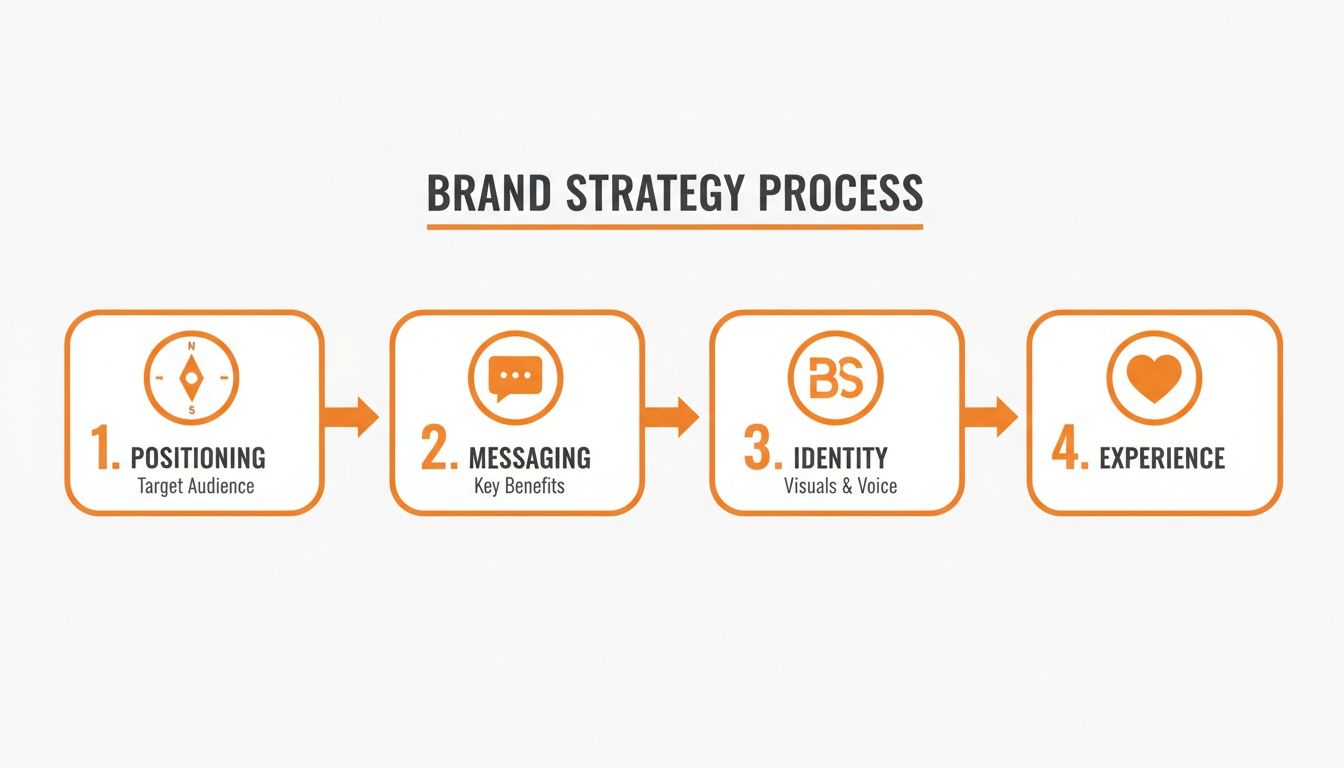
As you can see, a powerful brand experience is the end result of sharp positioning, clear messaging, and a consistent visual identity. It all works together.
To put it all in one place, here's a quick-reference guide to the essential pillars of brand strategy, outlining what each component means and why it's so critical for your startup's success.
Core Components of a Startup Brand Strategy
Component | What It Is | Why It Matters for Startups |
|---|---|---|
Positioning | Your unique place in the market and how you differ from competitors. | Helps you stand out in a crowded market and attract your ideal customers. |
Messaging | The core language, story, and voice you use to communicate your value. | Creates a consistent narrative that builds trust and emotional connection. |
Identity | The visual and sensory elements of your brand (logo, colors, typography). | Makes your brand instantly recognizable and memorable across all channels. |
Experience | The complete customer journey and every interaction they have with you. | Turns one-time users into loyal advocates and drives long-term growth. |
Getting these four components right is the foundation for everything that follows.
Why Brand Consistency Drives Startup Revenue
In a market flooded with options, consistency is what makes you memorable. Every time a customer interacts with your brand—whether it’s on your website, a social media post, or an ad—the experience should feel familiar. It should reinforce what you’re all about. This isn't just some "nice-to-have" detail; it directly impacts your bottom line.
In fact, brand consistency has become a serious revenue driver. Recent data shows that 68% of companies report brand consistency directly contributes 10–20% to their revenue growth. For startups in hyper-competitive markets, that number tells you everything you need to know. You can find more insights on this in M&R Group's analysis of marketing strategy priorities. Investing in a cohesive brand strategy isn't a luxury—it's essential for survival.
A brand is no longer what we tell the consumer it is—it is what consumers tell each other it is. Your strategy must be built to influence that conversation.
Ultimately, a well-defined brand strategy acts as the blueprint for every decision you make. It ensures that your entire team is building the same story, one consistent interaction at a time. This guide will walk you through the practical, step-by-step playbook to make that happen.
Finding Your Place in a Crowded Market
Let's be honest: in a saturated market, your startup doesn’t just need a voice; it needs a megaphone. Having a great product isn’t enough when countless competitors are all shouting for the same customer's attention. To cut through the noise, you have to carve out a unique, defensible space that is undeniably yours.
A killer brand strategy for startups starts with knowing exactly where you fit. This isn't just about features or pricing—it's about owning a specific idea in your customer’s mind. Think of it like real estate: you’re scouting for an unclaimed plot of land where you can build your fortress.
Conduct Competitor Analysis That Actually Yields Insights
Too many startups treat competitor analysis like a box-checking exercise. They fill spreadsheets with features, pricing tiers, and social media follower counts. While that data has its place, it’s just scratching the surface. Real insight comes from digging deeper to understand their brand strategy.
Instead of just cataloging what your competitors do, you need to ask why they do it.
Messaging and Tone: What story are they telling? Is their brand voice authoritative and buttoned-up, or is it playful and irreverent? Notion, for example, built its entire brand on a voice of empowerment and productivity, speaking directly to users who want to organize their lives in one place.
Target Audience: Who are they really talking to? Go look at their case studies, testimonials, and the language they use. Are they targeting enterprise clients in Los Angeles, or are they after freelance creatives from Santa Monica to Pasadena? Be specific.
Market Gaps: Where are they dropping the ball? Read their negative reviews and comb through their social media comments. Customer complaints are a goldmine of opportunities they’ve missed.
This kind of deep-dive analysis reveals the emotional and psychological territory your competitors occupy. More importantly, it shows you where the open spaces are. Your goal isn't to be a little bit better at what they do, but to be the only one who does what you do.
Build Customer Personas That Feel Real
Generic customer personas are a complete waste of time. "Marketing Mary, age 30-40" doesn't help you connect with anyone. Your personas need to feel like real people with genuine problems, motivations, and frustrations. A well-crafted persona becomes a north star for every decision you make, from product development to the copy on your homepage.
Here’s how to build personas with actual depth:
Do Real Interviews: Talk to your ideal customers. And no, don’t just send out a survey. Get on a call and listen to the exact words they use to describe their problems.
Identify Pain Points and Goals: What keeps them up at night? What are they trying to achieve that your product can help with? A startup in the San Gabriel Valley serving local businesses might discover their clients’ biggest pain isn't a lack of marketing, but a crushing lack of time.
Map Their Journey: How do they find solutions now? What are their current messy workarounds? Understanding their existing behavior is the key to positioning your brand as a vastly better alternative.
The best personas aren't demographic summaries; they are psychological profiles. They capture the 'why' behind a customer's actions, giving you the empathy needed to build a brand that truly resonates.
Craft Your Unique Value Proposition
Once you have a handle on the market and your customer, it's time to answer the most important question of all: "Why should they choose you?"
Your unique value proposition (UVP) is the clear, concise answer. It's not a fluffy slogan; it's a promise. A great UVP is the very core of your brand strategy.
A strong UVP absolutely must be:
Specific: Clearly state the benefit. "We save businesses money" is weak and forgettable. "We cut inventory management costs for Southern California retailers by 30%" is strong.
Unique: Highlight what only you can offer. Allbirds didn't just sell shoes; they sold the world's most comfortable shoes made from sustainable materials. That was their hook.
Desirable: It must solve a real, urgent problem for your target customer. Nobody pays for "nice-to-haves" when they have burning problems.
To truly find your unique position and differentiate from competitors, mastering the process of achieving product-market fit is non-negotiable. Your UVP is a direct reflection of having found that perfect alignment between your solution and a genuine market need.
Translate Your Strategy Into Core Messaging
Okay, your UVP is the strategic foundation. Now you have to bring it to life with messaging that actually connects with people. This framework translates your brand's core idea into the words you'll use day in and day out.
Mission Statement (The Why): This is your purpose. It’s why you exist beyond just making money. It should be aspirational and guide your company's bigger decisions.
Vision Statement (The Where): This is the future you're trying to create. It paints a picture of the world with your solution fully realized and making a difference.
Brand Voice (The How): This is your brand's personality. Are you the witty expert, the friendly guide, or the trusted professional? Your voice has to be consistent everywhere, from your website to your social media replies.
Tagline (The What): This is your memorable, bite-sized summary. It should be catchy and immediately communicate your core benefit. Think of Nike's "Just Do It" or Apple's "Think Different."
By nailing down these elements, you create a messaging playbook that ensures everyone in your startup is telling the same powerful story. That's how you build a brand that stands for something clear and compelling.
Designing Your Brand's Look and Feel

This is the fun part. It’s where all the abstract strategy work becomes something real—something your customers can see, touch, and remember. Your visual identity is much more than just a logo. It's the entire sensory experience that instantly tells people who you are.
Think of it as a visual shortcut to the promise you’re making. When done right, your look and feel should trigger the exact emotion you want people to associate with your startup. Every font, color, and design element works together to tell your story before a single word is read.
Choosing a Logo That Tells a Story
Your logo is the most concentrated version of your brand. It’s not just a cool icon; it's a symbol of your mission. The best logos are simple, memorable, and instantly recognizable. Just think of the Nike swoosh or the Apple logo—they’re powerful because they’re clean and packed with meaning.
For a startup, your logo needs to hint at your unique value. Building a fintech app focused on efficiency? A sharp, minimalist design probably makes sense. Launching a DTC brand for a younger crowd in a vibrant spot like West Hollywood or Venice? Bolder colors and a more playful font might be the perfect fit.
Before you get too deep into design, it’s critical to make sure your chosen name is unique and legally available. In Canada, for instance, this often involves getting a NUANS report. Nailing this down early secures your brand's foundation before you invest time and money into visual assets.
Selecting Colors and Fonts with Purpose
Never underestimate the power of colors and typography. They’re psychological tools that set the mood and shape perceptions long before anyone reads your messaging. A little color psychology goes a long way.
Blue: Almost universally signals trust, security, and professionalism. It’s a safe, solid choice for tech and finance startups.
Red: Evokes passion, energy, and a sense of urgency. Great for brands trying to make a bold, unmissable statement.
Green: Communicates growth, nature, and health. A natural fit for wellness or eco-friendly companies.
Yellow: Radiates optimism, warmth, and creativity. Super effective for brands that want to come across as friendly and approachable.
Your font choice says just as much. Serif fonts (like Times New Roman) can feel traditional and dependable, while sans-serif fonts (like Helvetica) look modern and clean. Whatever you choose, it needs to align with your brand’s voice.
Creating a Simple Brand Style Guide
If there’s one rule in branding, it’s consistency. A simple brand style guide isn’t optional; it’s a must-have. This document is your brand's rulebook, ensuring it looks the same everywhere—from your website and social media to your sales decks and email signatures.
Your style guide is the ultimate protector of your brand's integrity. It ensures every team member, freelancer, and partner represents your startup the same way, which is absolutely essential for building recognition and trust.
At a bare minimum, your style guide should cover:
Logo Usage: Clear do's and don'ts for your logo, including minimum sizes, clear space, and variations.
Color Palette: Your primary and secondary brand colors with their specific hex codes.
Typography: The exact fonts to use for headlines, subheadings, and body copy.
The Brand Experience Beyond Visuals
A brand's look and feel don't stop at design. The true brand experience is shaped by every single interaction a customer has with your startup. We're talking about your website's user experience (UX), the tone of your customer support emails, and even the way you package your products.
Each touchpoint is another chance to reinforce your brand and build a real connection. This is especially true for startups. Data shows that 81% of consumers say they need to trust a brand before buying from it. In a crowded market, building that trust isn't just nice to have—it's foundational.
Agencies that get startups, like DLL Studios at (650) 260-4067, specialize in building the brand foundations and digital presence that help new companies earn that trust quickly.
Ultimately, a cohesive and thoughtful brand experience is what turns casual buyers into loyal advocates. If you want to get deeper into the mechanics of this, it's worth checking out how to master the 6 steps of the design process for your Los Angeles business.
Launching Your Brand into the World

All the strategic planning in the world means nothing if your brand doesn't stick the landing. A brilliant brand strategy for startups is only as good as its launch plan. This is the moment your brand steps out from behind the curtain and into the real world, connecting all those abstract ideas to actual market execution.
A killer launch isn't a single, explosive event. It's a carefully orchestrated sequence of moves designed to build anticipation, grab attention, and create momentum that lasts. Forget the "build it and they will come" fantasy; you need a practical game plan to introduce your startup to the right people, in the right places, and at the right time.
Choosing Your Battlefield Wisely
Your ideal customers are already out there, spending their time on specific channels and platforms. The very first move in your go-to-market plan is to pinpoint exactly where those places are. Don't blow your limited budget trying to be everywhere at once. A focused, channel-specific strategy will always crush a scattered approach.
Start by asking some critical questions:
Where do our target personas actually get their news and information? Is it industry blogs, LinkedIn groups, or niche podcasts?
Which social media platforms do they use for professional reasons versus just mindlessly scrolling?
Are there key industry events, online communities, or newsletters that have their undivided attention?
The goal is to meet your audience where they already live, not force them to come find you. This targeted approach ensures your message actually lands instead of getting lost in the noise. For a comprehensive guide to planning your market entry, our detailed website launch checklist for a flawless launch will make sure you don't miss a single step.
Mapping Out a Phased Launch
A smart brand launch unfolds in stages, each with a clear objective. This phased approach helps you manage resources, build excitement, and gather crucial feedback along the way. Think of it as a three-act play for your brand's big debut.
Act 1: The Pre-Launch Buzz
This is all about stoking anticipation before you officially open your doors. The goal here is to warm up your audience so they're ready and waiting on launch day.
Content Teasers: Share behind-the-scenes glimpses, expert insights, and sneak peeks of your product.
Waitlist & Early Access: Build an email list by offering exclusive early access or a special launch-day discount. It’s a classic for a reason.
Founder-Led PR: Start telling your story. Get in touch with journalists, podcast hosts, and influencers in your niche to lock in some early coverage.
Act 2: The Official Debut
This is your big day. All your channels should light up in a coordinated push to announce that you are officially live. This phase is about making a big splash and driving that first wave of sign-ups or sales.
Act 3: Post-Launch Engagement
The work doesn’t stop on launch day. In fact, it’s just getting started. The first 30-90 days are critical for keeping the momentum going, gathering feedback, and turning those first users into true fans. Get in there, engage with your new community, celebrate early wins publicly, and use customer feedback to show you're listening and getting better every day.
Your launch isn't the finish line; it's the starting gun. The activities you prioritize in the weeks following your debut will set the trajectory for long-term growth and community building.
To keep everything on track, a simple checklist can be a lifesaver. Here’s a basic framework to get you started.
Startup Brand Launch Checklist
This simple table helps you organize your go-to-market activities across the different phases of your launch. It’s all about connecting what you’re doing to why you’re doing it.
Launch Phase | Key Activities | Success Metric |
|---|---|---|
Pre-Launch | Build a waitlist, share teaser content on social media, secure 2-3 media mentions or podcast interviews. | 500+ email sign-ups before launch day. |
Launch Day | Announce on all channels, launch on Product Hunt, send launch email to your list, run targeted ads. | 100+ new users/customers in the first 24 hours. |
Post-Launch (Day 2-30) | Collect user feedback, share early customer stories, host a founder AMA, engage heavily in communities. | 15% week-over-week user growth. |
This isn't just about ticking boxes; it's about making sure every action contributes to a clear, measurable outcome.
The Power of Localized Brand Activation
For many startups, trying to "go national" from day one is a recipe for burning cash. A much smarter strategy is to dominate a specific geographic area first. This hyper-local approach lets you build a concentrated, passionate user base that can serve as a powerful launchpad for future expansion.
Los Angeles is at the center of our service area, and we proudly support clients across a wide network of surrounding cities and neighborhoods throughout Southern California. Our reach includes every corner of L.A.—from Downtown Los Angeles, Hollywood, West Hollywood, Beverly Hills, and Santa Monica to the beach communities of Malibu, Venice, Marina del Rey, Hermosa Beach, Manhattan Beach, and Redondo Beach. We also extend service through the San Fernando Valley, including Sherman Oaks, Studio City, Encino, Van Nuys, North Hollywood, Burbank, Glendale, Pasadena, Woodland Hills, Chatsworth, Canoga Park, Reseda, Northridge, and Tarzana. In the San Gabriel Valley, we work with clients in Alhambra, Monterey Park, San Gabriel, Temple City, Rosemead, Arcadia, El Monte, South El Monte, West Covina, Covina, Baldwin Park, Azusa, Glendora, Duarte, and Monrovia. Farther southeast, we serve Whittier, Pico Rivera, Downey, Norwalk, La Mirada, La Habra, and Cerritos. We also support the South Bay—including Torrance, Carson, Gardena, Hawthorne, Inglewood, and Long Beach—as well as the Gateway Cities and communities throughout the I-10, I-5, 101, and 405 corridors. Whether you’re in a major metro area or a smaller surrounding neighborhood, our team delivers reliable, high-quality service anywhere in or around Los Angeles.
Measuring What Works and Adapting for Growth
Think your brand strategy is finished once it’s written down? Think again. That document isn’t meant to be framed and hung on the wall. It’s a living, breathing part of your business, and it needs constant attention to stay effective. The launch is just the starting line—real success comes from digging into what’s actually working, figuring out what isn't, and being nimble enough to change course.
A solid brand strategy for startups is guided by data, not carved in stone. The point isn’t to drown in spreadsheets, but to pinpoint the handful of key metrics that tell you if your brand is actually connecting with people and, more importantly, driving your business forward.
Identifying Your Core Brand Metrics
Tracking brand performance can feel like trying to boil the ocean. The trick is to focus on three core areas. You'll find these metrics hiding in plain sight within the tools you’re probably already using, like Google Analytics, your CRM, and social media dashboards.
You don't need a pricey, complex analytics suite to start. You just need to know where to look.
Awareness Metrics: This is all about reach. Are people even finding you? Keep an eye on direct traffic to your site (people who type in your URL), spikes in branded search volume (how many people are Googling your company name), and social media mentions.
Perception Metrics: So they know who you are, but what do they think of you? This is where you monitor customer reviews on sites like G2 or Yelp, track the sentiment of social media chatter, and use simple net promoter score (NPS) surveys to see how happy people are.
Loyalty Metrics: This is the ultimate test—are you building a real, sustainable business? Dig into your customer lifetime value (CLV), repeat purchase rate, and churn rate. These numbers tell you if you've earned genuine trust.
From Data to Decisions
Collecting numbers is the easy part. The real magic happens when you turn that data into smart decisions. Your metrics should be sparking questions, not just filling up a dashboard. For instance, did you see a huge jump in direct traffic right after sponsoring a local tech meetup in Beverly Hills? That's a pretty strong clue your hyper-local strategy is hitting the mark.
On the flip side, if your customer reviews consistently complain about a confusing onboarding process, you've just found a crack in your brand experience that needs to be fixed, fast. That feedback loop is everything.
A brand isn't what you say it is. It's what your customers experience and then tell others. Your measurement strategy is simply the process of systematically listening to those conversations.
Let’s get specific. Imagine you're a startup serving clients all over Southern California—from Downtown Los Angeles and Hollywood to the coastal spots like Malibu and Manhattan Beach. You can use geo-targeted analytics to see where your brand is actually making waves. Are you getting more love from the San Fernando Valley crowd in Sherman Oaks and Burbank, or is your message resonating more in San Gabriel Valley cities like Pasadena and Alhambra?
This kind of localized data lets you fine-tune your messaging and marketing spend for maximum impact, whether you're targeting businesses along the I-5 corridor or folks in South Bay neighborhoods like Torrance and Long Beach. The ability to measure and adapt at this granular level is a massive competitive advantage and essential for improving your online presence. If you're ready to go deeper, you can learn more about website conversion rate optimization in our detailed guide.
Creating a Culture of Brand Adaptation
Finally, measuring your brand can't just be a marketing thing. The insights you uncover need to be shared across the entire company, from the product team right through to customer support. When everyone understands how the brand is being perceived out in the wild, they all become brand champions.
Make it a habit. Schedule quarterly brand reviews to go over the data.
What Worked? Pop the champagne for the wins. Pinpoint the campaigns or messages that really connected.
What Didn’t? Get brutally honest about what fell flat. This isn’t about blame; it's a learning opportunity.
What’s Next? Use what you’ve learned to sharpen your strategy for the next 90 days.
This constant cycle of measuring, learning, and adapting is what keeps a startup’s brand from going stale. It’s how you make sure your brand doesn’t just launch strong but actually grows stronger over time.
Answering Your Top Startup Branding Questions
Even with the best playbook, building a brand from scratch is going to bring up some tough, practical questions. Founders are always walking that tightrope between investing in the future and managing a shoestring budget today. Let's tackle some of the most common questions I hear from startups trying to get their brand strategy right.
These are the straight-up, honest answers you need for the real-world challenges of building a brand that actually lasts.
How Much Should a Startup Budget for Brand Strategy?
This is the million-dollar question, isn't it? The truth is, there’s no magic number. A better way to frame it is as an investment in your company’s foundation, not just another line item under marketing costs. For a startup, a solid brand strategy is a core business asset.
If you’re in the very early stages, a meaningful slice of your seed funding should be earmarked for foundational branding. At a bare minimum, this covers a professional logo, a well-designed website that works flawlessly on any device, and a basic style guide. These things are non-negotiable—they're your digital storefront and your first impression.
You might be tempted to DIY some of it, but trust me, skimping on your visual identity and website is a mistake you’ll pay for later. Investing in an expert here pays for itself almost immediately in credibility and customer trust. As you grow, bringing in an agency can give you a more comprehensive solution that scales with your ambitions.
When Is the Right Time to Hire a Branding Agency?
Ideally, you bring in an agency before you launch or right as you're gearing up for a major growth spurt, like a Series A round. Getting that professional foundation in place early makes a powerful first impression on both your first customers and potential investors. It sends a clear signal: you're serious about building a real company.
But let's be realistic—many startups are already out in the wild when they realize something’s not clicking. If you’re seeing any of these symptoms, it’s a flashing red light that you need to call in an expert:
Inconsistent messaging across your website, social media, and sales decks.
A dated or unprofessional look that just doesn't match the quality of your product anymore.
Struggling to stand out in a sea of competitors who all sound the same.
Low brand recognition, even after months of hustling and marketing spend.
An agency can help you get to the root of the problem, fix what's broken, and sharpen your brand for maximum impact.
A brand must evolve with the company. Your core mission and values might stay the same, but your messaging and visuals will likely need to shift as your product matures and you learn more about your market.
Can My Startup's Brand Change Over Time?
Absolutely. In fact, it should. A static brand is a stale brand. Your company is going to evolve, and your brand has to evolve right along with it. While your core mission and values might be your north star, your messaging, visual identity, and even your target audience will likely need a tune-up as your product matures and you get more feedback from the market.
This evolution usually happens in one of two ways. A brand refresh is a smaller update, like tweaking your logo or modernizing your color palette. A full rebrand is a major overhaul, often signaling a fundamental shift in your business strategy.
The key is to make these changes for the right reasons—driven by customer feedback and performance data, not just because you're bored with the old look. If you keep a regular pulse on your brand's health, you'll know exactly when it's time to adapt, making sure it stays relevant and powerful as you scale.
Ready to build a brand that drives growth? The team at DLL Studios specializes in crafting a powerful brand strategy for startups, from visual identity to go-to-market execution. Let's build a brand that matters.
