


.png)
Master how to write product descriptions to boost sales
Before you can write a single word that sells, you need a strategy. It's tempting to jump right in and start listing features, but the product descriptions that actually convert are built on a solid foundation of customer insight.
This isn't just about writing; it's about creating a repeatable process that connects with your ideal customer every single time. It's about seeing the product through their eyes, knowing their questions before they ask, and speaking directly to what they truly need.
First, Get to Know Your Ideal Customer (Really Well)
You can't sell anything if you don't know who you're talking to. That’s where buyer personas come in. These are detailed, semi-fictional profiles of your ideal customers, and they’re the most critical first step. You don't have to guess, either—you're probably sitting on a goldmine of data right now.
Comb through your customer reviews, support emails, and social media comments. What words do they use? What problems keep popping up? For a local Los Angeles boutique, a persona might be "Santa Monica Sarah," a 30-year-old professional who needs versatile, sustainably-made outfits that can take her from the office to a weekend brunch.
Once you have that crystal-clear picture, writing a message that resonates becomes so much easier.
Translate Features into "What's In It For Me?" Benefits
This is the part where most product descriptions fall flat. Here’s the secret: nobody buys features. They buy solutions to their problems. They buy a better version of themselves. Your job is to connect what your product is with what it does for them.
A feature is a fact about your product, like "made from 100% merino wool." A benefit is the emotional or practical payoff for the customer, like "stay warm without the bulky layers, because this naturally breathable wool keeps you comfortable all day."
You're answering the silent question every shopper has: "So what? Why should I care?"
To get started, try this simple exercise:
List every feature: Get technical. Write down all the specs.
Ask "So what?": For each feature, keep asking "so what?" until you land on a genuine human benefit.
Focus on the transformation: How does this product make their day easier, solve a nagging frustration, or help them feel a certain way?
Here’s a quick look at how to transform dry specs into compelling benefits your customers will actually care about.
Translating Features into Customer-Focused Benefits
Product Feature (What It Is) | Customer Benefit (What It Does For Them) |
|---|---|
Waterproof GORE-TEX fabric | Stay dry and comfortable on your hike, no matter what the weather throws at you. |
Noise-canceling technology | Finally focus on your work without distractions, even in a busy coffee shop. |
Made with organic, fair-trade coffee beans | Enjoy a rich, delicious cup of coffee you can feel good about drinking. |
24-hour battery life | Go all day without scrambling for a charger. |
Spill-proof lid | Toss it in your bag with confidence—no more surprise coffee stains on your laptop. |
See the difference? One is a technical detail; the other is a solution to a real-life problem.
Find Your Brand Voice and Stick to It
Your brand voice is your business's personality. Are you witty and playful like a quirky gift shop in Silver Lake? Or are you authoritative and polished, like a B2B firm in Downtown LA?
A consistent voice builds trust and recognition. It should weave through every part of your product description, from the headline down to the final call-to-action. If you're not sure what your voice is, listen to how your best customers talk. Their language is your guide.
AI tools have certainly made content creation faster, but genuine connection is what closes the sale. While forecasts show 94% of marketers will use AI for content creation by 2026, the brands that win will be the ones that master human-centric storytelling. Personalizing your copy for those buyer personas you created can lift sales by 20% on average because it proves you're listening. You can learn more about how these marketing statistics shape strategy. Getting this foundation right is what separates descriptions that just inform from descriptions that truly persuade.
A Practical Process for Writing Compelling Copy
Okay, you’ve done the foundational work. Now it’s time to move from strategy to the actual creative part: writing. This isn't about waiting for a lightning bolt of inspiration. It's about applying proven techniques that take you from a blank page to compelling copy that actually converts. Following a system ensures every word you write has a purpose.
Your product's success can literally hinge on the first few words a customer reads. A strong headline is so much more than a label; it’s a hook designed to stop a scrolling thumb dead in its tracks. It needs to be benefit-driven, crystal clear, and weave in your primary keyword without sounding clunky.
Forget trying to be clever. Focus on clarity. If a Pasadena restaurant is advertising a new dish, a headline like "Spicy Tuna Crispy Rice" is functional. But "Your New Favorite Weeknight Indulgence: Spicy Tuna Crispy Rice" connects with what the customer actually wants.
Grab Attention with an Unforgettable Opening
Once the headline gets their attention, the opening line has to hold it. This is your shot to nail the product's core value and create an emotional spark. People don't buy products; they buy better versions of themselves. Your opening should paint a quick picture of that transformation.
Start by figuring out "the one thing" your product does better than anyone else. What's the single most important problem it solves or dream it helps achieve? Lead with that.
For instance, instead of opening with "This calendar has beautiful illustrations," try something like, "Finally get your family’s chaotic schedule organized in one beautiful place." The first is just a feature; the second is a real solution.
This visual really breaks down the essential building blocks for crafting descriptions that connect.
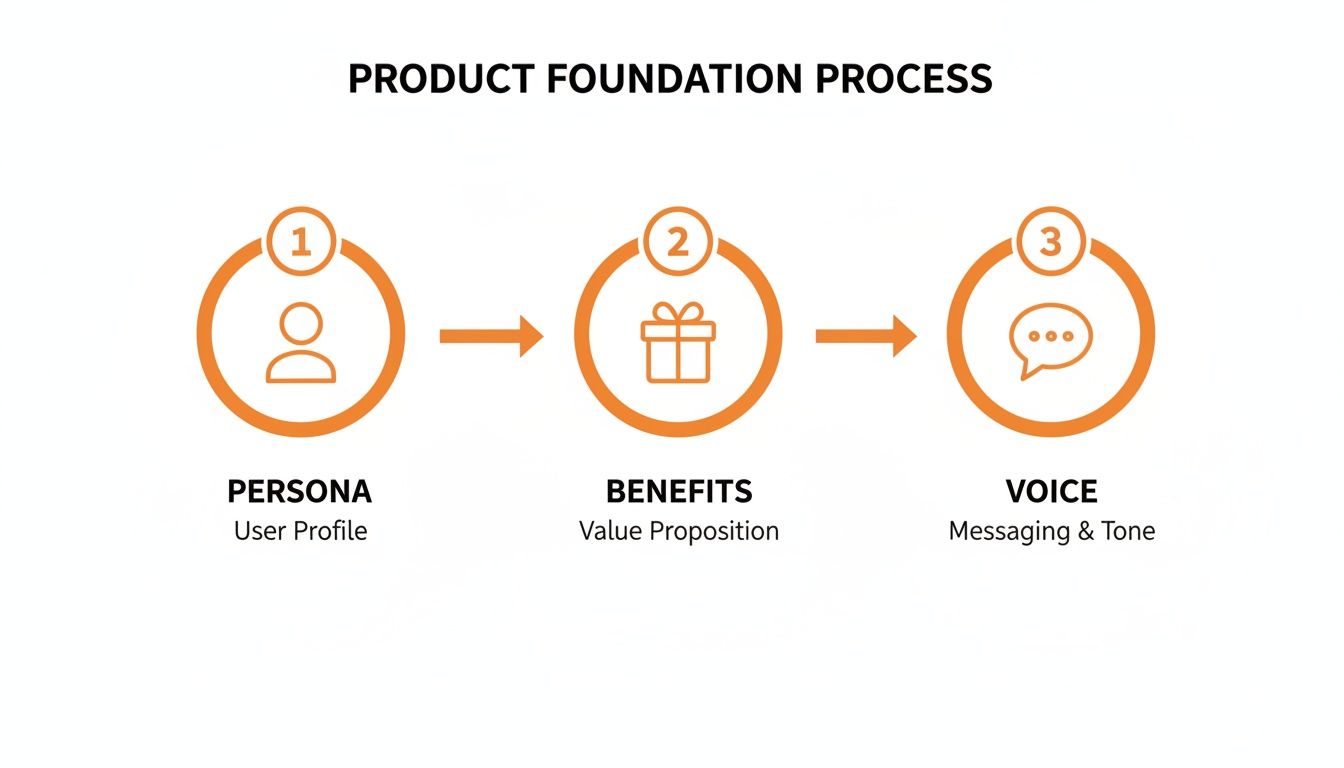
This flow really drives home the point that effective copy starts way before you type a single word. It begins with truly understanding your customer, defining the benefits, and locking in your brand voice.
Structure Your Copy for Easy Scanning
Let's be honest: people online don't read every word. They scan. A massive wall of text is an instant turn-off that sends potential buyers clicking away. To keep them on the page, you have to structure your descriptions for maximum readability.
Use short, punchy paragraphs—two to three sentences, max. Break up different ideas with descriptive subheadings, and use bullet points to call out key features and benefits. This creates visual breathing room and lets shoppers find the exact information they need in seconds.
Here are a few formatting tips to guide the reader’s eye:
Use bold text strategically to make the most important benefits pop.
Incorporate bullet points so technical specs are easy to digest.
Tell a quick mini-story that shows how the product fits into the customer’s life.
Remember, the goal is to make the buying decision feel easy and natural. A well-formatted description removes friction and builds confidence by presenting information clearly and concisely.
This structured approach is absolutely critical as online shopping continues to explode. Back in 2019, eCommerce sales hit $3.5 trillion worldwide. That figure is projected to rocket past $7 trillion by 2026, making killer product descriptions a non-negotiable for any business.
With 96% of shoppers bouncing from product pages without buying, your copy has to work harder than ever. We've seen that pages with benefit-focused descriptions can see conversion rates jump by up to 30% because customers can clearly visualize how the product solves their problems.
Lean on Proven Copywriting Formulas
You don't have to reinvent the wheel every time you sit down to write. Copywriting formulas give you a reliable framework for structuring your ideas in a persuasive way. To really get good at this, it's worth digging into the different powerful copywriting methods out there.
One of the most effective and straightforward formulas is the Problem-Agitate-Solve (PAS) model. It's simple but incredibly effective.
Problem: Start by calling out a pain point your target customer deals with.
Agitate: Dive a little deeper into that problem, reminding them how frustrating it is.
Solve: Introduce your product as the perfect solution that makes it all go away.
Imagine a company selling noise-canceling headphones in a busy area like Burbank. Here’s how they could use PAS:
(P) Tired of distractions ruining your focus at the local coffee shop?
(A) The endless chatter, the hiss of the espresso machine, and the traffic outside make it impossible to get any real work done.
(S) Our headphones create your own private bubble of silence, so you can finally concentrate and be productive anywhere.
See how that works? This simple structure turns a boring list of features into a compelling story that connects on an emotional level and pushes people to act.
Optimizing Descriptions for Search Engine Visibility
Look, a powerful, persuasive description is useless if your customers can't find it. Writing great copy is one half of the equation; getting it in front of the right audience requires a smart approach to search engine optimization (SEO).
This is where you connect what your product does with the exact words people are typing into Google.
It all starts with solid keyword research. This isn't about guessing what people might search for. It's about using real data to find the primary phrases and longer, more specific long-tail keywords your ideal customers use. Put yourself in their shoes—what would they type to find a solution to their problem?
For a business based right here in Southern California, that means thinking locally. A client in Sherman Oaks isn't just looking for "a web designer." They're searching for "web design Sherman Oaks" or "best local SEO agency San Fernando Valley." Weaving these specific, location-based terms into your descriptions helps you show up for the customers in your own backyard.
Strategically Placing Your Keywords
Once you've got your list of keywords, you need to place them where they’ll have the most impact. The goal is to sprinkle them in naturally, so the copy is discoverable for search engines but doesn't sound robotic to actual human beings.
Focus on these key areas:
Product Title: This is the most important spot. Your primary keyword should absolutely be here.
Headings and Subheadings: Use keywords in your H2s and H3s to signal what the content is about.
Body Copy: Weave your primary and secondary keywords throughout the main description, especially within the first 100 words.
Image Alt Text: This is huge for both accessibility and SEO. Describe your images for visually impaired users and search engines, including a relevant keyword.
This strategic placement is how you tell search engines your product page is a top-tier result for a specific search. To really dig into boosting your site's visibility, check out our guide on how to increase organic traffic with a practical SEO guide.
The Critical Importance of Unique Content
One of the most common—and damaging—mistakes e-commerce businesses make is grabbing the generic manufacturer descriptions. It saves a few minutes, sure, but copying and pasting creates duplicate content issues that can absolutely tank your search rankings.
Google’s job is to find the best, most unique answer to a user's question. If your product page has the exact same text as dozens of other sites, the search engine has no idea which one to rank. Your visibility plummets.
Writing unique, original descriptions for every single product is non-negotiable for SEO success. It's your chance to inject your brand's voice, highlight specific benefits for your audience, and give search engines fresh content to index.
This is your opportunity to stand out. Take the manufacturer’s specs and translate them into the compelling, benefit-driven copy we talked about earlier, tailored specifically to your brand and your customers.
To make sure you're hitting all the right notes, we've put together a simple checklist. Run every product description through this before you hit publish.
Your Essential Product Description SEO Checklist
This checklist is your go-to resource for making sure every product description is fully optimized to climb the search rankings and attract the right customers.
Optimization Point | Best Practice | Why It Matters |
|---|---|---|
Primary Keyword | Place in the product title, first paragraph, and at least one subheading. | Signals high relevance to search engines for your most important search term. |
Secondary Keywords | Sprinkle naturally throughout the body copy and in image alt text. | Captures a wider range of related searches and user intent. |
Content Uniqueness | Write 100% original content; never copy from manufacturers. | Avoids duplicate content penalties and helps you stand out from competitors. |
Image Alt Text | Describe every image clearly and include a relevant keyword. | Improves accessibility and helps your images rank in Google Images. |
Internal Linking | Link to related products or relevant blog posts on your site. | Keeps users on your site longer and passes authority between pages. |
Readability | Use short sentences, bullet points, and clear headings. | Good user experience is a known ranking factor; it keeps people engaged. |
Think of this table as your final quality check. Following these steps consistently will build a strong SEO foundation that pays off in the long run.
Optimizing for the Future of Search
The way people find information is always changing. As search engines evolve, writing clear, factual, and well-structured product descriptions is becoming even more important for visibility. Think about how you can directly answer potential customer questions within your copy. If you want to get ahead of the curve, you should be learning how to rank in Google AI Overviews.
By focusing on high-quality, original, and keyword-rich descriptions, you build a powerful asset that works for you 24/7. It attracts qualified buyers from places like Santa Monica to Pasadena and convinces them you have the perfect solution. This foundational SEO work ensures that the compelling copy you've worked so hard on gets the audience it truly deserves.
Build Trust With Smart Formatting and Social Proof

You can write the most brilliant, persuasive copy in the world, but if you present it as a giant wall of text, nobody is going to read it. Great formatting isn't just about making things look pretty; it's a critical tool for building trust and guiding your customer toward a confident "yes."
When a product page is clean and easy to scan, it sends a powerful message. It tells the shopper you’re professional, you care about their experience, and you aren’t trying to hide anything in the fine print.
Design For Scanners, Not Readers
Let's be honest: people don't read online, they scan. They jump around the page, hunting for the specific information they need. Your job is to format your description to meet this behavior head-on, making your key selling points impossible to miss.
Start by ditching long paragraphs. Keep them to one or two sentences, max. This creates crucial white space that makes the entire page feel less intimidating and more approachable.
From there, use formatting to direct their eyes where you want them to go.
Bold Key Benefits: Don't just bold random words. Highlight the phrases that solve a customer's problem. For example, "Stays cold for 24 hours" grabs attention far better than bolding the product’s name.
Use Descriptive Subheadings: Break your description into logical chunks with clear H3 headings. This lets shoppers skip right to the sections they care about, like "Materials & Care" or "How It Makes Mornings Easier."
Embrace Bullet Points: Bullets are your best friend. They transform a dense sentence packed with features into a simple, digestible list that’s easy to absorb at a glance.
A clean, scannable layout does more than just improve readability. It subconsciously builds credibility by showing the customer you're presenting information clearly and honestly.
Harness the Undeniable Power of Social Proof
What you say about your product is important. But what other people say about it? That's pure gold. This is social proof in action—the simple idea that we trust the actions and opinions of our peers.
In e-commerce, this translates directly to trust and can be the final nudge someone needs to make a purchase. In fact, research shows that consumers trust peer reviews 12 times more than descriptions written by the brand itself.
Weaving social proof into your product descriptions is easier than you think.
Star Ratings: This is the quickest visual cue for quality. Make sure your average star rating is displayed prominently near the product title.
Customer Testimonials: Find a short, powerful quote from a five-star review and feature it directly in your description using a blockquote. Pick one that reinforces a key benefit you’ve already mentioned.
User-Generated Content (UGC): Nothing screams authenticity like photos of real customers using and loving your product. Showcase these to provide relatable proof that what you sell actually delivers.
Putting It All Together for Maximum Impact
Let’s imagine a small business in Glendora that sells handmade, hypoallergenic baby blankets. A great description would blend clean formatting with compelling social proof.
They could lead with a benefit-focused headline and use short, story-driven paragraphs about a baby finally getting a peaceful night's sleep. Then, they'd use a bulleted list to highlight the soft, breathable fabric and easy-wash instructions.
But here’s where the magic really happens. They could add this:
"I finally found a blanket that doesn't irritate my son's sensitive skin. It's so soft, and he's sleeping so much better!" - Jessica P., Pasadena, CA
With that one quote, the feature "hypoallergenic fabric" is transformed into a trustworthy solution validated by a real parent. This combination of scannable design and authentic feedback is how you turn casual browsers into loyal customers. Improving your page's credibility is one of the most effective ways to boost sales, which is why we've put together a guide with other actionable strategies for improving your website conversion rate.
As the online marketplace gets more crowded, building trust isn't optional. With projections showing that over 50% of marketers will use generative AI daily by 2026, descriptions must be scannable, SEO-rich, and packed with social proof to stand out. We already know 96% of visitors will leave a site if they can't find clear benefits, but adding bullet-point specs and real reviews can flip that script, leading to a 15-20% uplift in purchase intent. You can find more on how digital marketing statistics are shaping e-commerce.
Applying Advanced Tactics and Platform-Specific Tips

Once you’ve nailed the basics of persuasive writing and SEO, it’s time to layer in the advanced strategies that really move the needle. This is where you go beyond just writing good copy and start thinking about how to use technology, platform-specific quirks, and constant improvement to get a leg up on the competition.
These tactics are what turn your product descriptions from static text into dynamic, hard-working assets that adapt to your audience and wherever they happen to be shopping.
Using AI as an Assistant, Not a Replacement
Let's be real—AI tools like ChatGPT are a godsend for beating writer's block. They can spit out feature lists, brainstorm different angles, and give you a solid first draft in seconds. Think of AI as your super-fast creative assistant, not the final author.
But whatever you do, don't just copy and paste the output. AI-generated text almost always lacks the personality, emotional depth, and little quirks that create a genuine connection with a customer. Your human insight is what transforms a generic, robotic draft into something that actually sells.
Let AI do the grunt work, then you swoop in to:
Inject your brand’s voice: Add the tone and personality that your customers know and love.
Sharpen the emotional hook: Make sure that opening line really grabs their attention.
Fact-check every detail: Double-check that all specs and claims are 100% accurate.
Your unique human touch is your greatest advantage. Use it to polish what the AI gives you until it sounds exactly like your brand.
Tailoring Descriptions for Different Platforms
Where you sell your products is a huge deal. A one-size-fits-all product description is a recipe for mediocrity because every platform has its own audience, formatting rules, and expectations. To write truly effective descriptions, you have to adapt.
Imagine a local boutique in Beverly Hills selling on their website, Instagram, and a local marketplace. What works on their beautifully detailed WordPress site will feel completely out of place in a fast-scrolling Instagram feed.
A critical mistake I see all the time is businesses copying and pasting the exact same description everywhere. Not only can search engines flag this as duplicate content, but more importantly, you’re missing a golden opportunity to connect with customers in the specific way they expect on each platform.
Here’s how you should be thinking about it:
Your Own Website (WordPress, Webflow): This is your turf—you have total control. Go all out with detailed descriptions, high-res images, videos, and customer testimonials. This is where you tell the full story.
Instagram Shops: It’s all visual and mobile-first. Lead with a killer photo, keep the text short and punchy, use bullet points for scannability, and throw in relevant hashtags.
Amazon or Etsy: These are competitive marketplaces. Your description needs to be keyword-rich, super scannable, and answer common questions immediately. You’re fighting for attention right next to other sellers on the same page.
Customizing your copy shows you understand the context of where your customers are, which builds trust and just makes for a better experience.
The Power of Continuous Testing and Optimization
Writing a product description isn't a "set it and forget it" task. The only way to know what really works is to test, measure, and refine your copy over time. This is called A/B testing, and it's as simple as creating two versions of a description and showing them to different people to see which one performs better.
You don't need fancy, expensive tools to get started. Even small experiments can reveal some powerful truths about your audience.
For example, a service-based business in Pasadena could test two headlines for a new offering:
Version A (Feature-Focused): "Our New Premium Website Design Package"
Version B (Benefit-Focused): "Get a Website That Attracts More Local Customers"
By tracking clicks and form submissions, they’ll quickly learn which message actually resonates. You can test almost anything—your call-to-action (CTA), the opening sentence, the bullet points, even the layout. Constant optimization ensures your product pages are always working as hard as you do.
Designing for Accessibility
Finally, an advanced tactic that’s becoming non-negotiable is designing for accessibility. This means making sure that everyone, including people with disabilities, can easily read and understand your content. Following ADA (Americans with Disabilities Act) guidelines isn’t just about legal compliance; it’s about providing great customer service to all potential customers.
For local businesses and service providers from Long Beach to Glendale, this is a fantastic way to build an inclusive brand that stands for something.
Here are a few simple ways to improve accessibility:
Write descriptive alt text for every image. This allows screen readers to explain the visual to users with visual impairments.
Use clear, straightforward language. Ditch the jargon and overly complex sentences that can trip people up.
Ensure high color contrast. Your text should be easy to read against its background. Period.
Making your descriptions accessible instantly widens your audience and sends a clear message that you value every single customer. For businesses that want a head start, an Accessory Shop Website Wix Studio Template can be a great foundation for building an e-commerce presence that is both effective and accessible from day one.
Frequently Asked Questions About Product Descriptions
Even with the best game plan, you're bound to hit a few specific questions once you're in the weeds of writing. Getting clear, no-nonsense answers is the key to refining your process and writing descriptions that you know will work.
Let's dive into some of the most common questions we hear from businesses, whether they're local shops in Redondo Beach or service providers across Pasadena.
How Long Should a Product Description Be?
There’s no magic word count that works for everything. The right length really boils down to how complex and expensive your product is.
For a simple, low-cost item, a punchy 50-100 words might be all you need to seal the deal. But for something more complex or with a higher price tag, you might need 300-500 words to answer every question and build enough trust for someone to click "buy."
Your goal isn't to hit a specific number. It's to say everything that needs to be said in as few words as possible. Always choose clarity over length, and lean on scannable formats like bullet points to make the important stuff easy to find.
Should I Use AI to Write Product Descriptions?
AI can be a fantastic starting point. I often recommend using it to break through writer's block, brainstorm a few different angles, or even generate a rough first draft. It's a great way to get a quick outline of features and benefits without staring at a blank page.
But you should never just copy and paste what it gives you. That human touch is non-negotiable. It's what you need to inject your brand's unique voice, double-check every detail for accuracy, and weave in the kind of persuasive storytelling that actually connects with a reader.
Think of AI as your very capable assistant, not your replacement.
How Often Should I Update My Product Descriptions?
Your product descriptions aren't a "set it and forget it" part of your website. I always suggest reviewing your top-performing and lowest-performing descriptions at least once a year.
It's also crucial to jump in and make updates whenever:
The product’s features or materials change.
You get new customer reviews or testimonials you want to feature.
Your SEO strategy shifts and you want to target new keywords.
You spot a drop in performance—maybe you’re getting lots of traffic but not enough conversions.
Running small tests on different versions of your copy is one of the smartest ways to keep things fresh and effective.
What Are the Most Common Mistakes to Avoid?
Just sidestepping a few common slip-ups can make a massive difference in how well your product descriptions perform. So many businesses make these small mistakes without realizing how much they're hurting sales.
Here are the biggest blunders to look out for:
Listing features, not benefits. Don't just say what it is; explain how it makes the customer's life better.
Using generic manufacturer copy. This is a killer for both SEO and your brand identity. Make it sound like you.
Writing huge walls of text. Shoppers are skimmers. Dense paragraphs will make them click away in a heartbeat.
Forgetting a clear call-to-action (CTA). Tell people exactly what you want them to do next.
Using jargon. Avoid technical terms or internal lingo that your audience won't get.
If you can steer clear of these, you’ll already be miles ahead of most of your competitors.
Ready to create a website with product descriptions that attract, engage, and convert? The team at DLL Studios specializes in building high-performing, SEO-friendly websites that deliver measurable results for businesses across Southern California. Los Angeles is at the center of our service area, and we proudly support clients across a wide network of surrounding cities and neighborhoods throughout Southern California. Our reach includes every corner of L.A.—from Downtown Los Angeles, Hollywood, West Hollywood, Beverly Hills, and Santa Monica to the beach communities of Malibu, Venice, Marina del Rey, Hermosa Beach, Manhattan Beach, and Redondo Beach. We also extend service through the San Fernando Valley, including Sherman Oaks, Studio City, Encino, Van Nuys, North Hollywood, Burbank, Glendale, Pasadena, Woodland Hills, Chatsworth, Canoga Park, Reseda, Northridge, and Tarzana. In the San Gabriel Valley, we work with clients in Alhambra, Monterey Park, San Gabriel, Temple City, Rosemead, Arcadia, El Monte, South El Monte, West Covina, Covina, Baldwin Park, Azusa, Glendora, Duarte, and Monrovia. Farther southeast, we serve Whittier, Pico Rivera, Downey, Norwalk, La Mirada, La Habra, and Cerritos. We also support the South Bay—including Torrance, Carson, Gardena, Hawthorne, Inglewood, and Long Beach—as well as the Gateway Cities and communities throughout the I-10, I-5, 101, and 405 corridors. Whether you’re in a major metro area or a smaller surrounding neighborhood, our team delivers reliable, high-quality service anywhere in or around Los Angeles. Start your project today.
