


.png)
How to Increase Ecommerce Sales with Proven Growth Strategies
Trying to figure out how to increase ecommerce sales can feel like chasing a moving target. It’s not about finding one magic bullet. Instead, the secret lies in a cohesive strategy built on four key pillars: creating a killer user experience, nailing the technical side of your site, driving the right kind of traffic, and turning customers into loyal fans.
We’re about to break down how the most successful brands masterfully weave these elements together to create a growth machine that just keeps running.
Your Blueprint for Sustainable Ecommerce Growth
This isn't just another list of generic tips. This is a practical roadmap for boosting your revenue for the long haul. Too many online stores get stuck focusing on one thing—like dumping money into ads—while their website foundation is cracked. Real, sustainable growth happens when every part of your business works in sync to pull customers in and keep them coming back.
For a deeper dive into boosting your online revenue, check out these proven strategies to increase sales.
Los Angeles is at the center of our service area, and we proudly support clients across a wide network of surrounding cities and neighborhoods throughout Southern California. Our reach includes every corner of L.A.—from Downtown Los Angeles, Hollywood, West Hollywood, Beverly Hills, and Santa Monica to the beach communities of Malibu, Venice, Marina del Rey, Hermosa Beach, Manhattan Beach, and Redondo Beach. We also extend service through the San Fernando Valley, including Sherman Oaks, Studio City, Encino, Van Nuys, North Hollywood, Burbank, Glendale, Pasadena, Woodland Hills, Chatsworth, Canoga Park, Reseda, Northridge, and Tarzana.
This diagram lays out the four-pillar growth strategy, showing how user experience, technical performance, traffic, and loyalty all connect.
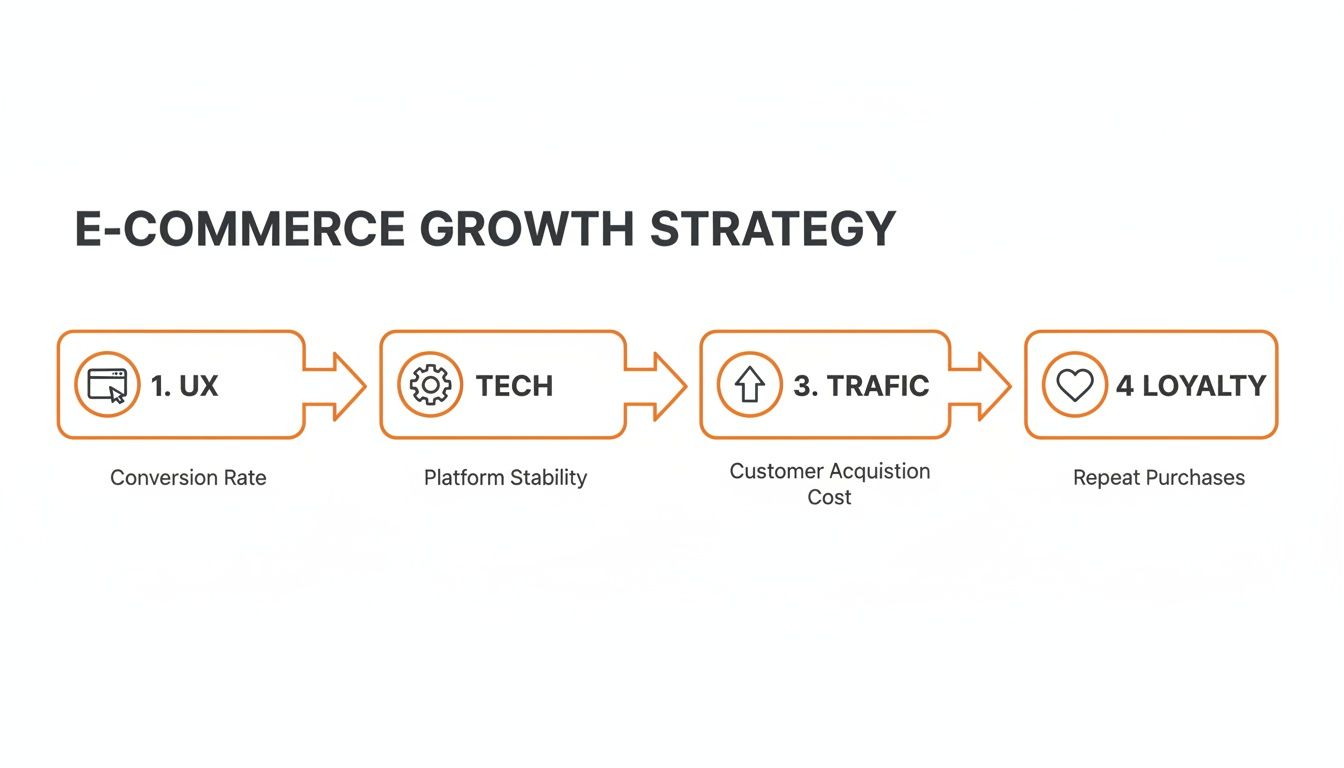
As you can see, lasting growth isn't about picking one area and ignoring the others. It's a balanced approach where each pillar supports the next, creating a powerful journey for every customer.
Building a Foundation for Success
Before you even think about scaling, you need a rock-solid foundation. This means perfecting every single touchpoint a customer has with your brand. Think of your website as your digital flagship store. If it’s slow, confusing, or feels sketchy, people are gone in a flash.
It's no joke—nearly 88% of online shoppers say they won't return to a site after a single bad experience.
The best ecommerce brands live and breathe this philosophy: customer experience isn't just a department, it's the entire company. Every detail, from how fast your pages load to the clarity of your product descriptions, directly impacts your bottom line.
A solid foundation also means you’re actually reaching the right people. Your digital strategy has to connect, whether your customers are in the San Gabriel Valley, where we work with clients in Alhambra, Monterey Park, San Gabriel, Temple City, Rosemead, Arcadia, El Monte, South El Monte, West Covina, Covina, Baldwin Park, Azusa, Glendora, Duarte, and Monrovia. Farther southeast, we serve Whittier, Pico Rivera, Downey, Norwalk, La Mirada, La Habra, and Cerritos. This is true for every pocket of Southern California, including the South Bay—including Torrance, Carson, Gardena, Hawthorne, Inglewood, and Long Beach—as well as the Gateway Cities and communities throughout the I-10, I-5, 101, and 405 corridors.
Turning Website Visitors Into Customers
Your website is your hardest-working salesperson, clocking in 24/7. But if it’s not set up to smoothly guide visitors from just browsing to actually buying, you're leaving a lot of money on the table. The real trick is turning a casual browser into a loyal customer, and that all comes down to creating a user journey that feels intuitive, trustworthy, and genuinely compelling.
Every single detail counts, from the moment someone lands on your site to that final click on the "Complete Purchase" button. Small, smart optimizations along this path can make a huge difference in your sales by cutting down on friction and building confidence. This is where you stop just listing products and start actively selling them.
Crafting Product Pages That Actually Convert
Your product pages are where the magic happens—or where it all falls apart. This is the last stop before a visitor decides to add something to their cart, so it has to be persuasive and crystal clear. Think of it as your digital sales pitch; it needs to answer every possible question and calm any hesitation.
High-quality visuals are completely non-negotiable. It’s not just a nice-to-have; industry data shows that 93% of customers see images as the single most important factor when they’re deciding whether to buy.
Use High-Resolution Imagery: Show off your products from every angle. Even better, include lifestyle shots that show the product in use. This helps people visualize it in their own lives, which is a powerful motivator.
Add Product Videos: A short video can explain features and benefits way better than a static image ever could. In fact, pages with videos can see 37% more add-to-cart conversions.
Write Persuasive Copy: Don't just list features; sell the benefits. How does your product solve a problem or make someone's life better? Use bullet points to make the key takeaways easy to scan.
Social proof is another must-have. When you display customer reviews and star ratings, you build trust almost instantly. An incredible nine out of ten customers say they read reviews before making a purchase, which just goes to show how much weight the opinions of others carry.
Streamlining the Path to Purchase
Once you’ve convinced a customer, the journey to checkout has to be dead simple. A confusing or clunky site navigation is a notorious sales killer. Your goal is to make it ridiculously easy for people to find what they want and move forward without getting frustrated.
A clean, intuitive site structure with logical categories and a powerful search bar is fundamental. If you're a local business serving a specific area like Los Angeles, you could even create category pages tailored to local needs—think beach gear for Santa Monica or specific tools for contractors in the San Gabriel Valley.
To really get this right, you have to stay focused on optimizing your site for conversions. Understanding how to improve ecommerce conversion rate with proven CRO tactics is what separates the brands that struggle from the ones that scale.
Optimizing the Checkout to Stop Abandoned Carts
The checkout process is the final hurdle, and it's where a shocking number of potential sales disappear. The global average cart abandonment rate hovers right around 70%. Every extra step you add, every unexpected fee you reveal, just increases the odds that your customer will walk away.
Your checkout flow should be designed with one thing in mind: speed and simplicity. Cut out every unnecessary field, question, and distraction. The less a customer has to think, the more likely they are to finish the purchase.
Here are a few proven ways to cut down on cart abandonment:
Offer Guest Checkout: Forcing people to create an account is a massive point of friction. Always, always give them a guest checkout option to speed things up.
Be Transparent with Costs: Show all the costs—shipping, taxes, and any other fees—right from the start. Surprise charges are the number one reason people abandon their carts.
Provide Multiple Payment Options: People expect choices. Make sure you offer a variety of payment methods, including digital wallets like Apple Pay and PayPal, in addition to standard credit cards.
By refining these on-site elements, from your product pages all the way to your final checkout screen, you build a powerful conversion machine. For more tactical advice, our guide on how to improve website conversion rate dives even deeper into these strategies. These small tweaks add up to create a much better shopping experience that directly boosts your bottom line.
Mastering Site Speed and the Mobile Shopping Experience
In ecommerce, every single second counts. A slow-loading website doesn’t just frustrate visitors; it actively drives them to your competitors. Your site's technical performance is the invisible foundation holding up every sale, and when it’s shaky, your entire business feels the tremors.
Let's get into the technical heart of your online store. We're focusing on two things that can truly make or break your revenue: site speed and the mobile shopping experience. Nailing these is a direct line to increasing your sales.
Why Site Speed Is a Sales Metric
Think of your site's speed as its first impression. A page that snaps to life feels professional and trustworthy. One that lags feels broken and sketchy, sending your bounce rate through the roof.
It’s not just about user perception, either. Google has made it crystal clear that page speed is a major ranking factor for both desktop and mobile searches. This means a sluggish site not only costs you conversions from the traffic you do get, but it also throttles your ability to attract new organic traffic in the first place.
A mere one-second delay in mobile load times can slash mobile conversions by up to 20%. This isn’t a minor UX issue; it's a huge revenue leak that you have direct control over.
For shoppers everywhere, a fast, reliable site isn't a luxury—it's the baseline expectation. Anything less puts you at a serious competitive disadvantage.
The table below breaks down just how much a few milliseconds can impact your bottom line. These aren't vanity metrics; they're direct indicators of your store's financial health.
How Website Performance Impacts Your Bottom Line
Performance Metric | Industry Benchmark | Impact on Sales & User Behavior |
|---|---|---|
Page Load Time | Under 2 seconds | Every 1-second delay can decrease conversions by 7%. A fast site feels reliable and encourages browsing. |
Time to Interactive (TTI) | Under 3.8 seconds | A long TTI means users can see your page but can't click anything. This frustration leads to high bounce rates. |
Core Web Vitals (LCP, FID, CLS) | "Good" score in all three | Google uses these to rank pages. A poor score hurts your SEO, reducing organic traffic and potential sales. |
Mobile Bounce Rate | Below 40% | A high bounce rate, especially on mobile, often points directly to slow performance and a poor user experience. |
As you can see, the connection between a snappy website and a healthy sales report is undeniable. Investing in performance is investing directly in revenue.
Actionable Steps to Boost Your Loading Times
You don't need to be a developer to make a real difference here. There are practical, high-impact changes you can implement right now to cut down your loading times and boost your sales.
Here’s where I always tell clients to start:
Compress Your Images: This is the big one. Huge, unoptimized images are the #1 killer of site speed. Use tools like TinyPNG or ImageOptim to shrink file sizes without wrecking the quality. A good rule of thumb is to keep product images under 100KB.
Leverage Browser Caching: Caching lets a visitor's browser "remember" static parts of your site, like your logo, fonts, and footer. The next time they visit, the page loads almost instantly because it doesn't have to re-download everything. Most ecommerce platforms have a simple toggle for this.
Minimize Third-Party Scripts: Every app, analytics tool, or marketing pixel you add to your site adds a little bit of performance overhead. Do a regular audit of your scripts and be ruthless. If a tool isn't providing clear, measurable value, cut it loose.
Embracing the Mobile-First Reality
The conversation has moved way past "Is your site mobile-friendly?" The real question now is, "Is your site built for mobile first?" With a huge chunk of online shoppers now browsing and buying on their phones, a perfect mobile experience is non-negotiable.
In fact, mobile devices drove 44.1% of US online sales in 2024, and that number is expected to climb to nearly 50% by 2027. You can't afford to ignore half your potential customers.
A clunky mobile site with tiny buttons you can't tap and text you have to pinch-to-zoom isn’t just an annoyance—it’s a sales killer. This is where responsive design comes in, ensuring your site automatically adjusts to fit any screen.
But a true mobile-first approach goes a step further. It means you design the mobile experience first, then adapt it for larger screens. This forces you to prioritize what's most important for the majority of your users. For a deeper look into this philosophy, check out our practical guide to mobile-first design.
Technical excellence here—like the fast, ADA-compliant websites we build at DLL Studios—isn't just about elegant code. It translates directly into a healthier bottom line and a better experience for every single person who visits your store.
Driving High-Intent Traffic with SEO and Content
Optimizing your product pages and checkout flow is a massive win, but it’s only half the battle. To really move the needle on sales, you need a consistent flow of qualified visitors—people who are already out there looking for exactly what you sell. This is where search engine optimization (SEO) and content marketing become your unfair advantage for long-term growth.
It’s not about just getting more traffic; it’s about getting the right traffic. Good SEO attracts shoppers with high intent, making them far more likely to buy than someone who just stumbles upon your site.
Building Your SEO Foundation
SEO for e-commerce isn’t some mystical secret. It’s a straightforward process of making your store more visible and appealing to both search engines and actual human customers. A solid foundation ensures that when someone in Los Angeles searches for a product you stock, your store shows up.
Everything starts with smart keyword research. Forget guessing what people search for. Use tools like Google Keyword Planner or Ahrefs to find the exact phrases your customers are typing into Google. Zero in on keywords with commercial intent—phrases that signal someone is ready to buy, like "buy vegan leather tote bag" or "best running shoes for flat feet."
With your keywords in hand, it's time for on-page optimization. This just means placing those keywords in the right spots on your product and category pages:
Page Titles & Meta Descriptions: This is your storefront window in the search results. Make them click-worthy and be sure to include your main keyword.
Product Descriptions: Write unique, benefit-focused descriptions for every single item. Never, ever copy and paste from the manufacturer. That's a fast track to duplicate content issues that can hurt your rankings.
URL Slugs: Keep your URLs clean, short, and descriptive. Think instead of .
SEO is the art of building a digital storefront on the busiest street on the internet—the first page of Google. It's a long-term investment that builds on itself, creating a reliable pipeline of customers that pays dividends for years to come.
For businesses serving a specific area like Southern California, from Beverly Hills to Pasadena, local SEO is a massive opportunity. Creating location-specific pages (e.g., "Bike Repair in Santa Monica") and optimizing your Google Business Profile can drive highly motivated local shoppers right to your digital or physical doorstep.
Using Content Marketing to Attract and Educate
While technical SEO gets you found, content marketing is what builds trust and establishes your brand as an authority. People don’t just buy products; they buy solutions to their problems. Your content is how you prove you have the answers.
So, stop just selling and start teaching. Create genuinely valuable content that helps your target audience make smarter buying decisions.
A well-executed content strategy can seriously boost your traffic and sales. For a deep dive into what's working now, you can explore some of the top 10 ecommerce SEO best practices for dominating rankings to see how all these pieces fit together.
Content Formats That Drive Ecommerce Sales
Not all content is created equal. For e-commerce, a few specific formats are absolute gold for attracting shoppers and nudging them toward a purchase.
Detailed Buying Guides: A comprehensive guide like "The Ultimate Guide to Choosing a Mountain Bike" can pull in shoppers who are early in their research. When you become their trusted resource, you're the first place they'll think of when it's time to buy.
Blog Posts Solving Specific Problems: Write articles that hit on common customer pain points. A skincare store could publish a post titled "How to Build a Skincare Routine for Oily Skin," then naturally link to their own relevant products within the post.
Product Comparison Posts: Help customers who are stuck between a few different options. A post comparing two popular blenders, for instance, can capture traffic from people who are this close to making a decision.
These strategies work because they put the customer's needs first. Combining a solid SEO foundation with genuinely helpful content is a proven formula for growing e-commerce sales. After all, organic traffic drives 53% of website visits on average, and content marketing generates three times more leads than traditional outbound methods at a 62% lower cost. This approach turns your website from a simple store into a resource that attracts, engages, and converts customers around the clock.
Using Paid Ads and Smart Retention to Scale Growth
Once you have a solid organic foundation, it's time to pour some gas on the fire. While SEO and content build a sustainable, long-term asset, paid advertising and smart retention are how you truly scale. This two-pronged attack lets you reach new customers with surgical precision while squeezing every last drop of value from the ones you already have.
Reaching New Customers with Paid Advertising
Paid advertising platforms like Google Ads and social media channels are your direct line to ideal customers. Unlike organic strategies that need time to gain traction, paid campaigns can start driving highly targeted traffic almost overnight. You can get in front of shoppers based on what they're searching for, their interests, and even their past behavior.
The real power here is in the precision. Forget the old "spray and pray" method. You can build campaigns that speak directly to niche audience segments. For example, a business in Los Angeles could run laser-focused ads for luxury goods targeting users in Hollywood and Beverly Hills, while simultaneously hitting beach communities like Santa Monica and Malibu with ads for summer apparel.
The Power of Retargeting
Ever heard that 98% of visitors will leave your website without buying anything? It’s a staggering number, but it's not a lost cause. Retargeting is your secret weapon for bringing those people back. It works by showing targeted ads to users who have already visited your site but didn’t pull the trigger.
These ads are a gentle nudge, keeping your brand top-of-mind as they browse other websites or scroll through their social feeds. Because these people have already shown interest, they are infinitely more likely to convert than a cold audience. A well-oiled retargeting machine can give your conversion rate—and your sales—a serious boost.
Don’t look at a non-converting visitor as a failure. Think of them as a warm lead. Retargeting lets you continue the conversation, overcome their objections, and guide them back to finish what they started.
Turning One-Time Buyers into Loyal Fans
Getting a new customer is great, but getting them to come back again and again? That's where the real money is made. It costs a whole lot more to attract a new buyer than it does to convince an existing one to make another purchase. This is where a smart retention strategy, fueled by email marketing, becomes your most valuable player.
Email gives you a direct line to your customers, helping you build real relationships and turn one-off transactions into long-term loyalty. By dropping value straight into their inbox, you stay connected and keep your brand front and center.
Consider the explosive growth of global ecommerce, where sales are projected to jump from $6.42 trillion in 2025 to $6.88 trillion in 2026—a 7.2% bump—and keep climbing to $7.89 trillion by 2028. Smart retention is how you carve out your piece of that pie. You can dig into more of these insights on global ecommerce growth over at Shopify.com.
Building Automated Email Funnels
The best email strategies run on autopilot. When you set up automated email funnels, you're making sure you communicate with customers at the most critical moments, all without having to lift a finger.
Here are a few essential funnels every store needs:
The Welcome Series: When someone new signs up, don't just send a single confirmation. Hit them with a series of three to five emails that introduce your brand story, show off your best-sellers, and maybe offer a small incentive to get them to make that first purchase.
The Abandoned Cart Funnel: This one is non-negotiable. Send a sequence of emails to shoppers who bail with items still in their cart. The first email can be a simple reminder, the second can create a little urgency, and the third could offer a small discount to close the deal.
The Post-Purchase Follow-Up: A customer just bought something. Your job isn't done. Follow up with emails asking for a review, suggesting products that complement their purchase, and offering helpful tips on how to get the most out of their new item.
When you pair targeted paid ads with a robust retention program, you create a powerful, self-reinforcing growth loop that consistently drives sales and builds a loyal customer base.
Your Partner for Ecommerce Success in Southern California
Figuring out how to increase your e-commerce sales isn't a one-and-done project; it’s a constant process of tweaking, testing, and improving. This guide has walked you through a ton of strategies, from user experience all the way to customer retention. But let's be real—a great plan is only half the battle. Execution is everything. For businesses trying to stand out, turning these complex tactics into real, tangible results takes expertise, time, and a dedicated focus that most owners just don't have.

This is where having a skilled digital partner in your corner can make all the difference. Especially for companies here in Southern California, a local team that actually gets the regional market can give you a serious advantage.
Local Expertise for a Competitive Edge
Whether you're operating out of Downtown Los Angeles, Hollywood, or one of the beach communities from Santa Monica down to Redondo Beach, the right partner can bring your growth strategy to life. It takes a deep understanding of local customer behavior across wildly different areas—from the San Fernando Valley and San Gabriel Valley to the South Bay and Gateway Cities—to truly connect. Whether you’re in a major metro area or a smaller surrounding neighborhood, our team delivers reliable, high-quality service anywhere in or around Los Angeles.
For Southern California businesses, a successful ecommerce strategy isn't just about applying generic best practices. It's about tailoring those practices to a unique and dynamic local market, ensuring you connect with customers from Beverly Hills to Baldwin Park.
Here at DLL Studios, we specialize in weaving together expert web design, technical development, SEO, and data-driven digital marketing to deliver growth you can actually measure. We’re proud to support clients all along the I-10, I-5, 101, and 405 corridors, turning ambitious e-commerce goals into reality.
Ready to build a more profitable online store and finally take that next step in your growth journey? Connect with the DLL Studios team at (650) 260-4067 and ask about our special rates for first-time customers. Let's start building your success story today.
Your Top Ecommerce Growth Questions, Answered
Navigating the world of ecommerce growth can feel like drinking from a firehose. You've got questions, and we've got answers based on years of experience helping stores like yours scale. Here are some of the most common things we get asked.
How Long Does SEO Really Take to Show Results?
Let's be real: SEO is a marathon, not a sprint. While you might see some small wins from on-page tweaks fairly quickly, a solid SEO strategy needs a good four to six months to start delivering the kind of results that really move the needle. Think of it as building equity in your brand's online authority.
The timeline really depends on a few things: how fierce the competition is in your niche, the technical shape your site is currently in, and how consistently you're putting out great content and earning quality links. Your first victories will likely come from ranking for niche, long-tail keywords, but hitting those top spots for the big, high-traffic terms? That takes sustained effort.
What Is the Most Important Metric to Track?
If I had to pick just one, it would be Conversion Rate. It's the ultimate truth-teller. It tells you exactly what percentage of your visitors are pulling out their wallets and making a purchase. It’s a direct measure of how well your site design, product pages, and pricing are working together.
But a single metric never gives you the full picture. For a truly healthy business, you need to keep a close eye on a few others:
Average Order Value (AOV): How much are people spending each time they buy?
Customer Lifetime Value (CLV): What's the total long-term value of a single customer?
Cart Abandonment Rate: How many people are bailing right before the finish line?
Should I Focus on New Customers or Retaining Old Ones?
Honestly? You need both. But if you're looking for the most bang for your buck, focus on your existing customers. It costs up to five times more to land a brand-new customer than it does to keep a current one happy.
The smartest play is a balanced one. Use SEO and sharp, targeted ads to bring new shoppers in the door. Then, wow them with exceptional service, personalized emails, and a loyalty program that makes them feel valued. That's how you create a sustainable growth loop that feeds itself.
How Much Should I Budget for Digital Marketing?
There’s no magic number here—the right budget is completely tied to your revenue, your growth ambitions, and your market. As a general rule of thumb, most ecommerce businesses earmark 7-12% of their total revenue for marketing.
If you’re a new business or you're in an aggressive growth phase, you'll probably need to push that number higher. The key is to start with a clear budget, test different channels to see what sticks, and track your return on investment (ROI) like a hawk. Once you find what works, double down on it.
Ready to turn these strategies into real, measurable growth? DLL Studios offers expert web design, SEO, and digital marketing services to help your ecommerce business thrive. Get in touch with us today and let's talk about hitting your sales goals.
