


.png)
How to Choose a Digital marketing Agency for Your Business
Choosing the right digital marketing agency starts with one simple truth: define your destination before you hire a driver.
This means getting crystal clear on what you actually want to achieve. Vague desires like "more traffic" or "better brand awareness" aren't enough. We need to translate those ideas into specific, measurable business outcomes. The best agency partnerships are built on this internal clarity, ensuring you find a partner who delivers the results your business needs, not just the services they happen to sell.
Laying the Groundwork for Agency Success

Before you even think about looking at agencies, the most important work happens internally. Without a map of what success looks like for your business, you can't possibly judge whether an agency has the right vehicle to get you there. A well-defined strategy is your best defense against misaligned expectations and wasted marketing dollars.
Think of this foundational work as your compass. It guides your search, helps you ask smarter questions, and keeps you from hiring an agency that’s brilliant at something your business doesn't actually need.
From Vague Ideas to Concrete Objectives
Saying you want "more leads" is a start, but it's not a real goal. A goal is something you can measure.
Let's look at the difference for a local business in Los Angeles:
Vague Idea: "I want more customers for my Burbank auto shop."
Specific Objective: "I need to generate 25 qualified service appointment leads per month from within a 10-mile radius of Burbank, specifically through local search."
See the difference? That level of detail instantly clarifies the kind of expertise you're looking for. The right agency for this job must excel at local SEO and maybe geo-targeted PPC campaigns, not just general social media management. If you're new to outsourcing, A Founder's Guide to Choosing an Outsourced Marketing Service offers a great high-level overview of what to consider.
A successful agency partnership isn't about finding a team that can do everything. It's about finding one that excels at the specific actions that drive your unique business objectives. Your goal-setting is the filter that separates the generalists from the specialists you really need.
To make this process easier, you can use a simple framework to connect your high-level business objectives to the marketing metrics that actually matter.
Translating Business Goals into Marketing KPIs
Use this table to connect your business objectives to specific marketing goals and the metrics you'll use to track real success.
Business Objective | Marketing Goal | Primary KPI | Example |
|---|---|---|---|
Increase local store traffic by 15% | Drive more foot traffic from online searches | Google Business Profile Clicks-to-Directions | A cafe in Santa Monica sees a 20% jump in direction requests. |
Grow online sales by 20% this quarter | Boost e-commerce conversion rates | Conversion Rate | An online boutique improves its checkout process, increasing conversions from 1.5% to 2.5%. |
Generate 50 new qualified leads per month | Increase lead volume from the website | Marketing Qualified Leads (MQLs) | A B2B consultancy generates 60 MQLs from a new whitepaper download form. |
Improve customer retention by 10% | Increase repeat purchases and engagement | Customer Lifetime Value (CLV) | An email campaign targeting past customers drives a 12% increase in repeat orders. |
By defining these connections upfront, you give potential agencies a clear scorecard for success. It moves the conversation from "what we do" to "how we'll help you achieve this."
Why a Data-Driven Strategy Is Non-Negotiable
Here’s a hard truth: a shocking number of businesses operate without a clear plan. Surveys show that 42% of organizations don't clearly define their digital marketing strategy, and 77% of marketers blame internal silos for the lack of alignment.
This is where a great agency proves its worth. You should look for a partner who can show you exactly how their proposed mix of SEO, PPC, and social media supports your specific objectives—not just push the channels they sell most.
Ask for real-world examples. Have them walk you through a time they increased organic traffic while also improving paid ad efficiency. Insist on seeing how they tie every activity back to ROI. This is especially critical if your budget, like the average company’s 7.7% of revenue, needs to deliver visible returns.
The strongest partnerships are always built on a shared definition of success. Our guide on 10 essential digital marketing strategies for startups in 2025 offers more insight into building a winning plan from the ground up. This clarity ensures every dollar you spend is tied to a tangible business outcome, whether that's driving foot traffic to your storefront or boosting e-commerce sales across the country.
Vetting an Agency’s Real-World Expertise

Once you’ve nailed down your internal goals, it’s time to turn your attention outward. The digital marketing world is flooded with agencies that say they can do it all. The reality? True mastery is rare. Your job is to cut through the noise and find the specialists who have a proven history of solving the exact problems you’re facing.
This part of the process is all about looking past the slick sales pitch and digging into hard proof. It’s how you make sure the agency you hire isn't just learning your industry on your dime. An agency that already gets the nuances of marketing a law firm in Beverly Hills versus a restaurant in Pasadena is going to deliver better results, faster.
Look for Industry-Specific Success Stories
This might be the single most important factor: proven experience in your vertical. An agency that has already walked this path with businesses like yours will understand your customers, your competitors, and the unique pressures of your market.
Think about it. A marketing strategy for a MedSpa in Marina del Rey has to navigate different compliance rules and speak to a totally different audience than a campaign for a construction company working along the I-10 corridor. Los Angeles is at the center of our service area, and we proudly support clients across a wide network of surrounding cities and neighborhoods throughout Southern California.
Don't settle for generic case studies. Ask for examples of work they've done for businesses similar to yours in size, industry, and even location. A great agency will be proud to share its relevant successes.
To really see if they know their stuff, check out their blog or resources. Spending some time exploring an agency's thought leadership and insights can tell you a lot about how deeply they understand the current trends and challenges in your field.
Analyze Their Portfolio and Case Studies
A portfolio shouldn't just be a gallery of pretty websites; it’s a library of solved problems. When you’re looking at an agency’s work, don’t just admire the finished product. You need to understand the why behind their strategy.
Ask yourself these questions as you review their work:
What was the original problem? Was the client desperate for more local leads in the San Gabriel Valley, or were they trying to scale e-commerce sales nationwide?
What was the agency's solution? Look for a clear line connecting the problem to the services they delivered. If the goal was local visibility, the case study should break down the specific local SEO tactics they used.
What were the measurable results? Fuzzy statements like "increased traffic" are a major red flag. You want to see hard numbers, like a "300% increase in organic leads," a "45% reduction in cost-per-acquisition," or "2x growth in online revenue."
This kind of detail shows the agency is driven by data and focused on delivering a real return on your investment, not just checking boxes.
Evaluate Their Core Competencies
A lot of "full-service" agencies are great at one or two things and just okay at the rest. Your mission is to find an agency whose core strengths are a perfect match for your business goals.
If your top priority is ranking for competitive local keywords in areas like Santa Monica or Hollywood, you need an SEO powerhouse.
If you need to generate leads now through paid ads, you need a PPC specialist.
If your main goal is building a brand voice and a loyal community, find a content and social media expert.
Ask them point-blank in your initial calls what their strongest services are. A transparent agency will be honest about its expertise. To get a better feel for their technical chops, it helps to understand what goes into conducting a comprehensive SEO audit so you can ask smarter, more specific questions.
Scrutinize Testimonials and Talk to References
So, what are their past clients really saying? Testimonials on an agency's website are a good start, but they’re always the highlight reel. Check out third-party platforms like Google, Clutch, or UpCity for a more unfiltered perspective.
And don’t be shy about asking for references. A confident agency will have no problem connecting you with past or current clients. When you get someone on the phone, ask pointed questions:
What was their communication and reporting like?
Did the agency actually deliver on what they promised at the start?
How did they handle a campaign that wasn't working or an unexpected challenge?
Hearing directly from another business owner gives you priceless insight into the day-to-day reality of working with that agency. This single step can either solidify your decision or wave a giant red flag before you sign any contracts.
How to Navigate a Crowded Agency Market
The digital marketing world is booming. That’s both a blessing and a curse. On one hand, you have more choices than ever. On the other, the sheer number of options can feel paralyzing, making it tough to tell a seasoned pro from an enthusiastic amateur.
Getting a handle on the market is the first real step in picking an agency that will actually grow your business, not just spend your budget.
This explosion in growth means the quality of work out there varies wildly. In the U.S. alone, there are over 60,000 digital advertising agencies, and that number has been growing by 12.6% annually for the last five years. The global market is set to more than double in six years, rocketing from $350 billion to $786.2 billion.
When a market expands that fast, it's easy for small and local businesses to get lost. You end up trying to sort through data-driven experts and generalists who are still learning the ropes. You can read the full research about digital agency growth to get a better feel for just how big this industry has become.
Know the Different Types of Agencies
Not all marketing agencies are created equal. As you start looking around, you’ll run into a few common models, and each comes with its own set of pros and cons.
Large, Full-Service Firms: These are the one-stop shops. They do it all—web design, PPC, social media, you name it. They can be a solid choice for big companies needing a ton of support, but they might be too slow or expensive for a small business in Los Angeles trying to make every dollar count.
Specialized Boutiques: Think of these as the specialists. They're smaller, laser-focused agencies that are masters of one or two things, like technical SEO or B2B social media. If you have a specific goal—say, dominating local search results in the San Gabriel Valley—a boutique firm will often deliver better, faster results.
Local Experts: For any business that relies on a specific geographic area, a local agency is a game-changer. A team that already gets the subtle differences between customers in the South Bay and the San Fernando Valley has a huge head start. They know the local media, what your competitors are doing, and how people in Southern California actually search online.
An agency’s history provides a powerful clue to its future performance. Look for a partner that has not only survived but thrived through major industry shifts. Their resilience is a direct reflection of their ability to adapt and deliver results, no matter what changes come next.
Why an Agency’s History Matters
In a field that reinvents itself every couple of years, sticking around is a real sign of competence. An agency that’s been in business for a while has successfully navigated huge industry shifts—from the move to mobile-first indexing to the privacy updates and AI tools we’re dealing with now.
That history is a big deal.
Agencies that have weathered these storms understand that marketing channels are volatile, compliance is non-negotiable, and tracking performance accurately is everything. They’ve seen what works, what doesn’t, and what just looks like the flavor of the month.
When you’re talking to potential partners, don't be shy. Ask them straight up:
How long have you been in business?
How have your services changed over the last few years to keep up?
What major industry shift had the biggest impact on your clients, and how did you handle it?
An agency that can give you clear answers and point to a history of adapting is one you can trust to steer your business through whatever comes next. This simple gut check helps you filter out the rookies and focus on stable, proven partners who know how to protect and grow your investment.
You’ve narrowed down the field and have a shortlist of agencies that look promising on paper. Now comes the real work: peeling back the layers of the sales pitch to see how they actually operate.
A confident, transparent agency won't shy away from tough questions. In fact, they'll welcome them. Their answers will tell you everything you need to know about their strategic thinking, their communication style, and whether they're truly the right partner to help you grow.
Think of this stage less like an interview and more like hiring a key team member. Because that's exactly what you're doing.
Beyond the Basics: Getting into Strategy and Process
Generic questions will only get you generic, rehearsed answers. To really understand how an agency thinks, you have to dig into their process and see how they tackle real-world problems. Vague promises won't move the needle, but a solid, repeatable process will.
Here’s where I like to start:
"Looking at our goals, what would be your top priorities for the first 90 days, and why?" This cuts right to the chase. It tests their ability to think strategically and shows you if they prioritize actions that will actually deliver an impact quickly.
"Walk me through what you do when a campaign isn't hitting its goals." This one is non-negotiable. You want a partner who is proactive and dives into the data, not one who waits for you to point out that something is wrong. Listen for words like "analyze," "test," "pivot," and "optimize."
"How do you balance long-term strategies like SEO with short-term wins from PPC?" Their answer here reveals a lot about their overall philosophy. Are they just focused on hitting immediate targets, or are they thinking about building a sustainable growth engine for your business? For a deeper dive, our article on Organic SEO vs. PPC is a great resource for understanding this balance.
A great agency will be able to explain their methodology without hesitation. They have a system, and they should be proud to show you how it works.
Uncovering the People and Communication Dynamics
The most brilliant strategy on earth is useless if the team behind it is disorganized, unresponsive, or just plain difficult to work with. You have to know who you'll be dealing with day-to-day.
Get specific with your questions about the team:
Here’s a pro tip: The person who sells you the service is often not the person who will manage your account. Always insist on meeting the actual account manager or strategist you'll be working with before you sign anything. A good rapport with this person is absolutely critical for a healthy partnership.
Diving into Technology and Measurement
Today's marketing is driven by data and technology. Your agency needs to be fluent in the tools and platforms that matter.
The numbers don't lie. Around 71% of marketers plan to invest at least $10 million in AI over the next few years, and 68% of businesses already see higher ROI from their content when using it. With 60 million businesses on Meta's platforms and digital video ad spend set to hit $72.4 billion, you can't afford a partner who is behind the times.
Ask them how they use analytics and AI—like predictive audiences in Google Ads or automated bidding strategies—to get more out of your budget. An agency that can clearly explain, with numbers, how they'll optimize your spend is one that's focused on what truly matters: measurable growth. You can discover more insights about digital marketing statistics on Marketing Dive.
Agency Interview Question Checklist
Feeling overwhelmed? Don't be. I've put together a checklist of the essential questions to ask during your interviews. This will help you cover all your bases and make sure you don't miss anything critical.
Category | Key Question to Ask | What to Listen For |
|---|---|---|
Strategy | What is your process for developing our initial strategy and keyword research? | A structured, data-driven approach that starts with understanding your business and customers, not just plugging keywords into a tool. |
Team | Who will be our day-to-day contact, and can we meet them? | Direct access to the strategist working on your account, not just a salesperson. Look for experience and a good personality fit. |
Reporting | What KPIs will you report on, and how often will we receive reports? | A focus on business-centric metrics (leads, sales, ROI) over vanity metrics (impressions, clicks). They should offer clear, regular reporting. |
Technology | What tools are in your tech stack for analytics, SEO, and automation? | |
Adaptability | Can you share an example of a time you had to pivot a client's strategy? | A story that demonstrates proactive problem-solving, data analysis, and transparent communication with the client. |
Armed with these questions, you’ll be able to confidently vet any agency and find a partner who is truly aligned with your vision for growth.
Making the Final Decision and Starting Strong
You’ve done the legwork—the research, the interviews, the proposal reviews. Now you’re down to a few solid contenders, and making that final call can feel like a huge weight. But at this point, it’s about shifting your focus from the price tag to the long-term value a true partner will bring to your business.
Comparing proposals isn't just about finding the cheapest option. In fact, that's often a recipe for disaster. A low-cost agency that doesn’t get your business or fails to deliver is far more expensive in the long run than a partner who costs a bit more but actually drives growth.
Think of your final check as a three-point inspection: the team, the tech, and the transparency. A high-quality agency will be solid in all three areas.
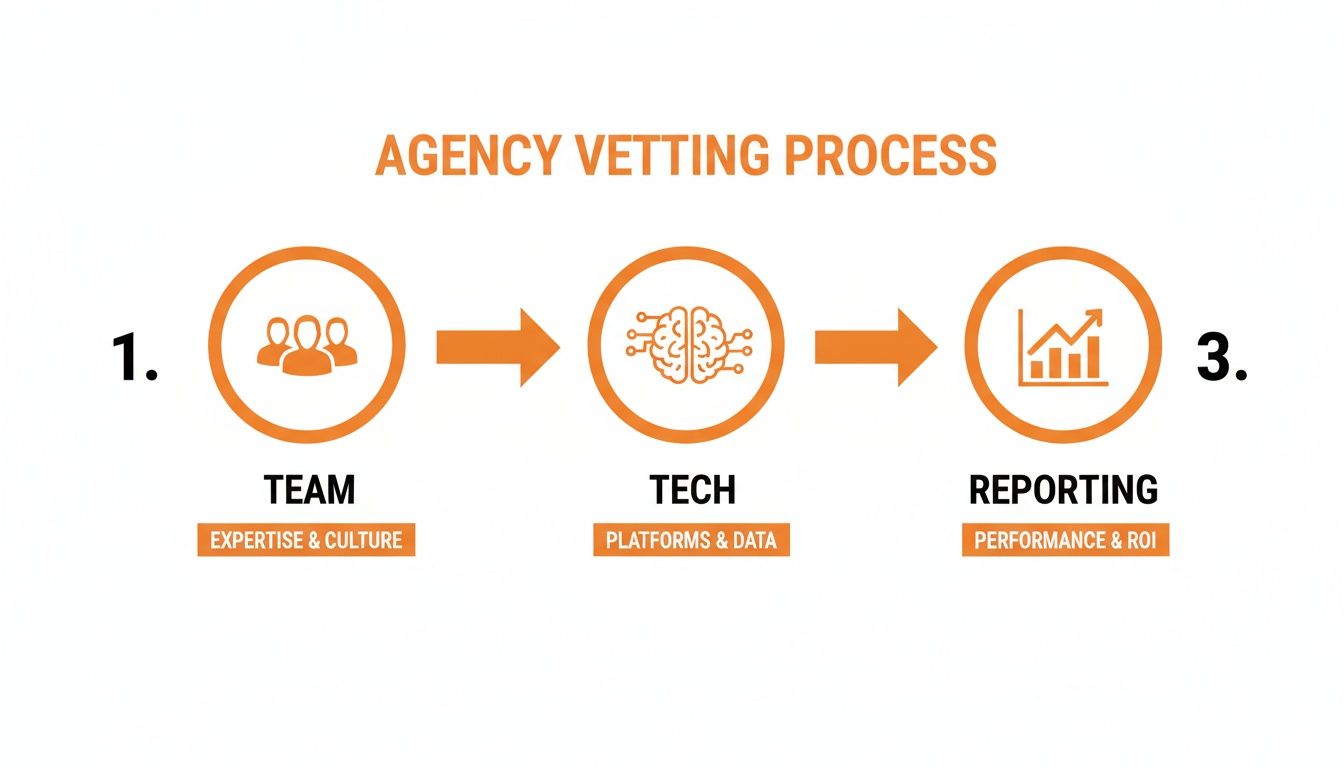
A great partnership truly hangs on the balance of the people doing the work, the tools they use to do it, and how clearly they can show you the results.
Identifying Final Red Flags
Even at this late stage, you need to keep your guard up. A few last-minute warning signs can signal a rocky road ahead, and spotting them now will save you a world of hurt.
Be wary of any agency that:
Makes Unrealistic Guarantees: No one can promise you a #1 ranking on Google, period. The algorithm is a beast. A confident, experienced agency will talk about data-driven projections and goals, not ironclad promises.
Lacks Transparency: If they’re cagey about who is actually on your account, what their process looks like day-to-day, or how they measure success, that's a huge problem. A good partner is an open book.
Uses High-Pressure Sales Tactics: A great agency knows its worth and doesn't need to strong-arm you into signing. They’ll give you the space you need to make the right choice for your business.
Focuses on Vanity Metrics: Be very cautious if their proposal is all about "impressions" or "clicks" but fails to connect those numbers to what you actually care about—leads, sales, and ROI.
A trustworthy agency sells a partnership, not just a service. They set realistic expectations, communicate openly, and focus on delivering measurable business outcomes. If it feels too good to be true, it almost always is.
Kicking Off a Successful Partnership
Once you’ve made your choice and the contract is signed, the real work begins. A smooth, proactive onboarding process is the bedrock of a strong, long-term relationship. It’s what ensures your investment starts paying off from day one.
A messy kickoff is a momentum killer, leading to missed deadlines, frustrating miscommunications, and a sluggish start. A great agency will take the lead here, but you need to know what to expect and be ready to do your part.
Your Onboarding Checklist
A successful onboarding should nail down these key items to get your partnership off the ground and running smoothly:
The Official Kickoff Meeting: This is your chance to meet the entire team who will be in the trenches with you. The goal is to align on the project scope, hammer out your goals one last time, and lock in a clear timeline.
Granting Account Access: Your new partner will need access to platforms like Google Analytics, your website’s backend, and social media accounts. Have those credentials ready to go so they can hit the ground running.
Defining Communication Channels: How will you stay in touch? A weekly call? A shared Slack channel? Monthly reports? Decide on this now to avoid guesswork and frustration later.
Establishing a Reporting Cadence: Agree on what reports will include and how often you'll get them. A solid report should be easy to digest and laser-focused on the KPIs you defined at the very beginning.
Setting 30-60-90 Day Expectations
Finally, a great agency will work with you to map out a clear plan for the first three months. This roadmap creates a shared definition of success and makes sure everyone is on the same page about what needs to happen first.
First 30 Days: This is all about deep dives, audits, and laying the foundation. Think technical SEO audits, comprehensive keyword research, and getting all the tracking and analytics set up correctly.
First 60 Days: Now the strategy starts to roll out. You should begin to see the first tangible results of their work, like new content going live or the first ad campaigns launching.
First 90 Days: By this point, there should be enough data to get a real sense of what's working. This is the time to analyze early performance, learn from the initial results, and start fine-tuning the strategy for even better outcomes.
This structured approach gives your new partnership immediate momentum and a shared vision for what success looks like.
Got Questions? We've Got Answers
Picking the right agency is a huge decision, and it’s smart to have questions. Here are some straight answers to the things business owners usually ask when trying to find the perfect digital marketing partner.
How Much Does a Digital Marketing Agency Cost?
Agency pricing is all over the map—it really depends on the services you need, their experience, and even where you're located. You’ll generally run into a few common pricing models:
Monthly Retainers: Expect to see these range from $1,500 to $10,000+ per month. This typically covers ongoing work like SEO, content creation, and PPC management.
Project-Based Fees: This is a one-time fee for a specific deliverable, like building a new website or running a deep-dive SEO audit.
Hourly Rates: Some agencies bill by the hour, usually between $100 and $300+, for consulting or ad-hoc tasks.
For a serious, comprehensive local strategy in a competitive market like Los Angeles, you should budget for a monthly retainer that bundles the core services. The most critical thing is to find a partner who is completely transparent about their pricing and can clearly map their fees to the results you can expect.
What Are the Biggest Red Flags When Hiring an Agency?
You've got to keep an eye out for warning signs. Be immediately skeptical of any agency that guarantees a #1 ranking on Google. That’s a promise no one can ethically make, because it's just not possible.
Other massive red flags include a total lack of transparency around their process, reports that are vague or impossible to understand, and aggressive, high-pressure sales tactics. If they hesitate to provide recent client references, that's another bad sign.
A partner worth their salt will be upfront, obsessed with data, and focused on setting realistic, achievable goals. If they’re selling you a fantasy instead of a strategy, it's time to walk away.
Should I Hire a Local Agency or a National One?
For any business that serves a specific geographic area, going with a local agency is almost always a huge advantage. This is especially true if you operate anywhere in the sprawling, diverse landscape of Southern California. Our reach includes every corner of L.A.—from Downtown Los Angeles, Hollywood, West Hollywood, Beverly Hills, and Santa Monica to the beach communities of Malibu, Venice, Marina del Rey, Hermosa Beach, Manhattan Beach, and Redondo Beach.
A local partner just gets it. We also extend service through the San Fernando Valley, including Sherman Oaks, Studio City, Encino, Van Nuys, North Hollywood, Burbank, Glendale, Pasadena, Woodland Hills, Chatsworth, Canoga Park, Reseda, Northridge, and Tarzana. In the San Gabriel Valley, we work with clients in Alhambra, Monterey Park, San Gabriel, Temple City, Rosemead, Arcadia, El Monte, South El Monte, West Covina, Covina, Baldwin Park, Azusa, Glendora, Duarte, and Monrovia. Farther southeast, we serve Whittier, Pico Rivera, Downey, Norwalk, La Mirada, La Habra, and Cerritos. We also support the South Bay—including Torrance, Carson, Gardena, Hawthorne, Inglewood, and Long Beach—as well as the Gateway Cities and communities throughout the I-10, I-5, 101, and 405 corridors. While a big national agency can certainly be effective, they often lack the boots-on-the-ground insight that gives a local business its competitive edge. Whether you’re in a major metro area or a smaller surrounding neighborhood, our team delivers reliable, high-quality service anywhere in or around Los Angeles.
Do I Need Both SEO and PPC Services?
For most businesses, the answer is a firm "yes." Running SEO and PPC together in an integrated strategy is almost always the fastest and most effective way to grow.
Think of it like this: SEO is a long-term investment. It builds your organic traffic, credibility, and authority over time. On the other hand, PPC delivers immediate, highly targeted traffic right now. PPC can start generating leads and sales almost instantly while your SEO efforts gain traction. A sharp agency will help you build a smart, blended strategy that allocates your budget wisely between the two, maximizing both your short-term wins and your long-term, sustainable growth.
Ready to partner with an agency that understands the Los Angeles market and delivers measurable results? DLL Studios helps businesses like yours build high-performing websites and campaigns that drive real growth. Let's talk about your project today.
