


.png)
Digital Marketing for Local Business Your Complete Playbook
If you run a local business, you’re not just competing for attention on the street corner anymore. Today, the biggest street is digital. Digital marketing isn’t some abstract concept or a list of trends to chase; it's about building a real, sustainable connection with the people right in your neighborhood.
This playbook is designed to turn your online presence into what really matters: foot traffic and phone calls.
Why Your Local Business Needs a Digital Game Plan
In a city like Los Angeles, competition is everywhere. Relying on foot traffic and word-of-mouth alone is a massive gamble. Your customers, whether they're in Hollywood, Glendale, or down in Redondo Beach, start their hunt for products and services online. A solid digital marketing strategy is what makes sure they find you first, not the other guys.
Think of your digital presence as your new storefront. It’s open 24/7, anyone can access it from anywhere, and it’s usually the very first impression a potential customer gets of your business. Without it, you’re basically invisible to a huge chunk of your local market.
The benefits are direct and they hit the bottom line.
Hyper-Local Targeting: You can zero in on specific neighborhoods, from Pasadena to Santa Monica. This means every dollar you spend is reaching customers who can actually walk into your store or hire you.
Measurable Results: A flyer or a newspaper ad is a shot in the dark. Digital marketing lets you track exactly how many people see your ads, click to your website, and call your business. This data is gold—it lets you fine-tune your approach for even better results.
Building Community Trust: When you engage with customers through reviews, social media, and genuinely helpful content, you become a trusted local authority. People in communities from Burbank to Torrance want to support businesses they know and feel connected to.
This chart breaks down the simple path a customer takes from an online search right to your front door.
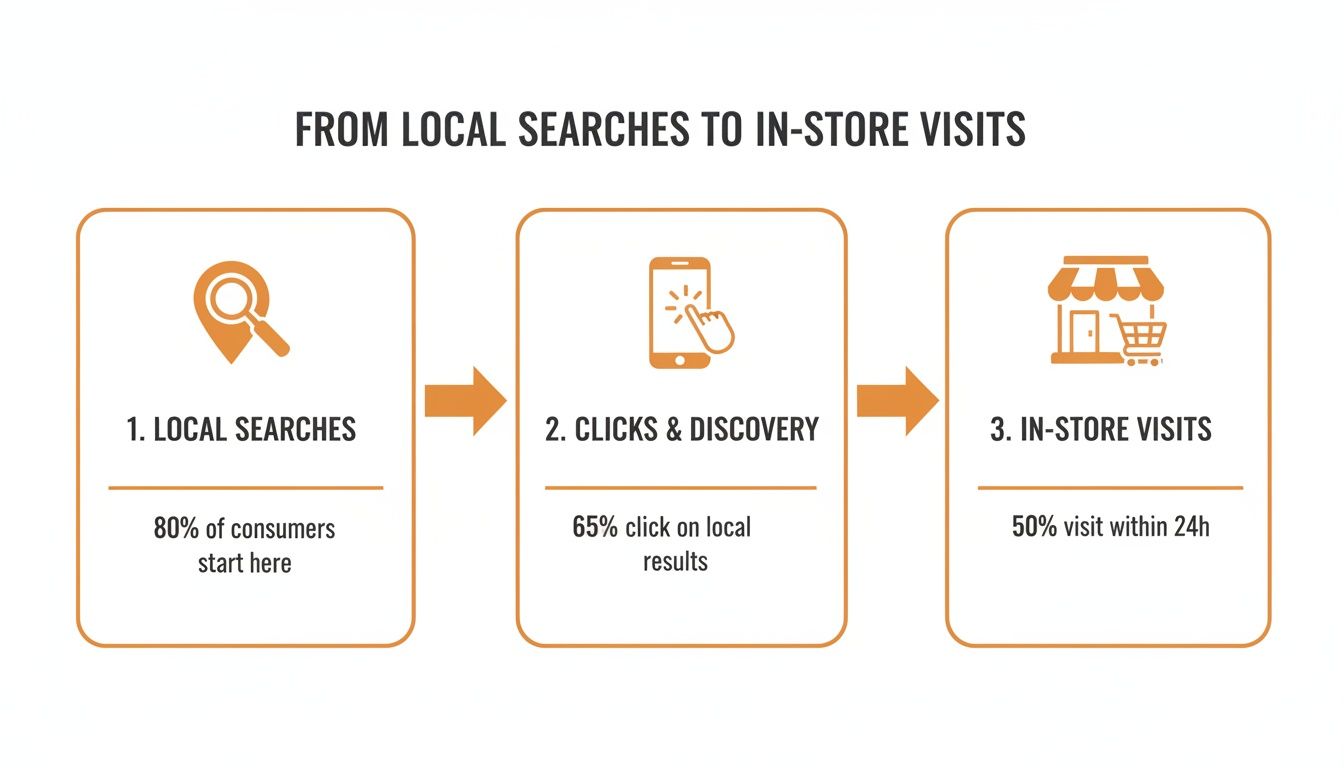
It’s a straightforward flow, but it drives home a critical point: every local search is a potential real-world sale just waiting to happen.
Leveling the Playing Field
Here’s one of the best parts about digital marketing for local businesses: it completely levels the playing field. You don’t need a seven-figure budget to compete. A small cafe in West Hollywood can absolutely outrank a national chain in local search results with smart, targeted strategies.
Take a plumber serving the San Gabriel Valley, from Alhambra to Azusa. They can use geo-targeted ads to appear only to homeowners in that specific area who are searching for "emergency plumbing repair" right now. That kind of precision is something traditional advertising could never dream of. It’s about working smarter, not just spending more.
To really get a feel for the landscape, it’s worth looking into how small businesses utilize multi-channel marketing strategies compared to the big brands. The core idea is always the same: be where your customers are.
The goal isn't just to be online; it's to become the undeniable go-to choice for customers in your service area. Whether you're based in the San Fernando Valley or the South Bay, digital marketing is the bridge connecting your business to the community you serve.
Ultimately, investing in your online presence is an investment in your business’s future. It makes you more resilient and ensures that when a local customer needs what you offer, your name is the first one they find and the one they trust enough to choose.
Master the Art of Local SEO & Show Up When It Counts
If your customers can't find you online, you might as well be invisible. This is where your journey into digital marketing for local businesses really kicks off: with Local Search Engine Optimization (SEO). It's all about making sure your business is the first thing people see the moment they start searching for your products or services nearby.
Think of it this way: when someone in your town needs a plumber, a haircut, or the best slice of pizza, they don't pull out the phone book. They pull out their phone. Your goal is to be right there in those search results.
Your Digital Storefront: The Google Business Profile
The single most powerful tool you have for local SEO is your Google Business Profile (GBP). This isn't just another online directory listing; it's your business's digital front door on the world's biggest search engine. A complete, optimized GBP can be the deciding factor that sends a customer your way instead of to the competitor down the street.
The whole point is to give Google so much accurate, compelling, and up-to-date information that it has to show your profile to people searching for what you offer.
Building Your Optimization Checklist
First things first, you need to lock down your core business details. This means your Name, Address, and Phone number (NAP) must be perfectly consistent everywhere online. Even a tiny variation like "St." vs. "Street" can create confusion for search engines and hurt your credibility. Consistency builds trust.
Next, you have to tell your story with pictures. Photos aren't optional anymore; they're essential. Put yourself in your customer's shoes. What do they want to see before they visit? If you run a local bakery, this means mouth-watering shots of fresh pastries, the cozy interior of your shop, and maybe a few happy customers enjoying their coffee. You're not just showing what you sell—you're selling an experience.
Here's a dose of reality: 46% of all Google searches are for local information. That's a staggering number of people actively looking for a business just like yours. A well-optimized profile is your ticket to getting in front of them.
To get this right, you need a methodical approach. We've put together a checklist to walk you through the most critical parts of optimizing your Google Business Profile.
Your Google Business Profile Optimization Checklist
Optimization Area | Action Item | Why It Matters |
|---|---|---|
Core Information | Verify your business and ensure NAP (Name, Address, Phone) is 100% consistent with your website. | Consistency builds trust with Google and customers. It’s the foundation of local SEO. |
Categories | Select the most accurate primary category and add all relevant secondary categories. | This tells Google exactly what your business does, helping you show up in relevant searches. |
Business Description | Write a compelling, keyword-rich description that explains what makes you unique. | This is your chance to sell your business in your own words and include terms customers search for. |
Photos & Videos | Upload at least 10 high-quality photos (exterior, interior, team, products) and a short video. | Visuals drastically increase engagement. Businesses with over 100 images get more clicks. |
Customer Reviews | Actively request reviews and respond to every single one—both positive and negative. | Reviews are a huge ranking factor and provide powerful social proof that builds trust with new customers. |
Google Posts | Regularly share updates, offers, events, and news using the Posts feature. | Keeps your profile fresh and engaging, signaling to Google that your business is active. |
Q&A Section | Proactively add and answer frequently asked questions about your business. | Removes friction for potential customers and positions you as a helpful expert. |
Services/Products | Add a detailed list of every service or product you offer, with descriptions. | Helps you rank for specific, long-tail searches (e.g., "emergency leak detection" vs. just "plumber"). |
Messaging Feature | Enable messaging and commit to responding to inquiries quickly. | Provides an easy, low-barrier way for potential customers to connect with you directly from your profile. |
Treat this checklist as your roadmap. Working through it piece by piece will transform your basic listing into a powerful tool for attracting local customers.
The Power of Social Proof and Engagement
Beyond the basic setup, your reviews are the lifeblood of your local reputation. They send a powerful signal to both potential customers and Google that your business is legitimate and delivers quality. Make it a habit to ask happy customers for a review.
More importantly, you must respond to every review.
For positive ones: A simple, personal thank you goes a long way. Mentioning the service they received adds a little extra SEO juice.
For negative ones: Respond quickly, professionally, and with empathy. Offer to take the conversation offline to fix the problem. This shows everyone else that you value customer satisfaction.
Your GBP also features a "Questions & Answers" section. Keep an eye on it. If you own a restaurant in Santa Monica, you might get questions about parking or vegan options. Answering them directly on your profile is incredibly helpful for future customers.
By meticulously managing every part of your profile, you create a powerful cycle. A better profile leads to more visibility, which brings in more customers, who then leave more reviews—further boosting your visibility. If you're looking to dive even deeper, our complete guide on local SEO services for businesses is a great next step. It's an ongoing process, but the payoff is huge.
Designing a Website That Turns Visitors into Customers
Getting found online is a massive win, but that’s only half the battle. Think of your website as your digital handshake, your 24/7 salesperson. It's the place where potential customers decide if they’re going to trust you with their business. In a crowded market, a "good enough" website just doesn't cut it anymore; it needs to be an engine that actively turns visitors into paying customers.
Your website is the central hub for all your digital marketing efforts. You can have a killer Google Business Profile or a brilliant local ad campaign driving tons of traffic, but if people land on a confusing, slow, or ugly site, you've just wasted your time and money. They'll leave, and they won't be back.

The goal is simple: guide every single visitor to take the one action you want them to take. That might be calling your office, scheduling an appointment, or requesting a quote.
Make a Strong First Impression on Any Device
The vast majority of local searches are happening on smartphones. If a potential customer in Pico Rivera is looking for your services on their phone and your site is a jumbled, hard-to-read mess, they are gone in seconds. Your website must be mobile-responsive, meaning it looks and works perfectly on any screen, big or small.
This isn't just about looking pretty. A mobile-friendly design is the foundation of a good user experience (UX). People need to find your phone number or address without having to pinch and zoom. Make it easy for them.
You have less than three seconds to grab a visitor’s attention. A clean, professional design that loads fast and is a breeze to use on a phone isn't a luxury—it’s an absolute requirement for turning traffic into leads.
Craft Unmistakable Calls to Action
Every page on your site needs a clear job to do, guided by a strong call-to-action (CTA). A CTA is just a prompt telling the user what to do next. Vague buttons like "Learn More" are weak and rarely get clicks.
Instead, get straight to the point with direct, action-oriented language that solves your customer's immediate problem.
For a plumber: "Get a Free Estimate Now"
For a restaurant: "Reserve Your Table Tonight"
For a consultant: "Schedule Your Free Consultation"
Make these CTAs impossible to miss. Use bright, contrasting button colors and place them in logical spots, like right at the top of your homepage or immediately after you’ve described a service they’re interested in.
Build Trust with Social Proof
Before a new customer trusts you, they want to see that other people have. Sprinkling real testimonials and reviews throughout your website is one of the most powerful ways to build instant credibility. Please, don't just bury them on a "Testimonials" page that nobody ever visits.
Weave them into your service pages. For instance, a landscaping company could feature a glowing quote from a happy client in Alhambra right on their "Lawn Care Services" page. This creates an immediate connection between your work and real, satisfied customers in the communities you actually serve. We dig deeper into this in our guide that explains how to create a website that converts visitors.
Attract Hyper-Targeted Traffic with Location Pages
For businesses serving multiple areas—say, a contractor working everywhere from Glendale to West Covina—location-specific service pages are an SEO goldmine. These are dedicated pages on your site optimized for one specific service in one specific city.
So, instead of a generic "Roofing Services" page, you'd create:
"Roof Repair in Pasadena"
"New Roof Installation in Arcadia"
"Commercial Roofing in Monrovia"
Each page should have unique content that feels local. Mention nearby landmarks, talk about common issues homeowners in that area face, or showcase a job you did down the street. This strategy helps you show up for those super-specific, high-intent searches (like "roofer near me in Pasadena"), attracting customers who are ready to make a call.
Running Smart Local Ad Campaigns That Actually Work
Paid advertising can feel like you’re just throwing money into the wind, but it absolutely doesn't have to be that way. For a local business, a smart ad campaign isn’t about plastering your name all over town. It’s about surgical precision.
Think of it as the express lane to getting new customers. While your Local SEO efforts are building that crucial long-term foundation, paid ads put you at the top of the page right now. It’s a powerful one-two punch. If you’re trying to figure out that balance, we’ve got a guide that breaks down organic SEO vs PPC for your business.
And here’s the good news: you don’t need a massive budget to compete. In fact, 84% of brands see positive results from local PPC. With a staggering 97 billion local searches happening every month, the opportunity is huge.
Even better, 88% of people searching locally on mobile will visit a store within 24 hours, and 28% of those searches lead to a sale. People are looking, and they're ready to buy. You just have to show up.
Demystifying Google Ads for Local Impact
When local businesses dip their toes into paid ads, Google Ads is usually the first stop. And for good reason. It lets you get in front of people who are actively searching for what you offer, catching them at the exact moment they need you.
The trick is avoiding the common mistakes, like casting your net too wide and watching your budget disappear on irrelevant clicks.
Let's walk through a real-world example.
Example: A Downtown Los Angeles Law Firm
Imagine a personal injury law firm right in the heart of Downtown L.A. Their ideal clients are probably within a reasonable driving distance. Targeting all of Southern California would be a massive waste of money.
Instead, they can get laser-focused with geo-targeting, setting just a 10-mile ad radius around their office.
This one simple tweak means their ads only show up for people in nearby areas like Hollywood, Pasadena, or Beverly Hills. Now, they can confidently bid on high-intent keywords they know will attract the right calls:
"car accident lawyer near me"
"personal injury attorney Downtown LA"
"slip and fall lawyer in Los Angeles"
By combining a tight location focus with super-specific keywords, their ad spend becomes incredibly efficient. They’re not paying for clicks from Riverside; they’re paying for clicks from people who can actually walk through their door.
The secret to local Google Ads isn't a huge budget. It's being ruthless with your targeting—who you show ads to, where they are, and what they’re searching for.
Connecting with Neighbors on Social Media
While Google is fantastic for capturing intent (someone needs a plumber now), social media ads on platforms like Facebook and Instagram are all about generating interest. This is where you connect with your community before they even know they need you.
You can target users in specific zip codes or even neighborhoods, making your brand a familiar, friendly face.
Example: A Long Beach Coffee Shop
A local coffee shop in Long Beach wants to get the word out about its new fall drink menu. They decide to run a campaign on Instagram and Facebook with a fun, visually appealing ad.
Here’s how they could dial in their targeting:
Location: Anyone within a 3-mile radius of the shop.
Interests: People who have shown an interest in "coffee," "local cafes," "brunch," or "Long Beach events."
Behavior: Users who have recently checked in or engaged with other local businesses nearby.
The ad itself could be a quick, eye-catching video of a barista crafting the new pumpkin spice latte. The call-to-action is simple and enticing: "Swipe Up for 10% Off Your First Order!"
This isn’t just an ad; it's a digital invitation sent directly to the people most likely to stop by. It feels personal, relevant, and incredibly local.
Building Community with Authentic Content and Social Media
A great local business is more than just a place to buy things—it’s part of the neighborhood's DNA. While local SEO helps customers find you and a slick website makes a great first impression, it's the authentic content and social media presence that builds real, lasting loyalty.
The goal is to stop thinking like a salesperson and start acting like a helpful neighbor. This shift creates a genuine connection that turns a one-time customer into a lifelong supporter.

And today, that connection is more critical than ever. A staggering 80% of US consumers search online for local businesses every single week, with platforms like Instagram and TikTok becoming major discovery tools.
The numbers don't lie: content marketing costs 62% less than old-school methods but pulls in three times more leads. When you consider that searches for 'near me' have exploded by 500%, creating locally focused content isn't just a good idea—it's essential for survival.
Create Content That Genuinely Helps Your Neighbors
Forget the generic, hard-sell approach. The best digital marketing for any local business is about creating content that answers real questions and solves problems for people in your community. When you do this, you instantly position yourself as the go-to expert in town.
Think about the unique challenges your customers are facing right now. If you run a plumbing service in Hollywood, a blog post titled "Common Pipe Issues in Older Los Angeles Homes" would be pure gold. It speaks directly to a local pain point. Or, if you own a sporting goods store in Pasadena, an article on "The 5 Best Local Hiking Trails for Beginners" provides immediate, tangible value.
This strategy is a double-win:
It attracts the right people. Someone in your service area searching for those exact answers will land right on your website.
It builds massive trust. You're not just trying to make a sale; you're offering free, expert advice that makes their life better.
Bring Your Community Together on Social Media
Think of your social media profiles as your digital town square. It’s the perfect place to show the human side of your business and cultivate a true sense of community. The secret is to be personal, engaging, and consistently show up.
One of my favorite tactics is teaming up with other local businesses. Picture a coffee shop in Venice collaborating with a nearby bookstore for a joint giveaway or a "book and brew" special. This kind of cross-promotion is brilliant—it introduces both businesses to new, highly relevant local audiences and makes the whole neighborhood feel more connected.
Don't just post at your audience; create a conversation. Use Instagram Stories to offer a behind-the-scenes look at your team, run polls asking for customer opinions, or share photos of happy customers (with their permission, of course). This authenticity is what people connect with.
User-generated content is a fantastic way to showcase that authenticity. Check out these practical strategies for generating user-generated content (UGC) to turn your best customers into your most powerful advocates.
Practical Content Ideas for Local Businesses
Feeling stuck on what to create? It's easier than you think. Here are a few real-world examples to get your creative juices flowing.
Local Content Ideas for Different Businesses
Business Type | Helpful Blog Post Idea | Engaging Social Media Idea |
|---|---|---|
Restaurant in Santa Monica | "Our Chef's Guide to the Santa Monica Farmers Market" | A "Meet the Team" Instagram Reel series featuring your chefs and servers. |
Landscaper in the Valley | "5 Drought-Resistant Plants That Thrive in the San Fernando Valley Heat" | A time-lapse video showing the transformation of a client's backyard in Sherman Oaks. |
Mechanic in Downey | "How to Prepare Your Car for a Southern California Road Trip" | A weekly "Quick Tip Tuesday" post sharing simple car maintenance advice. |
Boutique in Beverly Hills | "How to Style One Dress for Three Different L.A. Occasions" | A "Customer Spotlight" post featuring a local shopper wearing one of your outfits. |
By consistently putting out content that educates, entertains, and connects, you’ll transform your digital presence from a simple advertisement into a valuable local resource people actually want to engage with.
Common Questions About Local Digital Marketing
When you're running a local business, diving into digital marketing can feel like opening a can of worms. How much should I spend? Where do I even start? What actually works? It's easy to get overwhelmed. We hear these same questions all the time from business owners across Southern California, so let's cut through the noise with some clear, practical answers.
How Much Should My Business Budget for Digital Marketing?
There’s no magic number here, but a classic rule of thumb is to set aside 7-10% of your total revenue for all your marketing efforts. Frankly, for most local businesses, that feels a bit abstract. A much better approach is to start small, prove what works, and then scale up intelligently.
You could kick things off with a tight budget of just a few hundred bucks a month on Google Ads, zeroing in on specific service areas you want to own, like Encino or Sherman Oaks. The key is to track everything. Which campaigns are actually making the phone ring or filling out your contact form? Once you find a winner, you can confidently pour the profits back into that channel and really open up the throttle.
Key Takeaway: Before you spend a dime on ads, max out your free assets. Get your Google Business Profile completely dialed in and build a solid system for getting fresh customer reviews. These foundational pieces make every single dollar you eventually spend on advertising work ten times harder.
What Is the Single Most Important First Step to Take?
Hands down, the first thing you need to do is claim and meticulously optimize your Google Business Profile (GBP). This is your digital storefront on the biggest search engine in the world, and the best part? It's completely free.
Seriously, before you worry about a fancy website or a big ad budget, make sure your GBP is perfect. That means:
Accurate hours of operation
A correct, pin-verified address
High-quality, recent photos of your work, your team, and your location
A compelling business description packed with the right keywords
Right after that, your next job is to actively ask your happy customers for reviews. Then, make it a habit to respond to every single one. This one profile is the absolute bedrock of your local SEO. It's what gets you on that valuable map pack, which is where most customers ready to buy are looking.
How Long Does It Really Take to See SEO Results?
Local SEO is a marathon, not a sprint. The good news is that some changes, like beefing up your Google Business Profile with new photos or getting a burst of fresh reviews, can give you a noticeable bump in just a few weeks.
But for lasting authority and climbing to the top of the rankings, you need to be consistent. Generally, you can expect to see real, measurable growth in your rankings and customer traffic within 3 to 6 months of steady effort. "Steady effort" means things like consistently getting new reviews every month, building out local citations on relevant directories, and adding fresh, locally-focused content to your site. Unlike paid ads that vanish the second you stop paying, the work you put into SEO compounds over time, building an asset that brings you a stream of high-quality organic leads for years.
Do I Actually Need a Blog for My Local Business?
While it’s not a must-have for every single business, a blog is an incredibly powerful tool for attracting new customers and cementing your expert status. It’s your chance to directly answer the questions your local audience is typing into Google every single day. This transforms your website from a simple brochure into an indispensable resource.
Picture a roofer who serves communities from Glendale to Burbank. They could write a blog post titled, "Choosing the Right Roofing Material for Southern California's Climate." This one article does two huge things:
It helps them show up on Google for that exact search, attracting a homeowner who is actively looking for their services.
It instantly positions them as a knowledgeable local authority, building trust before they've even had a conversation with the potential customer.
A blog also gives you a constant supply of great content to share on social media and in email newsletters. That alone gives you a massive advantage over competitors whose websites are just a collection of static service pages.
Ready to stop guessing and start growing your local business with a proven digital marketing strategy? The team at DLL Studios has the expertise to elevate your online presence, attract more local customers, and deliver measurable results. Los Angeles is at the center of our service area, and we proudly support clients across a wide network of surrounding cities and neighborhoods throughout Southern California. Our reach includes every corner of L.A.—from Downtown Los Angeles, Hollywood, West Hollywood, Beverly Hills, and Santa Monica to the beach communities of Malibu, Venice, Marina del Rey, Hermosa Beach, Manhattan Beach, and Redondo Beach. We also extend service through the San Fernando Valley, including Sherman Oaks, Studio City, Encino, Van Nuys, North Hollywood, Burbank, Glendale, Pasadena, Woodland Hills, Chatsworth, Canoga Park, Reseda, Northridge, and Tarzana. In the San Gabriel Valley, we work with clients in Alhambra, Monterey Park, San Gabriel, Temple City, Rosemead, Arcadia, El Monte, South El Monte, West Covina, Covina, Baldwin Park, Azusa, Glendora, Duarte, and Monrovia. Farther southeast, we serve Whittier, Pico Rivera, Downey, Norwalk, La Mirada, La Habra, and Cerritos. We also support the South Bay—including Torrance, Carson, Gardena, Hawthorne, Inglewood, and Long Beach—as well as the Gateway Cities and communities throughout the I-10, I-5, 101, and 405 corridors. Whether you’re in a major metro area or a smaller surrounding neighborhood, our team delivers reliable, high-quality service anywhere in or around Los Angeles. https://www.dllstudios.com
