


.png)
Is SEO Worth It? Unpacking the Real Costs and ROI for Your Business
Let's get straight to it: For almost any business serious about growing for the long haul, SEO offers one of the best returns you'll find in digital marketing. It’s the difference between building a genuine asset and just renting some temporary attention. If you want a steady, predictable stream of customers who are already looking for what you sell, the answer is a firm yes.
Is SEO a Worthwhile Investment for Your Business?
Think of your marketing budget like a financial portfolio. Paid advertising, like Google Ads or social media campaigns, is a lot like renting a billboard on the busiest freeway in town. It gets you eyeballs immediately, but the second you stop paying, your sign comes down and the traffic vanishes. It works for quick wins but builds zero lasting value.
Search Engine Optimization (SEO), on the other hand, is like buying the land and building your own storefront in a prime location. It takes more work and investment upfront, and you'll need to maintain the property to keep it looking sharp. But over time, you build real equity. Your store becomes a landmark, pulling in a steady flow of customers on its own, long after the construction crew has gone home. This is why the question of "is SEO worth it?" is almost always a resounding "yes" for anyone focused on stability and long-term success.
Who Benefits Most From SEO?
While just about any business can get a lift from SEO, some see truly game-changing results. Local service businesses—think plumbers in Pasadena, dentists in Beverly Hills, or contractors across the San Fernando Valley—depend on SEO to show up the moment a potential customer has an urgent need. In the same way, e-commerce stores use it to get in front of buyers searching for specific products, helping them break free from the endless cycle of paying for every single click.
SEO is the only marketing channel that builds a compounding asset. Every piece of optimized content and every backlink earned is a small share of equity in your brand's digital presence, paying dividends for years to come.
Ultimately, SEO creates a durable engine that drives traffic, leads, and sales. It’s a strategic shift that moves your business from constantly chasing customers to being discovered by them. By investing in this digital foundation, you’re building a competitive advantage that’s incredibly difficult for others to copy, ensuring your brand stays visible and relevant everywhere from Downtown Los Angeles to Long Beach.
Calculating the True ROI of SEO
To really answer the question "is SEO worth it?" we have to get past the fluff and look at the hard numbers. The true value of SEO isn't just about getting more traffic; it's about building a predictable, profitable asset for your business. Calculating its Return on Investment (ROI) helps you stop seeing SEO as an expense and start treating it like a strategic investment that builds lasting value.
Unlike paid ads where the math is simple (you spend X, you get Y clicks), SEO's ROI is a bit more nuanced. Its value snowballs over time, which is what makes it such a powerful long-term play. The trick is connecting your SEO efforts to real, tangible business results.
The Core Metrics That Define SEO Value
To get a clear picture of your return, you need to look beyond vanity metrics like rankings and traffic. The numbers that really matter are the ones that directly affect your bottom line.
Customer Lifetime Value (CLV): This is the total profit you can expect from a single customer over their entire relationship with your business. Someone who finds you through a Google search might come back again and again for years, making that initial acquisition incredibly valuable.
Cost Per Acquisition (CPA): This tells you exactly how much it costs to land a new customer. Paid ads have a clear, immediate CPA, but SEO's CPA actually decreases over time. The initial investment you make in a great piece of content continues to attract new customers for months or even years, driving down your average cost with every new lead.
Once you know these two figures, you can start to see the financial model. If a customer is worth $2,000 over their lifetime (CLV) and an optimized blog post that cost $500 to create brings in just five new customers over a year, your return is already huge. If you want to dig deeper into the mechanics, this guide on how to calculate ROI to prove investment value is a great resource.
Industry Benchmarks: What a Strong Return Looks Like
The financial impact of SEO can vary by industry, but the results are almost always impressive. Across the board, SEO delivers a remarkably high return. Aggregate stats show an average SEO ROI of about 825% as of 2025. That means for every dollar spent, businesses typically see around $8.25 in revenue over time.
Digging into specific industries, the numbers get even more dramatic. Financial services can see over 1,031% ROI, while real estate can hit an incredible 1,389% ROI. B2B SaaS companies report a 702% ROI, and e-commerce averages a solid 317%. These figures aren't flukes; they highlight SEO's power to deliver consistent, compounding returns that grow as your efforts stack up.
This chart shows the fundamental difference between building long-term equity with SEO and essentially "renting" temporary visibility with paid ads.
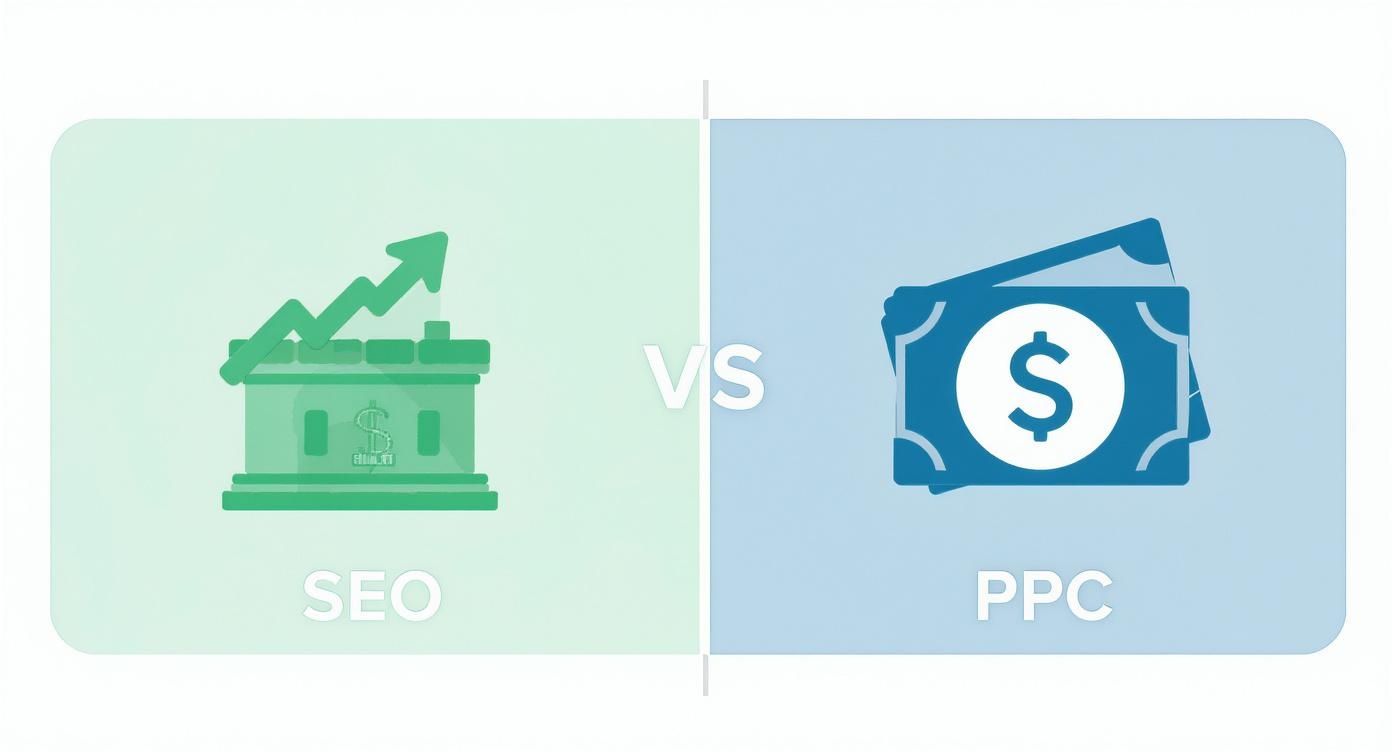
The key takeaway here is that while PPC buys you immediate traffic, SEO builds a sustainable asset that keeps generating value long after you've made the initial investment.
From Expense to Strategic Investment
When you start looking at SEO through this financial lens, your whole perspective shifts. It’s no longer just another marketing cost on your P&L statement. Instead, it becomes a capital investment in a high-performing digital asset.
A well-executed SEO strategy is like adding a new, highly effective salesperson to your team—one who works 24/7, never takes a vacation, and gets better at their job every single month.
Every optimized page, every helpful blog post, and every authoritative backlink adds to your brand's digital real estate. This asset appreciates over time, pulling in qualified leads from all over Los Angeles and beyond, whether they're in a busy hub like Downtown L.A. or a quiet neighborhood in the San Gabriel Valley. This is how you build a business that doesn’t just survive—it thrives on a solid foundation of organic growth.
Choosing Between SEO and Paid Ads
When you’re deciding where to put your marketing dollars, it almost always comes down to SEO versus paid ads. This is the classic debate: do you play the long game for strategic growth, or do you go for quick, immediate results?
To get a real feel for the difference, I like to use an analogy I've shared with clients for years: gardening versus fishing.
Paid ads are a lot like fishing. You bait your hook, cast your line, and you can pull in a fish almost immediately. It’s fast, direct, and incredibly effective if you need results right now. But the second you stop paying for bait and pack up your gear for the day, the fish stop biting. Your visibility—and your leads—vanish just as quickly as they appeared.
SEO, on the other hand, is like planting a garden. It takes some serious work upfront. You have to prepare the soil, plant the seeds, and water it consistently. For the first few months, you might not see much happening above the ground. But if you’re patient and put in the steady effort, that garden starts to grow. Eventually, it produces a reliable harvest you can reap season after season, becoming a sustainable asset that feeds your business for years to come.
Comparing Cost and Long-Term Value
The biggest difference between these two channels is how your investment behaves over time. With paid advertising, you're essentially renting traffic. Your cost is directly tied to your visibility. If your budget is $1,000 a month, that’s what it costs to stay in front of people. The moment you pause that campaign, your traffic drops off a cliff.
SEO works on a completely different financial model. That initial investment is all about building a foundation. Every optimized page, every blog post, every backlink becomes a permanent digital asset that keeps attracting visitors long after you’ve hit "publish." Over time, the cost to acquire a customer with SEO almost always goes down, because your established authority and content library are out there working for you 24/7, no extra per-click costs required.
SEO builds equity. Paid ads are a rental expense. While both can be useful, only one creates a lasting asset that appreciates in value and delivers compounding returns.
Lead Quality and Conversion Potential
Another huge piece of the puzzle is the quality of the leads you get from each channel. People who click on paid ads are often ready to buy, which is great, but they also know they’re clicking on an advertisement. Their trust level is naturally a bit lower than someone who discovers you organically.
Organic search traffic, the kind driven by SEO, consistently has higher engagement and conversion rates. Think about it: when someone types a question into Google and your business shows up as a top natural result, there's an immediate layer of trust. Google has essentially vouched for you, telling the searcher that your site is a credible and relevant answer. That makes them far more receptive to your message and much more likely to convert.
For local businesses, this difference is even more stark. A homeowner in Glendale frantically searching for "emergency plumbing repair" is instinctively going to trust the top-ranking local plumber on Google Maps over a sponsored ad that might be from a larger, faceless company.
The Financial Proof in Local Services
This isn't just theory—the data backs it up, especially in competitive local markets. A 2025 analysis of the trades industry (think HVAC, plumbing, and electrical services) found that SEO campaigns generated a return on ad spend (ROAS) of a staggering 19.9x.
That was nearly five times higher than the 4.4x ROAS from paid advertising. Even with a much smaller total spend, SEO drove slightly more revenue and slashed the cost per paying customer down to just $126.09, compared to $552.93 for paid ads. The full data shows how every dollar put into SEO brought back almost $20 in revenue.
The Smartest Strategy Uses Both
So, is SEO worth it compared to paid ads? For sustainable, long-term growth, the answer is a resounding yes. But the smartest strategy usually isn't about picking one over the other. It’s about making them work together.
Here’s how we approach it:
SEO is your foundation. Use it to build your permanent digital presence, establish brand authority, and generate a steady stream of high-quality organic leads.
Paid ads are your targeted boosts. Use them to launch a new product, promote a seasonal offer, or grab immediate visibility while your SEO efforts are gaining momentum.
This balanced approach lets you secure immediate wins while you invest in a future where your business isn't completely dependent on ad spend. For a deeper dive into this dynamic, check out our guide on organic SEO vs PPC and making the right investment for your business.
Understanding the Real Cost and Timeline for SEO
Let's cut to the chase. When business owners ask if SEO is worth it, what they really want to know is: how much is this going to cost, and how long until I see results? These are the two biggest hurdles, and the answers aren't simple. But getting a realistic grip on the budget and timeline is the only way to see SEO for what it is: a strategic investment, not just another expense.
Think of SEO as building a valuable piece of digital real estate, not buying a one-off piece of software. There's no fixed price tag. The cost depends entirely on your goals, how fierce the competition is in your market, and the current shape of your website. A local bakery in Sherman Oaks is playing a completely different game than a national e-commerce brand, and their budgets will reflect that.
Common SEO Pricing Models
For most businesses, SEO services are packaged in a couple of ways, each designed for different needs.
Monthly Retainer: This is the industry standard for a reason. You pay a set fee each month for a comprehensive, ongoing strategy. It’s an all-in-one approach that usually covers technical SEO, content creation, link building, and regular performance reports. For most small to medium-sized businesses, retainers fall in the $1,500 to $5,000+ per month range. This consistent investment is what builds and maintains the momentum needed to win.
Project-Based Fees: Sometimes, you just need a specific job done. A project-based fee makes perfect sense for one-off tasks like a deep-dive SEO audit, a tricky website migration, or setting up a new business in Pasadena with a rock-solid local SEO foundation. Project costs are all over the map, from $1,000 for a basic audit to $10,000+ for a massive site overhaul.
So, what are you actually paying for? It’s not just a magic trick to "get to number one." A quality SEO investment funds serious strategic work. It all starts with a foundational analysis of your site's technical health and a hard look at the competitive landscape. You can learn more about what that entails by conducting a comprehensive SEO audit.
From there, that investment goes into creating genuinely valuable content, building your website's authority with credible backlinks, and fine-tuning your local presence so customers from Santa Monica to the San Gabriel Valley can find you easily.
Mapping a Realistic SEO Timeline
The biggest myth about SEO is that results happen overnight. The truth? SEO is a marathon, not a sprint. Its real power comes from compounding growth, and that takes time to get going. Anyone promising instant first-page rankings is likely using risky tactics that can get your site slapped with a penalty by Google.
Here’s a more realistic look at what a well-executed SEO campaign timeline actually looks like:
Months 1-3: Foundational Work and Early Traction The first few months are all about laying the groundwork. We're talking technical fixes, deep keyword research, and mapping out a smart content strategy. You probably won't see a massive traffic spike yet, but crucial work is happening behind the scenes. Toward the end of this phase, you might start seeing some movement for less competitive, long-tail keywords.
Months 3-6: Building Momentum This is when things start to get exciting. The content you've been putting out begins to get indexed and ranked by search engines, which starts pulling in more organic traffic. You’ll see your visibility for core keywords begin to climb, and a noticeable uptick in leads or sales from organic search should follow.
Months 6-12: Significant Business Impact By now, the compounding effect is undeniable. Your site has built real authority in your space, and you’re likely ranking on the first page for several high-value keywords. The ROI from your initial investment becomes crystal clear as organic traffic turns into a predictable and primary engine for business growth.
The patience required for SEO is what makes it such a powerful competitive advantage. While your competitors are chasing short-term gains with expensive ads, you are building a sustainable traffic engine that will pay dividends for years.
Ultimately, understanding this timeline helps reframe the conversation. You’re not just spending money each month; you're investing in a system that methodically builds your brand’s visibility and authority, creating a durable marketing asset that only gets stronger over time.
How to Measure SEO Success and Prove Its Worth

To really answer the question "is SEO worth it," you have to look past the vanity metrics. Sure, hitting the first page of Google feels great, but rankings alone don't pay the bills. The real proof is in the data that connects organic search directly to your bottom line.
The good news? You don’t need a bunch of expensive software to get started. Free tools like Google Analytics and Google Search Console give you all the essential data you need. It’s all about focusing on the right key performance indicators (KPIs) to link your SEO work to actual business growth.
Focusing on Business-Centric KPIs
Instead of obsessing over keyword positions, it’s time to shift your focus to metrics that tell the story of customer behavior and, more importantly, revenue. These are the numbers that prove your investment is paying off.
Organic Traffic Growth: This is your foundation. Are more people finding your website through search engines this month compared to last month? A consistent, steady climb in organic visitors is the first clear signal that your strategy is working.
Conversion Rate from Organic Search: Traffic is nice, but conversions are what matter. This KPI tracks how many of your organic visitors take a valuable action—like filling out a contact form, buying a product, or signing up for your email list. A rising conversion rate means you’re not just getting more traffic, but better, more qualified traffic.
Lead Quality and Revenue: Now we're getting to the heart of it. Are the leads coming from organic search actually turning into paying customers? Tying revenue directly to your SEO efforts is the ultimate way to prove its worth and connect your marketing spend to sales.
Uncovering the Hidden Wins of SEO
Not every benefit of SEO is going to show up neatly in an analytics report. Some of the most valuable outcomes are indirect, but they’re just as critical for showing the full value of what you’re doing.
Tracking SEO success is about measuring both direct revenue and the subtle shifts in brand perception. A rise in branded searches, for example, is a powerful indicator that your brand authority is growing and people are seeking you out by name.
Think about these less obvious but equally powerful signals:
Phone Calls from Google Business Profile: For local businesses in places like Glendale or Torrance, a phone call is often the most valuable conversion there is. Your Google Business Profile insights will show you exactly how many people called you straight from the local search results.
Increase in Branded Searches: Are more people typing your company’s name directly into Google? That's a huge win. It’s a clear sign your brand awareness is on the rise, thanks to the increased visibility your SEO work has created.
The numbers consistently show that SEO is a customer-acquisition powerhouse. It doesn't just offer a higher ROI; it delivers far better conversion rates. Research shows that SEO leads convert at a 14.6% rate, which is nearly 8.6 times higher than the 1.7% you get from outbound leads. It also slashes customer acquisition costs by an average of 61%, proving how efficient it is at pulling in qualified prospects.
To measure your success and keep improving, using the right content optimization tools for SEO is a must. These tools help you refine your content to match what searchers are looking for, which is a core part of building an effective keyword optimization strategy. By tracking these tangible metrics, you can hold any SEO provider accountable and see exactly how your investment is building a more profitable, sustainable business.
Your Partner for SEO Growth in Los Angeles and Beyond
Figuring out that SEO is a smart investment is one thing. Finding the right team to actually make it happen is a whole different ballgame. That’s where we come in. We specialize in helping businesses across Southern California tap into the power of search to drive real, measurable growth that you can see on your bottom line.
For so many businesses, the answer to "is SEO worth it?" comes down to having a team that gets your unique market. It's what we do best.
Our biggest advantage? Deep local expertise. We know the difference between reaching customers in West Hollywood versus Woodland Hills. We understand what clicks with audiences in the South Bay compared to the San Gabriel Valley. This isn't just about plugging in keywords; it's about knowing the communities your business is a part of.
A Hyper-Local Focus on Southern California
Los Angeles is at the center of our service area, and we proudly support clients across a wide network of surrounding cities and neighborhoods throughout Southern California. Our reach includes every corner of L.A.—from Downtown Los Angeles, Hollywood, West Hollywood, Beverly Hills, and Santa Monica to the beach communities of Malibu, Venice, Marina del Rey, Hermosa Beach, Manhattan Beach, and Redondo Beach. We also extend service through the San Fernando Valley, including Sherman Oaks, Studio City, Encino, Van Nuys, North Hollywood, Burbank, Glendale, Pasadena, Woodland Hills, Chatsworth, Canoga Park, Reseda, Northridge, and Tarzana.
A winning local SEO strategy is built on more than just data. It requires an intimate feel for the neighborhoods, the competition, and how customers in each unique community actually search for what they need.
In the San Gabriel Valley, we work with clients in Alhambra, Monterey Park, San Gabriel, Temple City, Rosemead, Arcadia, El Monte, South El Monte, West Covina, Covina, Baldwin Park, Azusa, Glendora, Duarte, and Monrovia. Farther southeast, we serve Whittier, Pico Rivera, Downey, Norwalk, La Mirada, La Habra, and Cerritos. We also support the South Bay—including Torrance, Carson, Gardena, Hawthorne, Inglewood, and Long Beach—as well as the Gateway Cities and communities throughout the I-10, I-5, 101, and 405 corridors. Whether you’re in a major metro area or a smaller surrounding neighborhood, our team delivers reliable, high-quality service anywhere in or around Los Angeles.
Got Questions About SEO? Let's Clear a Few Things Up.
Even with all the data, it’s smart to have a few final questions before you dive into an SEO strategy. It's your investment, after all. Most of the time, the decision to move forward comes down to getting clear, straightforward answers to a handful of common concerns.
This is that part of the conversation. We'll tackle the most frequent questions we hear from business owners about putting money into organic search, hopefully giving you that last bit of clarity you need.
How Long Does It Really Take to See Results?
This is the big one, isn't it? While you might spot some early movement in keyword rankings within 3-4 months, the results that actually impact your bottom line—a real, noticeable uptick in leads and sales—typically take 6 to 12 months to kick in.
SEO is a long game. Think of it like building a house. The first few months are all about pouring the foundation with technical fixes and creating strategic content. That early work builds the momentum you need for growth that doesn't just show up, but sticks around and compounds over time. The exact timeline always depends on how competitive your industry is, where you're starting from, and how aggressively you pursue the strategy.
SEO isn't a quick fix; it's a strategic investment in building a durable business asset. The patience it demands is precisely what creates a powerful competitive advantage that’s tough for anyone else to copy overnight.
Can I Just Do SEO Myself, or Should I Hire an Agency?
You absolutely can tackle SEO on your own. It's possible to learn the basics. But—and this is a big but—it requires a massive time commitment. You have to learn the fundamentals, execute the work, and then constantly adapt to an industry that seems to change its mind every other Tuesday. For most business owners, that's time stolen from actually running the business.
Hiring an experienced agency is like taking a shortcut to the front of the line. You get immediate access to a team of specialists, sophisticated tools you wouldn't buy for yourself, and people whose only job is to focus on your growth. For any business serious about getting a real return on their investment, partnering with a pro is almost always the faster, more effective path to success.
With All This AI Search Stuff, Is SEO Still Worth It?
Yes, and honestly, it might be more important than ever. AI-powered search, like Google's SGE, isn't creating answers out of thin air. It still relies on high-quality, authoritative content from websites to generate its responses.
The core principles of good SEO—creating genuinely helpful content, proving your expertise, and offering a great user experience—are the very things these AI models are trained to look for. By investing in a solid SEO foundation today, you're positioning your business to be a trusted source for these new technologies. It ensures you're visible not just in the classic blue links, but in the AI-powered answers of tomorrow.
Ready to see what a strategic, localized SEO plan can do for your business in Los Angeles and beyond? At DLL Studios, we build custom strategies that deliver measurable results. Let's start a conversation about your growth. Get in touch with us today to learn more.

