


.png)
Choosing Small Business Website Design Packages That Drive Growth
Think of small business website design packages as an all-in-one kit for getting your business online, the right way. Instead of juggling separate bills for design, development, and hosting, these packages roll everything into a single, predictable cost. It’s the perfect launchpad for any business ready to make a real impact.
Why a Website Package Is Your Most Powerful Growth Tool
Let's be blunt: in today's market, a professional website isn't a "nice-to-have." It's a non-negotiable tool for survival and growth.
Your website is more than just an online brochure; it's your hardest-working employee. It operates 24/7 as your top salesperson, your most consistent brand ambassador, and a reliable customer service rep. Not having a professional digital storefront is like locking your doors to the millions of potential customers actively looking for you online.
A weak or nonexistent website bleeds money. The numbers don't lie. Web design is the first thing people notice, and it's what they use to judge you. A staggering 94% of a user's first impression is tied directly to your site's design, and 75% of people will judge your company's credibility based on that design alone.
Simple things like a confusing layout or slow-loading pictures are deal-breakers. 38% of users will click away if a site is unattractive, and another 39% will leave if images take too long to load. These aren't just stats; they're lost customers.
The True Cost of an Outdated Website
An old, clunky website isn't just an eyesore; it's actively sabotaging your business. It frustrates potential customers, tanks your brand's authority, and gets completely ignored by search engines.
Here’s what’s really happening when your site is behind the times:
You're Eroding Trust: A website that looks like it was built a decade ago sends a clear message: your business might be just as outdated.
You're Losing to Competitors: While you're standing still, your competitors are scooping up leads with modern, easy-to-use websites.
You're Invisible on Google: Older sites almost never have the technical backbone for solid SEO. If Google can't find you, neither can your customers. You can learn more about how a strong technical foundation impacts your SEO results in our comprehensive guide.
You're Ignoring Mobile Users: More than half of all web traffic now comes from smartphones. If your site isn’t mobile-friendly, you're invisible to a massive chunk of your audience.
Investing in a professional website design package isn't about pretty colors and fonts. It's a strategic move to build a dependable, lead-generating machine that works for you around the clock. It’s the foundation for your entire digital marketing strategy.
Ultimately, a well-built small business website design package shifts the conversation from "expense" to "investment." It gives you the essential tools not just to compete, but to actually win over today's customers who expect and demand a great online experience.
What's Really Included in a Website Design Package
Think of a small business website design package like a meal-kit delivery service. Each box comes with the core ingredients you need to cook a great meal. But you can also add premium extras—maybe some artisanal cheese or organic, farm-fresh produce—to take the final dish to another level. Figuring out which components you need is the key to choosing a package that actually helps your business.
At their heart, these packages bundle design, development, and a handful of essential features into one price. This approach saves you the headache of trying to stitch everything together yourself, juggling different vendors and getting hit with surprise costs. The whole point is to give you a clear, straightforward path from a rough idea to a live website.
The Foundational Ingredients Every Package Needs
While no two packages are identical, there are a few non-negotiables that any reputable agency should include. These are the absolute fundamentals that ensure your website is modern, works properly, and meets the expectations of anyone who lands on it. Without these, you're building your digital home on a shaky foundation.
Here are the essentials to look for:
Custom or Semi-Custom Visual Design: Your website’s look and feel needs to be a direct reflection of your brand. A solid package moves beyond generic, cookie-cutter templates to create a visual experience that actually connects with your target audience, whether they're in Los Angeles or anywhere else.
Responsive Development: More than half of all web traffic now comes from mobile devices, so your site has to look and work flawlessly on every screen. From a big desktop monitor in Sherman Oaks to a tiny smartphone in Santa Monica, this is what’s known as responsive design, and it’s non-negotiable.
Content Management System (CMS): The CMS is your website's control panel. It’s what lets you log in and easily update text, swap out photos, or write a new blog post without having to touch a line of code. WordPress is the giant in this space, powering over 43% of all websites, but other platforms like Wix Studio are fantastic alternatives. If you're curious about different platforms, our collection of professionally designed Wix Studio templates is a great place to find some inspiration.
Basic SEO Setup: This isn't a full-blown SEO campaign, but it's the critical groundwork. It involves setting up things like title tags, meta descriptions, and an XML sitemap so that search engines like Google can properly find, crawl, and understand what your site is about right from day one.
The diagram below breaks down how these core elements work together to impact your business.
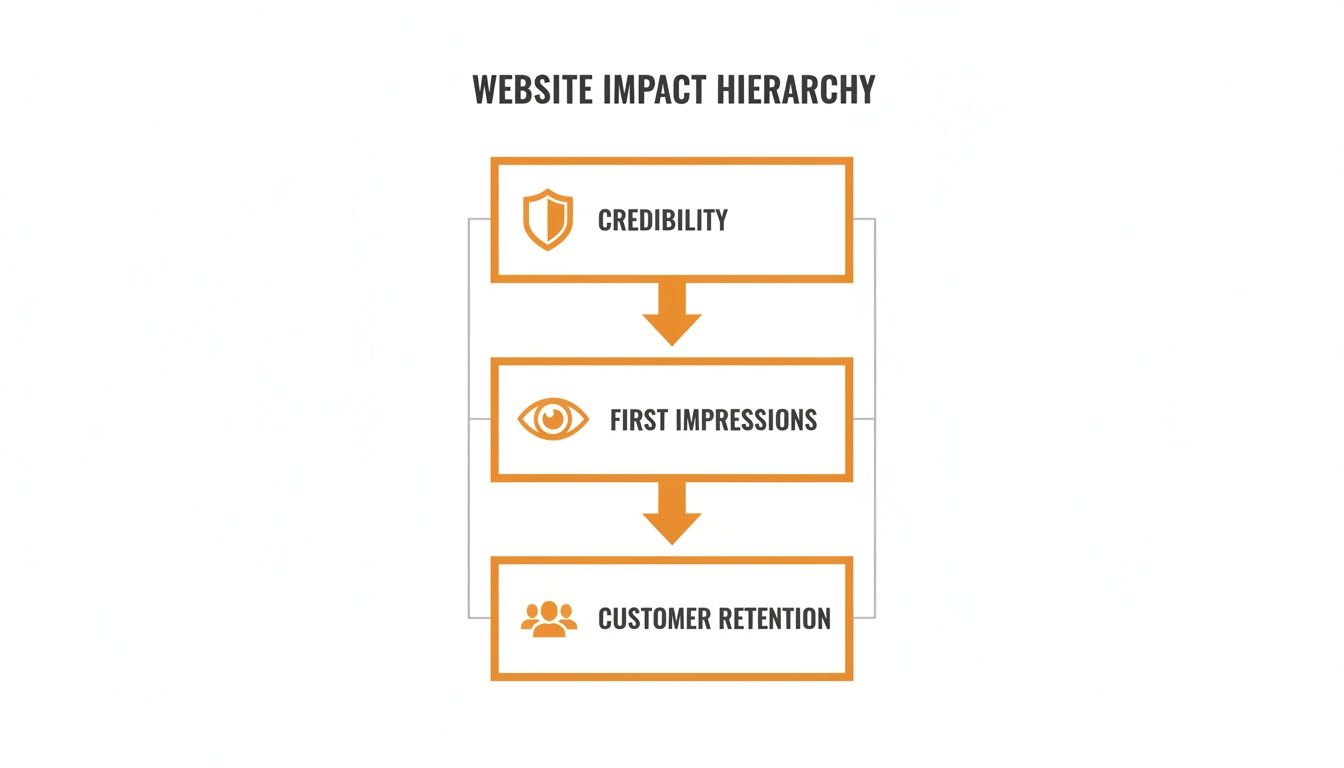
As you can see, a professional design establishes credibility. That credibility creates a great first impression, which is what ultimately helps you keep customers coming back.
Premium Add-Ons for Business Growth
Once you have the basics locked down, you can start looking at features that will actively help you grow. These are the premium components built to solve specific business problems, whether that’s selling products online, generating more leads with a blog, or making it easier for clients to book appointments.
Think of these as powerful upgrades that turn your website into a real workhorse.
A website shouldn't just be a digital brochure; it should be an active tool that generates leads, processes sales, and automates tasks. Premium features are what transform a static site into a dynamic business asset.
Here are some of the most common upgrades you'll find in higher-tier small business website design packages:
E-Commerce Functionality: This is a must-have for any business looking to sell products or services online. It includes everything from setting up a product catalog and secure payment gateways (like Stripe or PayPal) to building a smooth shopping cart and checkout experience.
Blog or Content Hub: A blog is one of the single best tools for boosting your SEO and positioning your business as an expert in your field. This add-on typically involves setting up a blog section that’s simple to manage and structured for search engine success.
Professional Copywriting: The words on your website are every bit as important as the design. Professional copywriting ensures your message is clear, persuasive, and strikes the right tone with your ideal customers, from the corporate offices in Beverly Hills to the creative studios in Hollywood.
Appointment Booking Integration: For service-based businesses like consultants, dentists, or salons, this is a game-changer. Integrating a scheduling tool lets clients book appointments directly through your site, cutting down on endless back-and-forth emails and phone calls.
As you start comparing what’s included in various website design packages, one of the biggest forks in the road will be choosing the right e-commerce platform. It's a decision that will influence what your site can do and how well it can grow with you for years to come.
How to Budget for Your Website Design Package
Let’s get right to the question every small business owner asks: “So, what’s this going to cost me?”
Trying to budget for a new website can feel like you're aiming at a moving target. You see prices all over the place, from a few hundred bucks for a DIY site to tens of thousands for a big agency project. The key to making a smart investment is understanding what actually goes into that final price tag.
Think of it like building a house. A pre-fab tiny home and a custom-built mansion are both technically houses, but the scope, materials, and level of detail create a massive difference in cost. It’s the exact same story with small business website design packages.

The price isn't just a random number; it's tied directly to the complexity and the value you're getting. Your budget will ultimately come down to what you need your website to do for your business.
Key Factors That Influence Website Cost
There are a few core ingredients that determine the price of a website package. Once you know what they are, you can look at a proposal and see exactly where your money is going. A simple brochure site for a local Glendale service business will have a very different price tag than a sophisticated e-commerce platform for a retailer in Beverly Hills.
Here are the main cost drivers:
Level of Customization: Can you get by with a pre-built template, or do you need a completely unique design from the ground up? A fully custom website gives you a one-of-a-kind user experience that nails your brand, but it requires a lot more design and development time.
Number of Pages: A basic five-page site (Home, About, Services, Blog, Contact) is much simpler to build than a website with 25+ pages that include detailed service breakdowns, case studies, and individual team bios.
Feature Complexity: This is a big one. Adding special functions will drive up the cost. Think e-commerce shopping carts, secure payment gateways, customer login portals, or integrated booking systems. Each of these requires specialized development work.
Agency Expertise and Location: An experienced agency with a solid track record and a deep portfolio will naturally command higher rates than a freelancer who is just starting out. An agency in a major hub like Los Angeles may also have a different pricing structure than one in a smaller town.
Setting a Realistic Budget
Knowing the cost drivers is a great start, but you still need a number in mind. Website design pricing for small businesses is a wide spectrum. A DIY approach using a website builder might run you anywhere from $100 to $3,000. If you hire a professional design agency, packages typically range from $15,000 to $30,000 for a standard project. For larger or more complex websites, you could be looking at $40,000 to $75,000 or more.
While that sounds like a big investment, keep this in mind: businesses that invest in quality user experience design can see an ROI as high as 9,900%. To see how a well-designed site becomes a powerful investment, explore the ROI potential with web design statistics.
To land on the right budget, start by defining your main goal.
Are you launching a new brand and just need a sharp-looking online brochure? A starter package could be perfect.
Trying to get more leads for your service business? You'll need a growth-focused package with strong calls-to-action and a solid SEO foundation.
Planning to sell hundreds of products online? An e-commerce package with robust inventory management is non-negotiable.
The right budget isn't the lowest price you can find; it's the amount that aligns with your business objectives and delivers a clear return on investment. A cheap website that doesn't generate leads is far more expensive than a premium one that does.
At the end of the day, your website should be treated as a capital investment, not just another business expense. It’s an asset that works for you 24/7—generating leads, building credibility, and driving sales. By understanding what shapes the cost, you can pick a package that gives your business a rock-solid foundation for growth. For a transparent look at what different investment levels get you, feel free to explore our small business website design plans and pricing.
Choosing the Right Package for Your Los Angeles Business
Picking a small business website package isn't like ordering off a menu. It’s about finding the combination of tools that will actually move the needle for your business. For any Los Angeles business owner, the right package is the one that perfectly lines up with your industry, your customers, and what you ultimately need your website to do.
Think about it this way. A high-end law firm in Beverly Hills needs to project authority and build instant trust. Their ideal package would focus on a secure, sophisticated design with professional attorney profiles and maybe a private client portal. Now, picture a new e-commerce startup slinging custom surfboards in Santa Monica. They need a package built for a smooth, mobile-first shopping experience with killer product galleries and rock-solid payment processing.
The needs across Southern California are wildly different. A one-size-fits-all template just won't cut it, which is why the right package is so critical—it turns your business goals into a website that actually works.
Matching Packages to Real L.A. Business Scenarios
Let's bring this down to earth with a couple of real-world examples from around Los Angeles. When you see how different packages solve specific problems for local businesses, it’s much easier to figure out what you really need.
Scenario 1: The Downtown LA Restaurant
Business Goal: Drive more online orders and fill tables through reservations.
Essential Package Features: * Online Ordering Integration: A seamless system that sends orders straight to the kitchen, making pickup and delivery a breeze for customers. * Reservation System: A built-in booking tool (think OpenTable or Resy) that lets diners lock in a table without ever leaving your site. * Mobile-First Design: Let’s be real, most people are ordering from their phones. The menu and checkout process have to be flawless on a small screen. * Mouth-Watering Menu Gallery: High-quality photos aren’t just nice to have; they’re essential for convincing someone they’re hungry.
Scenario 2: The San Fernando Valley Contractor
Business Goal: Generate high-quality leads and show off their craftsmanship.
Essential Package Features: * Prominent Lead Capture Forms: Easy-to-find "Request a Quote" forms on every important service page. No one should have to hunt for it. * Project Portfolio Gallery: A stunning visual gallery with before-and-after shots of jobs in places like Sherman Oaks or Encino. * Client Testimonials and Reviews: Trust is everything in this business. A dedicated section for rave reviews is a must. * Local SEO Foundation: The package has to be built with local search in mind, targeting terms like "kitchen remodeler in Van Nuys" to attract clients right in their backyard.
The best small business website design packages aren’t defined by a long list of features. They’re defined by their ability to solve a specific business problem. Figure out your main goal first, and the right features will become obvious.
Your Partner in Southern California
Los Angeles is at the center of our service area, and we proudly support clients across a wide network of surrounding cities and neighborhoods throughout Southern California. Our reach includes every corner of L.A.—from Downtown Los Angeles, Hollywood, West Hollywood, Beverly Hills, and Santa Monica to the beach communities of Malibu, Venice, Marina del Rey, Hermosa Beach, Manhattan Beach, and Redondo Beach. We also extend service through the San Fernando Valley, including Sherman Oaks, Studio City, Encino, Van Nuys, North Hollywood, Burbank, Glendale, Pasadena, Woodland Hills, Chatsworth, Canoga Park, Reseda, Northridge, and Tarzana. In the San Gabriel Valley, we work with clients in Alhambra, Monterey Park, San Gabriel, Temple City, Rosemead, Arcadia, El Monte, South El Monte, West Covina, Covina, Baldwin Park, Azusa, Glendora, Duarte, and Monrovia. Farther southeast, we serve Whittier, Pico Rivera, Downey, Norwalk, La Mirada, La Habra, and Cerritos. We also support the South Bay—including Torrance, Carson, Gardena, Hawthorne, Inglewood, and Long Beach—as well as the Gateway Cities and communities throughout the I-10, I-5, 101, and 405 corridors. Whether you’re in a major metro area or a smaller surrounding neighborhood, our team delivers reliable, high-quality service anywhere in or around Los Angeles.
An Essential Checklist for Vetting Web Design Agencies
Picking the right small business website design package is only half the job; finding the right agency to bring it to life is just as important. The relationship you have with your web design partner can make or break the long-term success of your online presence. It's time to move the conversation beyond the price tag and focus on real value—finding a team that actually gets your vision.
A great agency is more than a service provider; they’re a strategic partner. They should be just as invested in your company’s growth as you are. To find that kind of partner, you need to ask the right questions—the ones that cut through the sales pitch and get to the core of their process, expertise, and commitment.

Evaluating Their Portfolio and Industry Experience
First things first: look at their past work. An agency's portfolio is more than a gallery of pretty designs; it’s a track record. It shows you what they can actually deliver. Don't just skim it—dig into their projects to see if their style and capabilities are a good fit for you.
When you're looking through their work, ask these questions:
Can you show me websites you’ve built for businesses in my industry or with similar goals? If an agency has worked with businesses like yours, they already have a head start on understanding your customers and challenges.
What specific results did you achieve for those clients? You're looking for measurable outcomes here, like more traffic, higher conversion rates, or better search rankings. Case studies are gold.
How do you approach user experience (UX) in your designs? A great website should be a breeze to use. Their answer needs to show they put the end-user first.
Understanding Their Process and Communication
A professional agency has a transparent, well-defined process. You should know exactly what to expect at every stage, from the kickoff meeting to the final launch. Clear communication is key to preventing misunderstandings and keeping the project on schedule.
Choosing a web design agency is a significant business decision. The right partner won't just build you a website; they will create a digital asset that drives growth and adapts with your business over time.
To get a feel for their workflow and how they collaborate, ask these questions:
What is your typical project timeline, from start to finish? This will help set realistic expectations for when you'll be live.
How many rounds of revisions are included in the package? Knowing this upfront prevents scope creep and unexpected bills down the road.
Who will be my main point of contact, and how often can I expect updates? Having a dedicated project manager and regular check-ins makes for a much smoother experience.
Clarifying Post-Launch Support and Maintenance
Launch day isn’t the finish line—it’s just the beginning. A website is a living asset that needs ongoing care to stay secure, fast, and effective. A good agency will have clear options for support and maintenance after launch, protecting your investment for the long run. When vetting potential agencies, it helps to be methodical, much like using a comprehensive vendor due diligence checklist to ensure nothing is missed.
Here are the must-ask questions about long-term support:
What does your ongoing maintenance plan include? Look for specifics like software updates, security scans, performance monitoring, and regular backups.
What is your process for handling technical issues or requested changes after launch? You need to know their response time and how they bill for any post-launch work.
Will I have full ownership of the website and all its assets upon completion? This is a non-negotiable. You must own your domain, hosting, and all website files, period.
Asking these questions will empower you to spot red flags, find a partner that shares your goals, and build a relationship that sets you up for lasting success.
Common Questions About Website Design Packages
Even after you've mapped out a plan, the idea of investing in a new website can bring up a lot of questions. It's a big step! You're not just buying a digital brochure; you're building a core piece of your business infrastructure. To help you feel confident moving forward, we’ve answered some of the most common questions we hear from small business owners.
Our goal is to give you the clarity you need to make the best choice for your company, whether you’re serving clients in Downtown Los Angeles or growing a customer base in Pasadena or Long Beach.
How Long Does It Take to Build a Small Business Website?
This is usually the first thing people ask, and the honest answer is: it really depends on the scope of the project. A good analogy is building a commercial space. A simple retail storefront in Redondo Beach will go up much faster than a multi-level office complex in Beverly Hills. Websites work the same way.
For a standard, informational website for a small business, you can generally expect a timeline of about 4 to 6 weeks. This window covers all the critical stages—from initial discovery and strategy sessions to design mockups, development, and finally, plugging in your content.
But if you're looking at a more complex build—say, an e-commerce store with hundreds of products or a site with a custom client portal—you’re likely looking at 3 to 4 months or even longer. The timeline is also a two-way street; it depends heavily on how quickly you can provide feedback and how many revisions we go through together.
What Is the Difference Between a Custom Website and a Template?
Getting clear on this is key to setting the right budget and expectations from the get-go.
Think of it like buying a suit. A template-based website is like buying a suit "off-the-rack." It’s affordable, it looks sharp, and you can wear it right away. The catch is that it wasn't made just for you, so the fit might be a bit generic, and you’ll probably see other people with the same one.
A custom website is the opposite—it’s like getting a bespoke, tailored suit. It's designed and built from scratch to perfectly match your brand's unique style, measurements, and functional needs. While it’s a bigger investment in both time and money, the result is a one-of-a-kind digital presence that truly makes you stand out.
Do I Need to Provide My Own Website Content and Images?
That’s a great question, and it really hinges on the specific small business website design package you go with.
Many starter packages are built with the expectation that you'll supply the written copy and all the images. On the other hand, more comprehensive packages often include professional copywriting services and access to a library of high-quality stock photos to make sure your site looks and sounds its best.
A beautiful design can be completely undermined by poor-quality photos or unclear text. High-quality content is non-negotiable for building trust and converting visitors into customers.
We always make it a point to discuss content creation right at the start of a project. That way, everyone is on the same page, and we can ensure the final website has the polished, professional feel it needs to connect with your audience.
What Kind of Support Is Available After My Website Launches?
Launch day isn’t the finish line; it’s the starting line. Your website isn't a "set it and forget it" asset. It’s a living part of your business that needs regular care to perform well and stay secure.
We can’t stress this enough: an ongoing maintenance and support plan is the best way to protect your investment. Think of it like the regular tune-ups needed for a commercial vehicle that’s constantly running up and down the I-5 or 101.
These support packages typically cover all the essentials, including:
Regular Software Updates: Keeping your platform (like WordPress) and its plugins current is your first line of defense against security risks.
Security Scans and Monitoring: We’ll proactively scan for malware and other vulnerabilities to keep your site and your customers’ data safe.
Performance Checks: We make sure your site stays fast and responsive for users everywhere, from the San Fernando Valley to the South Bay.
Regular Backups: We create secure copies of your site, so if anything goes wrong, we can get you back online quickly.
Choosing the right website package is one of the most important decisions you'll make for your business. If you're ready to build a website that not only looks incredible but also delivers real, measurable results, the team at DLL Studios is here to help. We specialize in creating web solutions for businesses across Southern California that are built to perform.

