


.png)
Boost Your dental practice website design to Increase Bookings
Dental practice website design is like creating a warm, efficient reception area on the web. It needs to feel inviting and trustworthy from the first click. When done right, it turns curious visitors into scheduled patients.
Los Angeles is at the center of our service area, and we proudly support clients across a wide network of surrounding cities and neighborhoods throughout Southern California. Our reach includes every corner of L.A.—from Downtown Los Angeles, Hollywood, West Hollywood, Beverly Hills, and Santa Monica to the beach communities of Malibu, Venice, Marina del Rey, Hermosa Beach, Manhattan Beach, and Redondo Beach. We also extend service through the San Fernando Valley, including Sherman Oaks, Studio City, Encino, Van Nuys, North Hollywood, Burbank, Glendale, Pasadena, Woodland Hills, Chatsworth, Canoga Park, Reseda, Northridge, and Tarzana. In the San Gabriel Valley, we work with clients in Alhambra, Monterey Park, San Gabriel, Temple City, Rosemead, Arcadia, El Monte, South El Monte, West Covina, Covina, Baldwin Park, Azusa, Glendora, Duarte, and Monrovia. Farther southeast, we serve Whittier, Pico Rivera, Downey, Norwalk, La Mirada, La Habra, and Cerritos. We also support the South Bay—including Torrance, Carson, Gardena, Hawthorne, Inglewood, and Long Beach—as well as the Gateway Cities and communities throughout the I-10, I-5, 101, and 405 corridors. Whether you’re in a major metro area or a smaller surrounding neighborhood, our team delivers reliable, high-quality service anywhere in or around Los Angeles.
Every element — from clear trust signals to lightning-fast load times — should guide someone naturally from discovery to booking.
Why Dental Web Design Is Crucial For Patient Growth
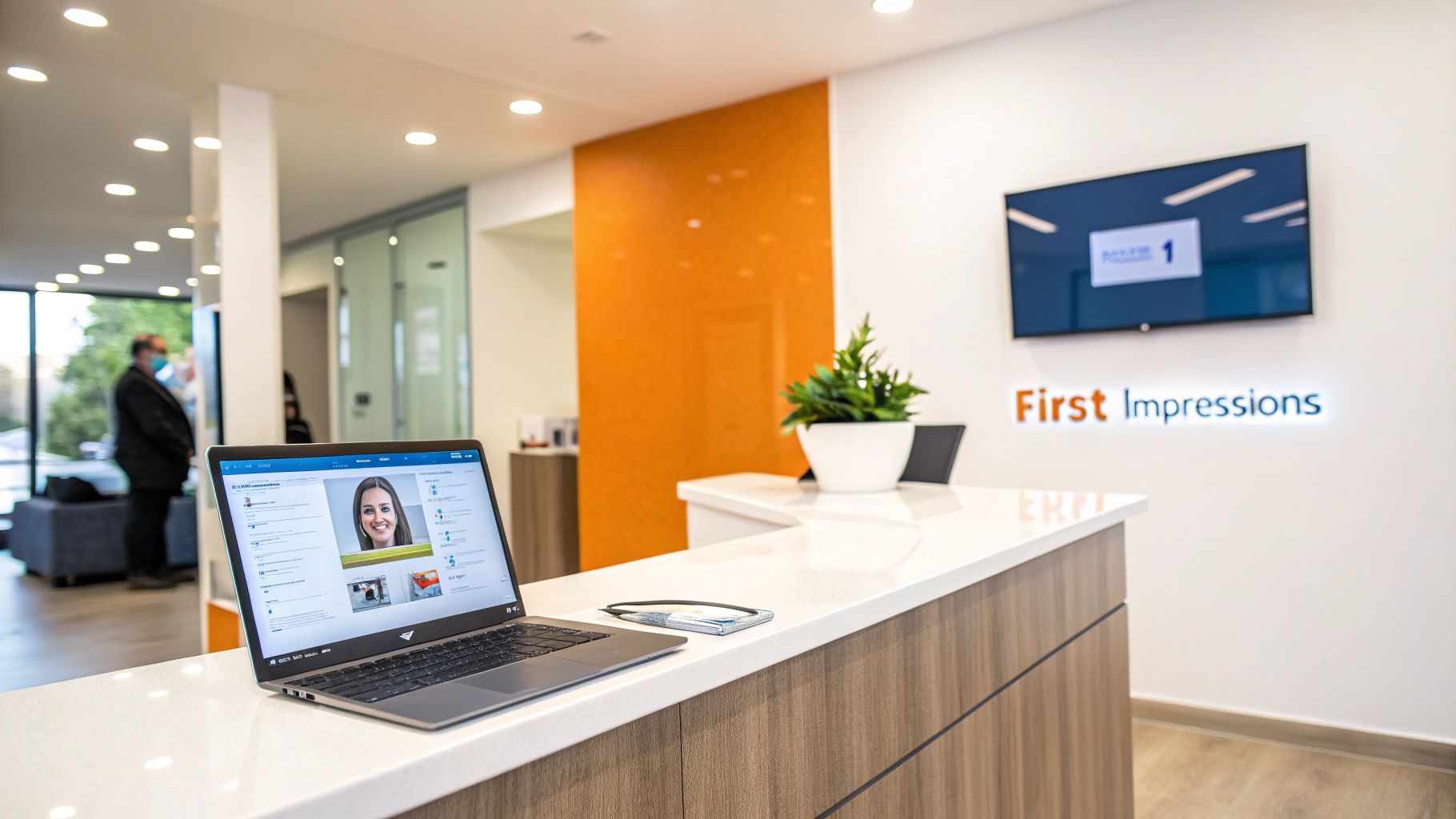
Think of your website as a front-desk concierge greeting visitors online. Every button, headline, and image works like a friendly smile and a guiding hand.
Clear menus act like well-placed signage in a clinic, directing prospects to services, reviews, or contact forms. Sprinkle in trust badges, genuine testimonials, and professional photography, and you instantly boost your credibility.
In a crowded market, a poorly designed site can drive away nearly 40% of potential patients before they even read your services. You can explore more insights in the full research on dental website design statistics.
Trust Signals: Badges, real-life testimonials, and polished imagery
Mobile Responsiveness: Serves 63% of users who browse on smartphones
ADA Compliance: Ensures accessibility for every patient
Fast Performance: Aim for load times under three seconds
Mobile-first design is non-negotiable when 63% of your visitors research you on their phones. Optimizing touch targets, lazy-loading images, and prioritizing critical content keeps people engaged.
Accessibility goes beyond simple navigation. Meeting ADA standards not only opens your doors to more patients but also demonstrates genuine care.
Performance cannot be an afterthought. Every extra second of delay chips away at conversions. Strive to serve your pages in under three seconds.
Trust Signals: Testimonials, badges, and professional imagery
Mobile-First Layouts: Responsive, intuitive interfaces on every device
ADA Compliance: Alt text, keyboard navigation, and screen-reader support
Performance Tactics: Image optimization, smart caching, and fast hosting
High Level Roadmap For Your Project
Strategy Session
Wireframe Review
Visual Design
Content Integration
Testing
Launch
Your website should feel like a helping hand at every click, guiding patients from curiosity to confirmed appointments.
Every design choice mirrors the patient journey—awareness, consideration, decision—so visitors move effortlessly toward booking. By aligning UX, on-page SEO, and content strategy at each stage, your site becomes both guide and gateway to better dental care. With this GPS roadmap, you’re ready to explore core concepts and case studies of dental practice website design in depth. Let’s dive.
Understanding Core Concepts In Dental Practice Website Design
Designing a dental website is a lot like arranging a welcoming reception area—you want patients to feel at ease from the moment they arrive. A thoughtful layout nudges them from casual browsing to booking that first appointment.
Here, we break the patient journey into three clear phases: Stage 1: Discovery, Stage 2: Consideration, and Stage 3: Booking. Each stage ties back to UX/UI, on-page SEO, branding, and ADA compliance, so you know exactly how to guide visitors forward.
Stage 1: Discovery – Draws in new visitors with optimized copy and local SEO signals.
Stage 2: Consideration – Builds confidence through straightforward navigation, real patient stories, and accessible design.
Stage 3: Booking – Turns interest into action with eye-catching CTAs and friction-free forms.
“Your homepage should act as a friendly guidepost that welcomes and directs patients.”
Building Website Foundations
Think of your site as a sturdy house. Five pillars hold up the roof: UX, UI, on-page SEO, branding, and ADA compliance.
UX clears the path—visitors never get lost.
UI highlights what matters most—buttons, forms, key messages.
SEO makes you discoverable with the right keywords.
Branding reinforces trust through consistent visuals.
ADA opens the door for everyone, regardless of ability.
When these elements work in harmony, patients flow naturally from one step to the next.
Mapping The Patient Journey
Imagine a driver at a busy intersection. In the discovery phase, on-page SEO and local listings are your street signs—they let patients know you’re right around the corner.
Next comes consideration, which feels like a guided tour of your practice. Trust badges, transparent fees, and accessible layouts remove any second-guessing and help prospects feel secure.
SEO Tactics for Local Visibility
ADA Compliance for Broad Access
Brand Elements That Resonate Emotionally
Integrating Core Website Elements
A winning dental website weaves together several layers. UX layouts chart a logical course. UI design zeroes in on what’s important. Then, branding and ADA work behind the scenes to keep everything welcoming and usable.
Element | Role | Example |
|---|---|---|
UX | Navigation Flow | Clear menu labels |
UI | Visual Cues | High-contrast CTAs |
SEO | Discoverability | Targeted local keywords |
ADA | Accessibility | Alt text and keyboard support |
Branding | Emotional Tone | Consistent logos and color palette |
Think of SEO as the street signs leading people to your door. Trust signals act like friendly doormen, inviting visitors inside. When you align these elements, your website becomes both guide and gateway.
UX And UI Strategies For Patient Conversion
Imagine your website as a friendly guide, helping visitors find the right doorway to book an appointment. Great UX and UI whisk away confusion and nudge prospects straight to the form.
A clear menu here, a standout button there—these aren’t just design flourishes. They act like signposts and handshakes, moving someone from curious click to confirmed booking. Small changes can spark big results: think 23% lifts in click-throughs and a surge in scheduled visits.
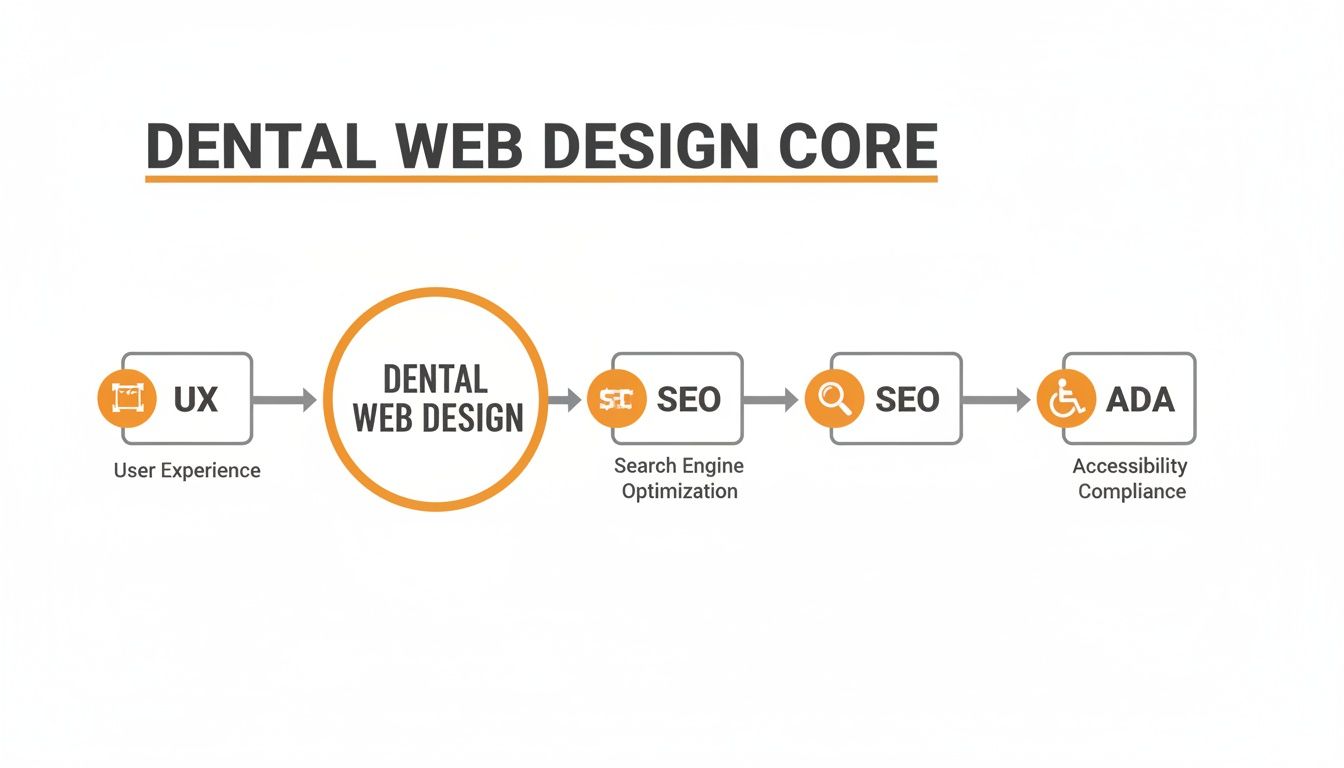
This infographic lays out how UX, SEO, and ADA compliance form a tripod for a winning dental website. Usability drives visibility, while accessibility makes sure no patient is left out. In essence, UX welcomes visitors, SEO brings them in, and ADA compliance keeps the doors open for everyone.
Intuitive Navigation Menus
Menus should feel like clear road signs, not a maze.
Aim for no more than 5 primary items—anything deeper forces a visitor to hunt for what they need.
Group related services under simple labels
Use a sticky menu to keep options in view as users scroll
Match your menu wording to patient language for instant clarity
For example, Acme Dental saw an 18% drop in bounce rate simply by trimming excess menu entries.
Visual Hierarchy As Design Compass
Think of visual hierarchy as your north star. It guides eyes to key actions and keeps the journey on course.
For instance, larger text for main calls to action (CTAs) and an accent hue on buttons ensure critical elements pop.
Make primary CTAs at least two sizes bigger than body text
Reserve bold colors exclusively for buttons
Surround forms with whitespace so they breathe
“A clear visual path makes scheduling an appointment feel effortless.” – Lead UX Designer
Micro-Interactions As Reassuring Handshakes
Tiny animations can do wonders for confidence. A hover glow on your booking button, or a gentle shake when a field goes empty, whispers “we’ve got you.”
• Hover effects add a playful nudge• Real-time field validation slashes form errors• Subtle loading icons tell users, “we’re on it”
After introducing a simple loading animation, one practice enjoyed a 12% boost in form submissions.
For more on crafting high-converting layouts, check out our guide on how to create a website that converts visitors in the DLL Studios blog.
Sticky Call Buttons For Immediate Contact
A sticky call button is like having your front desk on speed dial—always within reach.
Keep labels short and action-driven (“Call Now”)
Choose a vibrant color that stands out against your site’s palette
Ensure the touch target meets mobile accessibility standards
A recent study found 35% more calls when a sticky button stayed visible on phones.
Implementing these UX and UI strategies turns your dental website into a warm, reliable companion. Visitors in San Fernando Valley, San Gabriel Valley, South Bay, and Gateway Cities will glide from curiosity to booked appointment without a hitch.
SEO Strategies For Dental Practice Visibility
Getting your dental practice website to rank is like hanging a bright sign above your clinic door. Every detail—from headings to meta tags—needs to resonate with both potential patients and search engines.
Start by zeroing in on keyword research. Find the exact phrases your future patients type. Then, draft title tags and meta descriptions that speak directly to those queries.
A headline like “Top-Rated Cosmetic Dentist in Pasadena” can boost your click-through rate by 27% when it aligns with local intent.
On-Page SEO Essentials
Begin by focusing each page on a single topic. You should:
Break content into sections with headers (H1, H2, H3)
Write a unique meta description for every page
Add descriptive image alt text to reinforce target keywords
“Good on-page SEO is like an organized library,” says an SEO analyst. “Books are easy to find.”
Next, refine your title tags:
Lead with your primary keyword
Include a clear value proposition
Keep it under 60 characters
Image optimization matters, too. Compress files for faster loading and use alt tags like “dental implant procedure LA.”
Finally, implement schema markup. Adding LocalBusiness schema often triggers rich snippets, making your listing stand out.
Element | Purpose | Best Practice |
|---|---|---|
Title Tag | Improve click-through | Under 60 characters |
Meta Description | Summarize page content | 150–160 characters |
Image Alt Text | Accessibility and SEO signal | Include target keyword |
Schema Markup | Enhance SERP appearance | Use LocalBusiness schema |
Local SEO Tactics
Local SEO drives people right through your virtual doors. First, claim and optimize your Google Business Profile (GBP):
Accurate NAP (Name, Address, Phone)
High-quality photos of your clinic
Up-to-date business hours and services
Then audit citations across Yelp, Healthgrades, YellowPages, and others. Inconsistent details can hurt your ranking.
Gathering patient reviews is essential. Aim for 20+ five-star ratings in six months to see a noticeable boost.
Here’s a quick review-generation checklist:
Ask right after treatment
Send a friendly follow-up link
Respond to every review with gratitude
For more real-world tips, check our guide on Local SEO for Doctors.
Geo-targeted content also helps. Try blog posts like “Best Emergency Dentist in Sherman Oaks,” featuring:
Local service area highlights
Patient success stories by neighborhood
FAQs with neighborhood keywords
Combine strong on-page fundamentals with these local tactics, and your site turns into a patient magnet. This two-pronged SEO approach can drive a 40% increase in organic leads and appointments.
Tracking And Analytics
You can’t improve what you don’t measure. Set up Google Analytics and Google Search Console to track:
Growth in organic sessions
Click-through rate on title tags
Views on your Google Business Profile
Configure goal tracking for appointment-button clicks and conduct regular audits. This keeps your dental practice site competitive in the Southern California market.
Next up: platform integrations and security best practices.
“Consistent tracking reveals which keywords drive booked appointments,” notes a local SEO specialist.
These SEO strategies guide patients from search results straight to your booking page, powering long-term growth.
Platform Choices, Integrations And Security Practices
Selecting a website builder is like choosing the right set of dental instruments—you need simplicity for routine tasks and enough power for complex procedures. At DLL Studios in Los Angeles, we serve practices across every corner of L.A. and nearby communities in the San Fernando Valley, San Gabriel Valley, South Bay, and gateway corridors. Over time, we’ve tested Wix Studio, Webflow, and WordPress to see where each platform excels—and where they might fall short.
Each option brings its own strengths. Wix Studio feels like drag-and-drop building blocks, complete with automatic SEO hints. Webflow hands you pixel-perfect design control. WordPress powers more than a third of the web thanks to its vast plugin ecosystem.
Integrations And APIs
Your site needs to talk seamlessly to booking tools and EHR systems. Real-time availability, secure intake forms, and smooth data exchange turn a website into an extension of your front desk.

From this Webflow editor view, you can adjust global styles, update meta tags, and preview breakpoints for every device.
Comparison Of Top Website Builders
Before you decide, here’s a side-by-side look at the big three for dental practices:
Platform | Ease Of Use | Flexibility | SEO Features | Pricing | Best For |
|---|---|---|---|---|---|
Wix Studio | Beginner-Friendly | Limited Code Access | Built-In SEO Advisor | $16–$45/mo | Quick, Turnkey Launches |
Webflow | Moderate Learning Curve | Advanced CSS Control | Clean Code, Custom Schema | $29–$212/mo | Designers & Developers |
WordPress | Moderate (With Hosting) | Unlimited Plugins | Yoast & Rank Math Plugins | $5–$25/mo | Deep Customization & Scalability |
Wix Studio gets you live in hours, Webflow lets you fine-tune every pixel, and WordPress offers an endless plugin library for every feature you can imagine.
Performance And Security Practices
A slow or vulnerable site can drive patients away. Think of speed and security as your site’s seatbelt and airbags.
Implement an SSL certificate, enable CDN caching, and trim scripts so pages load in under 3 seconds.
HTTPS Enforcement encrypts all data between patients and your server.
Regular Backups create restore points if anything goes wrong.
Malware Scanning catches threats before they spread.
Firewall Rules block suspicious traffic and brute-force attempts.
Checklist To Keep Your Dental Website Fast And Safe1. Choose a reliable hosting platform2. Integrate booking and EHR APIs securely3. Apply SSL and CDN settings4. Automate backups and malware scans5. Review ADA plugin updates
Learn more about builder pros and cons in our guide on Wix Studio vs WordPress vs Shopify Which Platform Wins to see which foundation suits your dental practice website design needs.
Choosing A CDN Provider
To serve patients across Los Angeles with minimal lag, pick a CDN with global edge servers:
Cloudflare: Free DDoS protection and an Always Online cache for static assets.
AWS CloudFront: Seamless integration with S3, detailed access logs, and fast asset delivery.
By pairing the right platform with seamless integrations and rock-solid security, your dental practice website becomes more than an online brochure—it turns into a trusted hub that welcomes new patients and supports your growth.
Content Strategy And Real World Examples
When someone lands on your dental site, they want answers fast. A solid content strategy not only earns patient trust but also gives your search rankings a boost. Below, we’ll map a plan covering service pages, blog posts, FAQs, videos, and testimonials that speak directly to common patient concerns.
Here’s how each content type plays its role in your dental marketing funnel:
Service Pages explain treatments in patient-friendly language and strengthen your local SEO signals.
Blog Posts tackle questions like “How often should I get a cleaning?” to attract organic traffic.
FAQs use conversational phrasing to address quick concerns and win at voice search.
Video Scripts guide short, engaging clips that build trust and keep visitors on site longer.
Patient Testimonials showcase genuine experiences and reinforce why you’re the right choice.
Planning A Publishing Calendar
A calendar keeps everyone aligned and prevents topics from slipping through the cracks. Here’s a simple template:
Month & Week: Slot each post into a specific date.
Topic Title: Tie it to a patient question or a local keyword.
Content Type: Specify whether it’s a blog post, video, FAQ, or service page.
Team Member: Assign who’s responsible for creating it.
Status: Mark it as Draft, In Review, or Published.
SEO Focus Keyword: Something like dental practice website design in Hollywood.
With this approach, you’ll cover every neighborhood—from Downtown Los Angeles and Hollywood to West Covina and Long Beach.
Weaving Storytelling And Compelling Calls To Action
Stories help people picture themselves walking into your office. Open with a relatable concern, show how your team stepped in with genuine care, and wrap up with a clear next step.
Start with a patient scenario everyone recognizes.
Highlight the empathetic solution your team provided.
Finish with a bold CTA like Schedule Your Free Consultation Today.
“A patient who reads a story feels seen and is 46% more likely to book an appointment,” notes a recent industry survey.
Checklist For Updating Content
Outdated copy can erode trust and tank your rankings. Run through this list every quarter to keep things fresh:
Review and update statistics like success rates or treatment costs.
Refresh images and videos to reflect your current office and team.
Audit internal links to point toward new resources.
Fix broken links and remove outdated plugins.
Verify all local references to cities such as Glendale, Pasadena, and Torrance.
After following this routine, practices in Santa Monica and Encino reported a 30% boost in organic traffic.
Real Examples From Successful Practices
Practice Name | Approach | Result |
|---|---|---|
Bright Smile LA | Weekly blogs on whitening tips | 25% increase in leads |
Valley Family Dent | FAQ videos on insurance and pricing | 18% more bookings |
Oceanview Dentistry | Patient story pages for implants | 22% boost in calls |
These snapshots show how targeted content and smart keywords can drive real results. You can adapt the same tactics for areas like Glendale and Sherman Oaks.
Tracking Content Performance
Measure page views, time on page, and conversion actions to pinpoint which topics resonate most. Then every six months, refresh or prune underperforming content based on these insights.
DLL Studios partners with clients across Southern California, from Beverly Hills to Tarzana, to expertly bring your dental practice website design to life.
Frequently Asked Questions
What design features truly move the needle for a dental practice website? Think of your CTAs as signposts guiding visitors. Paired with authentic patient testimonials, they steer folks straight to your booking page.
How vital is ADA compliance on your site? Imagine accessibility as a wide-open front door. By adding alt text and keyboard-friendly navigation, you tap into 20% more potential patients and shield your practice from legal hurdles.
Key Conversion Elements
Clear CTAs: Buttons in bold colors with action-driven text.
Trust Badges: Display certification seals and association logos.
Concise Testimonials: Short patient quotes paired with friendly photos.
What platform factors matter most for dental websites? It’s like picking the right toolkit—you need easy editing, built-in SEO features, and out-of-the-box ADA support. This combo makes rolling out updates across Los Angeles and surrounding neighborhoods a breeze.
Choosing The Right Platform
How do I integrate appointment booking without friction? Hook up to platforms like NexHealth or Zocdoc via their APIs. Real-time availability slashes those back-and-forth phone calls.
“Booking integrations can lift appointments by 15%,” notes a web specialist.
Can I tackle local SEO in-house? Absolutely. Start by optimizing your Google Business Profile, weave in neighborhood keywords, and actively seek reviews from patients in Santa Monica and Torrance. Consistent NAP (Name, Address, Phone) details are your secret weapon for local rankings.
What maintenance steps keep your site fast and secure? Automate daily backups, turn on a CDN for caching, and check load times every month. Don’t forget to update your ADA plugins and run a quick screen-reader test to stay compliant.
Content And Updates
What content resonates with dental patients online? Service pages, blog posts, and FAQ sections answer their burning questions. Sprinkle in video testimonials to boost engagement and dwell time.
Content Checklist
Service Pages: Break down treatments in everyday language.
Blog Posts: Target local search terms with practical answers.
Videos: Let real patients tell their stories on camera.
How often should I refresh site content? Aim for a quarterly tune-up. One Glendale practice saw a 30% traffic jump after committing to regular content audits.
Ready to elevate your dental website? Partner with DLL Studios for expert guidance and measurable results.
