


.png)
Affordable Website Design Services for Lasting Business Growth
Let's be honest, the phrase "affordable website design services" can make a business owner a little nervous. It often brings to mind thoughts of cheap templates, shoddy work, and a final product that does more harm than good.
But that's a huge misconception. True affordability isn't about finding the rock-bottom price; it's about getting the best possible value and a real return on your investment. Think of it as a smart business tool—one that balances professional quality and must-have features with a budget that actually helps you grow.
What Affordable Website Design Really Means
Instead of just looking for the cheapest option, the better question to ask is, "What level of investment will actually deliver tangible results for my business?"
A well-built website is an asset. It's your hardest-working employee, operating 24/7 to generate leads, build your credibility, and bring in revenue. When you see it that way, the upfront cost is just one piece of the puzzle. The real measure of affordability is the return it brings back to you.
Shifting Focus From Cost to Value
The moment you stop viewing your website as an expense and start seeing it as a growth engine, everything changes. A site that costs a little more but doubles your incoming leads is infinitely more "affordable" than a dirt-cheap one that sits there collecting digital dust.
The goal is to find that sweet spot where professional design meets a sensible budget. That’s where the magic happens.
The best affordable website design services strike the perfect balance between professional quality, essential features, and long-term support. The aim isn’t just to save a few bucks; it’s to get the best value that drives measurable growth for your business.
The Market for Accessible Web Design
And the great news? The demand for high-value, accessible web design has exploded. The global website builder market is already worth $2.32 billion, and in the US alone, Web Design Services is a massive $47.4 billion industry.
Within that huge market, quality affordable services are carving out a major space. You can now get an entry-level custom website with 5-7 pages, mobile optimization, and basic SEO starting around $1,500. That’s a world away from the typical $2,000-$15,000 price tag many agencies quote.
These numbers prove that getting a high-quality, professional website is more achievable than ever for small businesses. You can find more great insights into small business website statistics on networksolutions.com.
A Clear Breakdown of Website Design Costs
Ever wonder what your money actually gets you with affordable website design? Let's pull back the curtain. Think of it like building a house: you can go with a straightforward, functional floor plan that covers all the essentials, or you can design a custom home with unique architecture, high-end finishes, and specialty rooms.
Both options give you a house, but the scope, complexity, and final price tag are worlds apart. It’s the exact same story with websites. A basic five-page informational site is your functional floor plan, while an e-commerce platform with a custom client portal is the custom-built home. Both serve a purpose, but their costs reflect the work involved.
This chart shows how true value isn't just about the lowest price—it's that sweet spot where quality, features, and budget all click into place.
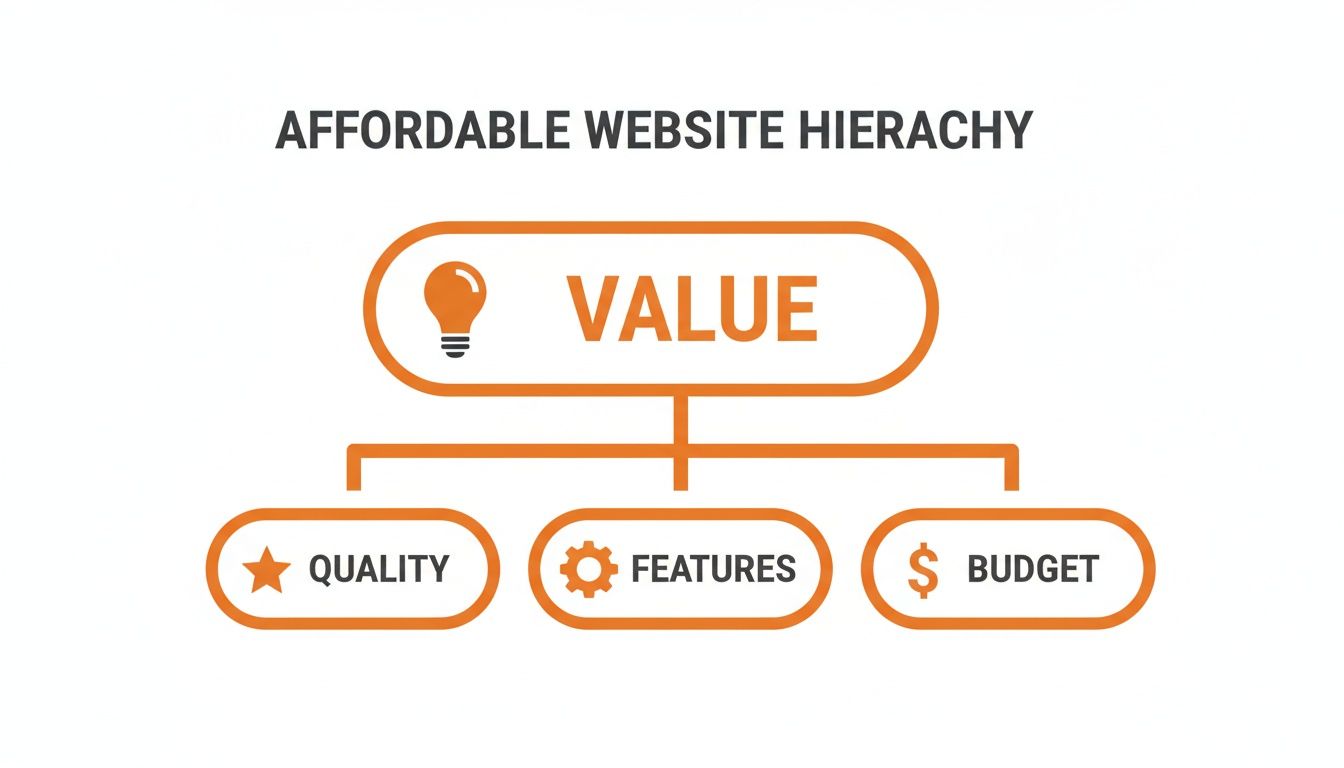
As you can see, the goal isn't just being cheap. It’s about finding the ideal intersection where great design and must-have features meet a price point you can comfortably manage.
Core Factors That Shape Your Quote
The final cost of your website directly mirrors the time, skill, and resources needed to bring it to life. A transparent quote should break this down for you, so you know exactly where your investment is going. Getting familiar with these variables helps you make smarter decisions.
Three main things drive the cost of any web design project:
Page Count and Content: A simple "brochure" site with five pages (Home, About, Services, Blog, Contact) will always be more budget-friendly than a 25-page site with multiple service pages and a huge resource library. More pages mean more work.
Design Complexity: A clean, modern design built on a proven layout is faster—and therefore cheaper—to produce than a highly artistic design full of complex animations and one-of-a-kind interactive elements.
Custom Functionality: This is the biggest variable by far. Need to sell products online? Add a booking system? Create a members-only portal? Any feature like this requires serious development time, which naturally increases the project's scope and price.
Comparing Common Website Design Packages
To make things clearer, many agencies (including us) offer tiered packages. These bundles group common features together at different price points, giving you a solid starting point that aligns with your budget. Good startup budget and cost management is all about picking the right tier without having to sacrifice quality.
Here’s a look at what different packages typically include, helping you see where your business might fit.
Package Tier | Average Cost Range | Typical Features | Best For |
|---|---|---|---|
Starter | $1,500 – $3,000 | 5-7 pages, standard design, mobile-responsive, basic SEO setup, contact form. | New businesses, freelancers, or professionals who need a simple, professional online brochure. |
Growth | $3,000 – $6,000 | 10-15 pages, semi-custom design, blog integration, advanced SEO, lead capture forms. | Established small businesses focused on generating more leads and boosting their online visibility. |
E-commerce | $6,000 – $10,000+ | All Growth features, plus a full online store setup, payment gateway integration, and product pages. | Businesses ready to sell products or services directly from their website. |
These tiers are just a framework, of course. Any good agency will work with you to customize a quote. If you're curious about specifics, you can always explore our website design plans and pricing for a more detailed breakdown.
Uncovering Potential Hidden Costs
A good quote is a transparent one, but it’s still smart to ask what isn't included in the initial project fee. Knowing about these ongoing expenses helps you build a realistic long-term budget without any nasty surprises.
A truly affordable website is one with no financial surprises. A trustworthy design partner will be upfront about all potential costs, including the ongoing services needed to keep your site secure, fast, and effective after launch.
Make sure you ask about these common additional costs:
Domain Name Registration: This is the annual fee for your website address (like yourbusiness.com). It's usually around $15-$20 per year.
Website Hosting: This is the service that keeps your site online and accessible to visitors. Expect to pay anywhere from $15-$50 per month.
Ongoing Maintenance: Think of this as insurance for your website. It covers security scans, software updates, and backups. Plans often run from $50-$200 per month.
Premium Plugins or Licenses: If your site needs special features, it might rely on third-party tools that have their own annual subscription fees.
Choosing Your Path: DIY Builders vs. Pro Agencies
When you start looking for an affordable way to get a website, you’ll quickly run into three main options. Each one has its own trade-offs between time, money, and the quality of the final product. Getting a handle on these paths is the first step to making a smart decision that actually helps your business.
Think of it like buying a suit. You can grab one off the rack (that’s your DIY builder), get a standard size tailored to fit a bit better (a template), or have one custom-made from scratch (a professional agency). You end up with a suit in all three scenarios, but the fit, the quality, and the impression you make are worlds apart.
The DIY Website Builder Route
Platforms like Wix, Squarespace, and Shopify have made it incredibly easy for anyone to get a website online. Their drag-and-drop editors promise a fast, cheap solution, which sounds perfect for startups or anyone on a shoestring budget.
The biggest pull is the low upfront cost. For a small monthly fee, you get the tools to build something functional without ever touching code. But that affordability has a hidden price: your time. What looks simple on the surface can quickly become dozens of hours spent fighting with layouts, figuring out why something broke, and bumping up against the platform’s limits.
The true cost of a DIY website isn't the monthly subscription fee; it's the countless hours of your time invested in learning, building, and troubleshooting—time that could have been spent running your business.
On top of that, DIY sites often have a tough time with performance and SEO. The code behind them can be clunky and slow, and the built-in SEO tools are usually pretty basic. It’s hard to rank well when you’re starting at a disadvantage. While they’re a decent starting point for some, many businesses find they’ve outgrown their DIY site in a year or two and have to start all over again.
The Customizable Template Middle Ground
The next option is a solid middle ground: using a pre-designed template on a more powerful platform like WordPress or Wix Studio. This route gives you some of the cost savings of a DIY builder but with far more room for customization and growth.
Templates give you a professionally designed foundation that you or a developer can then tweak to match your brand. It saves a ton of time compared to staring at a blank screen. It’s a popular choice for anyone who wants a polished look without paying for a fully custom build. You can see what’s possible by exploring a collection of professional designs, like these Wix Studio templates that are customizable.
This path isn’t a walk in the park, though. Trying to customize a template beyond what it was designed for can get technical, fast. You might find yourself needing to learn CSS or JavaScript just to make a simple change. And if you’re not careful, using poorly coded templates or too many plugins can bog down your site, making it slow and insecure. This creates what’s known as technical debt—a mess of problems you’ll have to pay someone to fix later.
The Professional Agency Investment
Your third option is to hire a professional web design agency. This is definitely the biggest upfront investment, but it almost always delivers the best long-term value. An agency isn’t just building a website; they’re delivering a complete strategy designed around your business goals.
When you work with an agency like DLL Studios, you’re hiring an entire team of experts—strategists, designers, developers, and SEO specialists—all working to build a high-performing asset for your business. The process starts with a deep dive into your brand, your customers, and your competition. This ensures the final website isn’t just pretty, but is built to perform.
This approach completely removes the time suck and technical headaches of the other options. You get a fully custom, SEO-optimized, and scalable website designed from day one to generate leads and sales. The higher cost is better seen as an investment in a powerful tool built to deliver a real return. For any business that’s serious about growth, the expertise and peace of mind an agency provides is worth every penny.
Essential Features of a High-Performing Website
A great website is so much more than a pretty design; it’s a finely tuned engine built for performance. When you invest in affordable website design services, you’re not just buying a digital brochure. You’re securing a business asset designed to attract visitors, earn their trust, and turn them into customers.
To pull that off, every website needs a solid foundation of non-negotiable features. Think of them as essential investments, not optional extras. They all work together to drive real business outcomes like better search rankings, higher visitor engagement, and more sales.
Mobile-First Responsive Design
These days, your website’s journey almost always begins on a smartphone. A mobile-first approach isn't a trend anymore; it's the standard. It means your site is designed for the smallest screen first and then adapted for larger devices like tablets and desktops. The goal? A flawless experience for every single user.
Responsive design is the tech that makes this happen, automatically adjusting layouts, images, and navigation to fit any screen size. With most web traffic now coming from mobile devices, a site that isn't mobile-friendly is basically invisible to a massive chunk of your audience.
In fact, with over 80% of modern websites needing mobile optimization, any worthwhile web design service delivers a fully responsive site as a core part of their package. As you can see in recent trend reports, this focus on multi-device usability directly boosts visitor engagement and can lead to 20-30% higher retention rates. You can read more about current affordable website design trends on everydayweb.co.
Seamless User Experience (UX)
User experience, or UX, is all about the feeling someone gets when they use your website. Is it easy to get around? Can they find what they're looking for without hitting a dead end? A good UX turns casual visitors into loyal customers by making their journey intuitive and, frankly, enjoyable.
A great user experience is invisible. Your visitors shouldn't have to think about how to use your website; it should just work, guiding them naturally from one point to the next.
Key elements of a strong UX include:
Logical Navigation: A simple, clean menu that helps users find key pages like "Services" or "Contact" in a click or two.
Readable Content: Using clean fonts, short paragraphs, and clear headings to make your information easy to scan and digest.
Intuitive Layout: Organizing content in a predictable way that doesn't leave users guessing where to look next.
Solid SEO Foundations
Search Engine Optimization (SEO) is how your website gets found on Google. A truly affordable web design service doesn’t just build a site; it builds SEO best practices right into its DNA from day one. This foundational work is what sets you up for long-term visibility.
We're not talking about complex marketing campaigns here. It's about getting the technical basics right. This includes a logical site structure that search engines can easily crawl, proper use of heading tags (H1, H2, etc.) to organize content, and optimized page titles and meta descriptions that tell Google exactly what each page is about.
Lightning-Fast Load Speeds and Security
In an age of instant gratification, speed is everything. If your website takes more than a few seconds to load, visitors will bail—and probably never come back. Slow speeds crater your user experience and sink your search rankings, as Google actively prioritizes fast-loading sites.
Just as important is security. Every professional website must have an SSL certificate, which you can spot by the HTTPS in the URL. This encrypts the data shared between your site and its visitors, protecting their information and building crucial trust. Modern browsers now flag non-HTTPS sites as "Not Secure," which is a surefire way to scare away potential customers before they even see your homepage.
Finding the Right Web Design Partner in Los Angeles
Finding the right partner for any project is tough, but when it comes to web design in Southern California, a local expert can be a game-changer. An agency that lives and breathes the competitive local market knows how to translate your business goals into a website that actually connects with your customers. It means looking past the sales pitch and getting into the nitty-gritty of their work and their process.
This isn’t just about hiring someone to build a website. It’s about finding a team that can operate as an extension of your own. You need a partner who understands your vision, communicates without jargon, and has a proven history of getting results for businesses just like yours.
Analyzing Portfolios for Quality
A portfolio is more than a gallery of pretty designs—it’s the evidence. When you’re looking through an agency’s past work, don’t just skim the homepages. Click around. Get a feel for the sites and ask yourself a few critical questions.
First, how’s the user experience? Is the navigation obvious? Can you find the contact info or a list of services in a couple of seconds? A site that’s confusing is a major red flag, no matter how cool it looks.
Next, check the technical stuff. Pull up their portfolio sites on your phone and your computer. Do they load fast? Do they look just as good on a small screen? Keep an eye out for the little things, too. Broken links, blurry images, or weird formatting all point to a lack of attention to detail.
Finally, look for variety and relevance. Has the agency worked in your industry before? While a diverse portfolio shows they’re adaptable, seeing them succeed with businesses similar to yours gives you that extra bit of confidence that they already get your world.
Reading Between the Lines of Client Testimonials
Client testimonials and reviews on sites like Google or Clutch are gold, but you have to know how to interpret them. Generic praise like, "they did a great job," is nice, but it doesn't really tell you anything.
Look for the specifics. The best reviews mention concrete results or details about the process. Did the new site actually increase their leads? Was the project manager responsive? Did the agency stick to the timeline and the budget?
A great testimonial doesn't just say the agency was good; it explains why. Look for clients who highlight specific skills like clear communication, strategic thinking, or a seamless project management process. These details reveal an agency's true strengths.
Also, check out how an agency handles negative feedback. A professional and helpful response to criticism can tell you more about their character than a dozen five-star reviews. It shows they take ownership and are committed to doing things right.
Your Agency Evaluation Checklist
Before you sign on the dotted line, run through this checklist. A solid agency should have clear, confident answers for every single one of these points.
Communication Style: How will they keep you in the loop? Is there a dedicated project manager you can call?
Project Management Process: What tools do they use to keep things on track? Can they walk you through their typical project timeline from start to finish?
Industry Understanding: Do they ask smart questions about your business, your customers, and your competition?
Technical Expertise: What platforms are their bread and butter (like Wix Studio, Webflow, or WordPress)? Does their skill set match what you’ll need down the road?
Scope and Revisions: How many rounds of changes are included in the price? What’s the process if you need to add something new halfway through?
Post-Launch Support: What happens after the site is live? Do they offer training, maintenance, or ongoing support?
Finding the right team is especially important in a place as sprawling and diverse as Los Angeles. Los Angeles is at the center of our service area, and we proudly support clients across a wide network of surrounding cities and neighborhoods throughout Southern California. Our reach includes every corner of L.A.—from Downtown Los Angeles, Hollywood, West Hollywood, Beverly Hills, and Santa Monica to the beach communities of Malibu, Venice, Marina del Rey, Hermosa Beach, Manhattan Beach, and Redondo Beach. We also extend service through the San Fernando Valley, including Sherman Oaks, Studio City, Encino, Van Nuys, North Hollywood, Burbank, Glendale, Pasadena, Woodland Hills, Chatsworth, Canoga Park, Reseda, Northridge, and Tarzana. In the San Gabriel Valley, we work with clients in Alhambra, Monterey Park, San Gabriel, Temple City, Rosemead, Arcadia, El Monte, South El Monte, West Covina, Covina, Baldwin Park, Azusa, Glendora, Duarte, and Monrovia. Farther southeast, we serve Whittier, Pico Rivera, Downey, Norwalk, La Mirada, La Habra, and Cerritos. We also support the South Bay—including Torrance, Carson, Gardena, Hawthorne, Inglewood, and Long Beach—as well as the Gateway Cities and communities throughout the I-10, I-5, 101, and 405 corridors. Whether you’re in a major metro area or a smaller surrounding neighborhood, our team delivers reliable, high-quality service anywhere in or around Los Angeles.
By asking the right questions and doing your homework, you can confidently pick a partner who will not only build you a great website but also support your business for years to come. To see what that kind of local expertise looks like in action, feel free to explore our approach to Los Angeles web design services.
Answering Your Top Questions About Affordable Web Design
Investing in a new website is a big step, and it's natural to have questions. Let's tackle some of the most common ones we hear from small business owners. My goal here is to give you clear, straight-up answers so you can move forward with confidence and understand the real value behind a professional, yet affordable, website.
How Much Should a Small Business Website Cost, Really?
There’s no one-size-fits-all answer, but for a professional, well-built website, a small business should expect to invest between $1,500 and $5,000. The final number really depends on what you need—how many pages, any special features like e-commerce, and how complex the design is. A simple, beautiful informational site will land on the lower end, while a full-blown online store will be higher.
The best way to think about it is as an investment, not just a cost. A $3,000 website that pulls in $15,000 of new business delivers a fantastic return. On the flip side, a "free" DIY site that brings in zero customers is actually a huge missed opportunity. Always insist on a detailed quote that breaks everything down.
Can a Less Expensive Website Still Rank Well on Google?
Absolutely. A website's ability to rank on Google comes down to how it's built, not how much you paid for it. SEO success is about technical fundamentals.
A good affordable design service will build your site on a rock-solid SEO foundation. That means making sure it’s mobile-friendly from the get-go, loads lightning-fast, and has a logical structure that search engines can easily understand. They’ll also handle the on-page basics, like title tags and meta descriptions, right from the start.
While you'll still need ongoing SEO work to climb the ranks, a well-built affordable site gives you the essential framework to compete. A shoddily made DIY site, however, can be riddled with technical issues that sabotage your ranking potential before you even begin.
A website's ability to rank on Google comes from its technical structure, mobile performance, and quality content—not its price tag. An affordable, professionally built site starts with a strong SEO foundation, giving you a crucial advantage over template-based or DIY alternatives.
What’s a Realistic Timeline for Building a Website?
For a typical affordable website project, you’re looking at a timeline of 4 to 8 weeks from kickoff to launch. This can shift a bit depending on the scope and, honestly, how quickly you can provide feedback and content like text and images. Agencies that specialize in affordable sites have usually perfected their process to deliver quality without dragging things out.
Here’s a rough breakdown of the phases:
Discovery and Planning (1 week): This is where we nail down your goals, who you're trying to reach, and the sitemap.
Design and Revisions (1-2 weeks): We create the visual mockups and concepts for you to review.
Development (2-3 weeks): Your approved design gets turned into a fully functional, responsive website.
Content Integration (1 week): We plug in all your text, images, and other media.
Final Review and Launch (1 week): One last round of testing and quality checks before we push it live.
The single biggest factor in keeping a project on track? Getting your content and feedback in on time.
My Website Is Live… Now What?
Once your site launches, the journey isn't over. You need to think about three key things to protect your investment: hosting, maintenance, and fresh content. Any good web design partner will walk you through these options so you know exactly how to keep your new digital home in great shape.
Hosting: This is simply the service that keeps your website online and available for everyone to see. Think of it as the rent for your spot on the internet.
Maintenance: This is crucial. It covers things like software updates, security scans, and regular backups to keep your site running smoothly and safely. Most agencies, including us, offer affordable monthly plans to take care of all the technical stuff for you.
Content: A static website eventually becomes stale. To keep growing, you need a plan for adding new content, whether it's blog posts, case studies, or new project photos. This tells both visitors and search engines that your business is active and relevant.
Thinking about these ongoing needs from day one ensures your website remains a valuable asset long after launch day.
Ready to build a powerful, professional website without breaking the bank? At DLL Studios, we specialize in creating affordable, high-performing websites that drive real results for businesses. Start your project with us today!

