


.png)
Digital Marketing for Professional Services That Wins Clients
For lawyers, accountants, consultants, and other professionals, marketing isn't just about getting your name out there—it's about building trust. It's the strategic use of online channels like your website, search engines, and expert content to attract, engage, and ultimately win over high-value clients. This approach goes far beyond relying on word-of-mouth, allowing you to establish your firm's expertise online and generate a reliable stream of qualified leads.
Building Your Digital Foundation for Client Growth
In the world of professional services, trust is the ultimate currency. Potential clients are often facing complex legal, financial, or business challenges. They aren't just shopping for a service; they're searching for a proven expert who can deliver a very specific, critical outcome.
And where does that search almost always begin today? Online.
Relying on a static website and the occasional referral is no longer enough to build a thriving practice. The way clients find and vet professionals—whether it's an attorney in Downtown Los Angeles or a financial consultant in Beverly Hills—has completely changed. Your digital presence is now your most important storefront, a virtual office that's open 24/7, working tirelessly to make a compelling first impression.
Your Website: The Hub of Your Marketing Ecosystem
Think of your digital marketing strategy as a wheel. At the very center of that wheel—the hub that connects every other piece—is your website.
It’s far more than a digital brochure. It’s the definitive source of truth about your firm and the central destination for every single marketing campaign you run. A modern, mobile-friendly website isn't just nice to have; it's a non-negotiable for establishing credibility from the very first click.
To build a powerful digital foundation, you need an integrated ecosystem where different channels work together, each one amplifying your message. These are the core spokes that connect back to your website hub:
Search Engine Optimization (SEO): This is how clients find you when they use Google. It ensures your firm shows up for critical searches, from "business lawyer in Santa Monica" to "CPA for startups in Pasadena."
Content & Thought Leadership: This is how you prove your expertise. Through insightful articles, detailed case studies, and helpful guides, you answer your clients' biggest questions, build trust, and demonstrate your authority.
Paid Advertising (PPC): This gives you immediate, highly targeted visibility. It lets you reach specific client profiles across the San Fernando Valley or the South Bay at the precise moment they need your help.
This visual shows exactly how your website acts as that central hub, connecting foundational channels like SEO, content, and ads to build a powerful online presence.
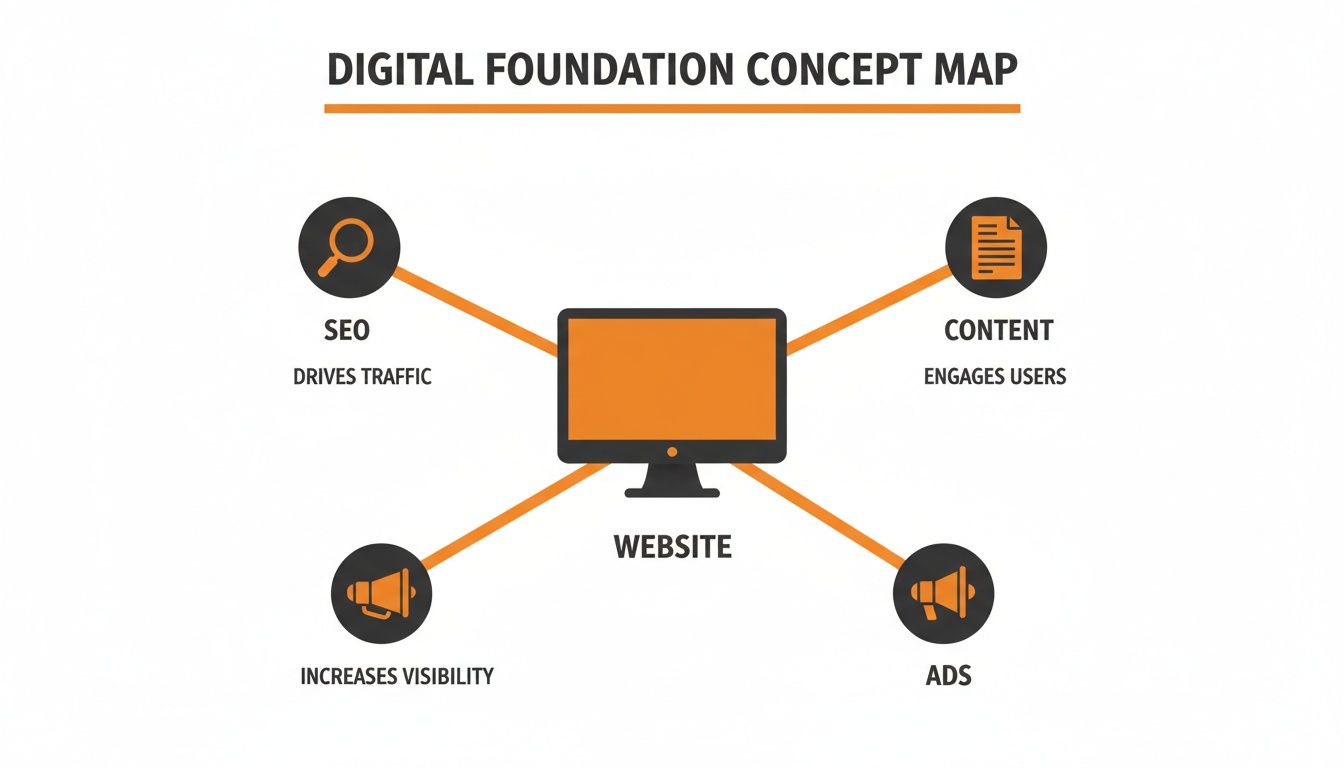
As you can see, every channel is designed to drive high-quality traffic back to your website, making it the single most critical asset in your marketing toolkit. To get this right, take a look at our guide on how to create a website that converts visitors into clients.
Adapting to the New Competitive Reality
The sheer scale of online marketing is massive and continues to grow, making a proactive strategy absolutely essential. The global digital advertising and marketing market hit $667 billion in 2024 and is projected to climb to $786 billion by 2026.
This explosion in spending highlights just how intense the competition is for a potential client's attention online. In fact, approximately 63% of businesses have already increased their digital marketing budgets to keep up.
For professional services firms, this data sends a crystal-clear message: a strategic digital presence is no longer optional. It is the primary engine for building a reputable brand and generating the high-value leads you need to thrive.
To help you navigate this, here's a quick summary of the core channels and how to think about them.
Core Digital Marketing Channels for Professional Services
This table breaks down the essential digital marketing channels, their main goals, and the key metrics you should be tracking to measure success in a professional services context.
Channel | Primary Goal | Key Performance Indicator (KPI) |
|---|---|---|
Website & UX | Build credibility; convert visitors into leads. | Conversion Rate; Time on Page; Bounce Rate |
SEO | Attract qualified traffic from search engines. | Organic Traffic; Keyword Rankings; Leads |
Local SEO | Dominate local search results (e.g., "near me"). | Map Pack Rankings; Google Business Profile Clicks |
Content & Thought Leadership | Demonstrate expertise and build trust. | Organic Traffic; Engagement (Shares, Comments) |
Pay-Per-Click (PPC) | Generate immediate, targeted leads. | Cost Per Lead (CPL); Click-Through Rate (CTR) |
LinkedIn & Social Media | Build professional networks; share expertise. | Engagement Rate; Follower Growth; Website Clicks |
Email Marketing | Nurture leads and stay top-of-mind. | Open Rate; Click-Through Rate; Unsubscribe Rate |
Reputation Management | Build and maintain a positive online reputation. | Star Ratings (Google, Avvo); Number of Reviews |
Each of these channels plays a distinct role, but they work best when they're all pulling in the same direction—driving potential clients to your website and reinforcing your firm's authority.
Attracting High-Value Clients With Strategic SEO
For any professional services firm, the game is won or lost in one critical moment: when a potential client with an urgent need turns to Google for help.
Imagine a startup founder in West Hollywood frantically searching for a "tax accountant for small business," or a family in Burbank looking for a "trust and estate lawyer." Search Engine Optimization (SEO) is what puts your firm at the very top of those search results. It's the engine that turns your website into a powerful, consistent magnet for high-value clients.
Don't think of SEO as some dark art or a technical chore. It's much simpler than that. Think of it as the digital equivalent of securing the best, most visible office location in town. It's the ongoing process of making your website more attractive to search engines like Google, which in turn makes you more visible to the people actively seeking your exact expertise. For professionals, this is the most direct path to connecting with qualified leads who already know they have a problem you can solve.
The importance of this can't be overstated. A massive 93% of all website traffic comes from search engines, making SEO an absolute cornerstone of any serious digital marketing plan. Add to that the fact that 97% of people check out a business online before ever making contact, and it's clear: your ranking directly shapes a potential client's decision to even consider you.

A successful SEO strategy signals to search engines that your firm is the most relevant, trustworthy, and authoritative answer to a potential client's search. It's not about one magic trick; it's about getting a combination of factors right to earn that top spot.
The Three Pillars of SEO for Professionals
A rock-solid SEO strategy is built on three core pillars. They all work together, and if you neglect one, the whole structure gets wobbly.
On-Page SEO: This is everything you do on your actual website pages. It’s about creating dedicated pages for each of your key services and using the specific phrases your clients are searching for, like "commercial litigation attorney Los Angeles" or "forensic accounting services." It also means writing clear titles, helpful descriptions, and genuinely useful content that answers the questions your clients are asking.
Technical SEO: This is the behind-the-scenes work that makes sure your site is fast, secure, and easy for Google's robots to crawl and understand. A website that loads quickly on a phone and offers a secure connection (HTTPS) is seen as more professional and user-friendly, and Google rewards that with better rankings. If you're not sure where your site stands, the best first step is conducting a comprehensive SEO audit.
Local SEO: For most professional service firms, this is the most important pillar of all. Local SEO is laser-focused on making you visible to clients in your specific geographic area, whether that's the San Gabriel Valley, the South Bay, or a specific neighborhood like Studio City.
Dominating Your Service Area with Local SEO
Local SEO is where you win the "near me" searches that drive so much business. The absolute cornerstone of this strategy is your Google Business Profile (GBP)—that info box that pops up in Google Maps and local search results.
Your Google Business Profile is your digital storefront on the world's biggest search engine. It's often the very first impression a potential client has of your firm, making it your single most important local marketing asset.
To truly own your local market, you need to focus on these key actions:
Claim and Obsessively Optimize Your Profile: Fill out every single section. Make sure your firm’s name, address, phone number, and hours are perfect. Write a detailed description of your services. Most importantly, use high-quality, professional photos of your team and office to build instant trust.
Generate a Steady Stream of 5-Star Reviews: Don't be shy about this. Actively encourage your satisfied clients to leave positive reviews. These reviews are a massive signal of credibility, both to potential clients reading them and to Google’s ranking algorithm.
Create Location-Specific Content: Write pages or blog posts that speak directly to clients in the specific cities you serve. An article titled, "What Pasadena Businesses Need to Know About Entity Formation," immediately helps you rank for that search while proving your local expertise.
Build Local Citations: Get your firm’s name, address, and phone number (NAP) listed consistently across reputable online directories like Yelp, Avvo, and other industry-specific sites. This consistency acts as a vote of confidence, reinforcing your legitimacy and location to search engines.
By mastering these pillars—especially Local SEO—you transform your website from a passive digital brochure into an active, lead-generating machine that consistently connects you with ideal clients right in your backyard.
4. Establishing Authority With Content That Builds Trust
In fields like law, finance, and consulting, clients don't just hire a firm—they hire proven expertise. Content marketing is how you put that expertise on display for the world to see, building trust long before a potential client ever considers picking up the phone. It’s all about answering your ideal client's most pressing questions so thoroughly that your firm becomes the only logical choice in their mind.
This is a complete reversal from old-school advertising. Instead of just telling clients you're an expert, you show them through insightful, educational content. This simple shift positions you as a trusted advisor, not just another vendor, which makes all the difference in the world of professional services.

Beyond the Basic Blog Post
Look, a regularly updated blog is a great start, but truly effective content marketing for professionals goes much deeper. It means creating high-impact resources that speak directly to a client's challenges, no matter where they are in their decision-making process. The goal is to guide them from their initial "what if" moment all the way to a signed engagement.
Think of it like building a case for your own firm. Each piece of content you create is another piece of evidence that proves your competence and deep commitment to getting clients results.
Content is how you broadcast your expertise, earn trust, and show potential clients exactly how you solve their problems. It’s the fuel for your SEO, social media, and lead generation engines.
To make this happen, you need a plan. A well-defined content marketing strategy is non-negotiable, as it ensures every article, guide, and case study you publish has a clear business purpose.
High-Impact Content Formats for Professionals
To really build trust and bring in qualified leads, you need to focus on formats that showcase deep knowledge and real-world results. Generic, surface-level articles just won't cut it when big decisions and serious money are on the line.
Here are the content types that consistently deliver for professional service firms:
In-Depth Guides and White Papers: Go deep. Create comprehensive resources that tackle complex client questions head-on. A guide like "A Founder's Playbook for Series A Funding" or "Navigating Commercial Real Estate Leases in a Post-Pandemic Market" instantly establishes your authority and attracts the right kind of attention.
Detailed Case Studies: Nothing builds confidence like proof. Showcase a specific client challenge, walk through the strategy your firm deployed, and highlight the tangible, positive outcomes you delivered. This turns abstract claims of expertise into concrete, undeniable results.
Client Testimonials and Video Interviews: Social proof is incredibly persuasive. Featuring a satisfied client talking about their experience with your firm provides a level of third-party validation you simply can't create on your own. It's authentic, and it works.
Service-Specific FAQ Pages: Get ahead of the questions. Anticipate and answer every single thing a potential client might ask about a particular service. This not only delivers immense value but also helps you capture valuable long-tail keyword traffic from people actively searching for solutions.
How Content Directly Fuels Your SEO
There's a powerful, symbiotic relationship between content and SEO. Your content strategy and SEO strategy shouldn't be two separate things; they are two sides of the same coin.
Every high-quality guide or case study you publish creates a new opportunity for your website to show up on Google. By targeting the specific phrases and questions your clients are actually typing into the search bar, your content becomes a magnet for organic traffic. For example, a detailed article on partnership disputes could help a law firm rank for searches like "business litigation attorney near me."
What’s more, truly exceptional content gets noticed. It attracts backlinks from other reputable websites, which is one of the most powerful ranking signals for Google. When another site links to your guide, they're essentially casting a vote of confidence in your expertise, boosting your entire website's authority. Consistently producing this caliber of content is the key, which is why many firms find they unlock the power of SEO by hiring a professional blogger to drive the process.
Using Paid Ads and Social Media with Precision
While SEO and content marketing are fantastic for building your firm's long-term digital authority, sometimes you just need to reach a very specific audience, right now. This is where paid advertising and a sharp social media strategy come in. Think of them as a powerful accelerator, giving you immediate, highly targeted visibility the moment a potential client realizes they have an urgent need.
If SEO is like building a permanent, high-traffic office over time, paid ads are like placing a perfectly worded billboard directly on the freeway exit your ideal client is taking at that exact moment. It’s all about precision, not just presence.

This kind of digital marketing for professional services is about capturing high-intent leads without burning through your budget. We're not chasing vanity metrics here; we're focused on tangible business development that leads to actual consultations and new clients.
Capturing High-Intent Leads with PPC
Pay-Per-Click (PPC) advertising, mainly through platforms like Google Ads, lets you bid on the specific keywords your clients are searching for. When someone in Alhambra searches for a "business contract lawyer," your firm’s ad can show up right at the very top of the results, instantly grabbing their attention.
The beauty of it is you only pay when someone actually clicks on your ad. This makes it an incredibly efficient way to generate qualified leads. Unlike SEO, which can take months to show results, a well-structured PPC campaign can start delivering phone calls and form submissions within days. The secret is to focus on "high-intent" keywords—the phrases that signal someone is ready to hire a professional, not just doing preliminary research.
PPC isn't just advertising; it's a direct response to a stated need. By targeting the exact phrases your clients use when they're looking to solve a problem, you connect with them at the peak of their interest.
For instance, a family law practice in Encino could target phrases like "divorce attorney in the San Fernando Valley." That level of specificity ensures your ad spend is aimed squarely at people actively seeking the services you provide, right in your local area.
LinkedIn: The Professional's Social Media Platform
When it comes to B2B professional services—think management consulting, corporate law, or commercial accounting—LinkedIn is the undisputed champion of social media. This isn’t the place for vacation photos. It's a dynamic environment for building professional networks, sharing deep industry insights, and cultivating invaluable referral sources.
But just having a profile isn't enough. An effective LinkedIn strategy requires a bit more effort:
Optimizing Partner Profiles: Every partner and key professional at your firm should have a fully optimized profile that clearly communicates their expertise and the firm’s unique value.
Sharing High-Value Content: Regularly post the thought leadership content you’ve already created, like your guides, case studies, and articles. This reinforces your authority and keeps your firm top-of-mind.
Strategic Engagement: Don’t just broadcast; engage. Comment thoughtfully on industry news, congratulate contacts on their achievements, and participate in relevant group discussions to grow your network.
Choosing the Right Platform: PPC vs. LinkedIn Ads
Deciding where to put your advertising budget really depends on your specific goals. Are you trying to catch someone with an immediate, urgent problem, or are you looking to build relationships with key decision-makers in a specific industry over time? This table breaks down the core differences to help you decide.
Choosing the Right Platform PPC vs LinkedIn Ads
Feature | Google Ads (PPC) | LinkedIn Ads |
|---|---|---|
Primary Goal | Capturing active, high-intent search demand (e.g., "accountant near me"). | Targeting specific professionals by job title, industry, or company size. |
Audience Intent | Reactive: Responding to a user's direct search query. | Proactive: Reaching a defined audience, often before they even start searching. |
Best For | Services with clear, immediate needs (B2C law, local accounting, etc.). | Complex B2B services with long sales cycles (consulting, M&A advisory). |
Targeting Method | Keyword-based targeting. | Demographic and firmographic targeting. |
When you use these channels with precision, you create a complete client acquisition system. PPC captures immediate demand, while a strong LinkedIn presence nurtures long-term relationships and referral opportunities. This one-two punch ensures your firm has a steady flow of high-value leads coming from every angle.
Managing Your Reputation to Foster Client Loyalty
In the world of professional services, your reputation isn't just a part of your brand—it is your brand. Long before a potential client ever looks at your credentials or list of services, they're searching for signs of trust and credibility. That makes proactive reputation management a non-negotiable part of any digital marketing strategy.
Trust is really built on two things: transparency and social proof. And in today's market, social proof almost always comes from online reviews. A consistent stream of positive feedback on platforms like Google, Avvo, or even industry-specific sites acts as a powerful endorsement. It tells prospective clients that others have trusted you with their sensitive issues and were happy with the results.
Building and Protecting Your Online Reputation
Getting a handle on your reputation isn't a passive activity; it requires a deliberate, ongoing process. The first step is to simply ask. You need to actively encourage satisfied clients to share their experiences. This can be as simple as sending a polite, personalized follow-up email after a case wraps up or a project is finished, including a direct link to make leaving a review as easy as possible.
But a strong reputation isn't just about collecting five-star ratings. It’s also about how you handle the inevitable bumps in the road. Responding to negative reviews constructively and professionally is absolutely critical. A thoughtful response that acknowledges a client's concerns without getting defensive can show your commitment to client satisfaction. Sometimes, it can even turn a negative situation into a positive signal for others who are watching.
Your online reputation is the digital version of word-of-mouth, working for you 24/7 across every corner of your service area—from Downtown Los Angeles to the San Gabriel Valley. Protecting it isn't just damage control; it's a core business development activity.
Nurturing Relationships with Email Marketing
Beyond public-facing reviews, email marketing gives you a direct, personal line to your clients, helping you foster loyalty and stay top-of-mind. Unlike the broad, often noisy, reach of social media, email lets you deliver valuable content directly to an audience that has already given you permission to be there.
This isn't about spamming your contacts with sales pitches. For professionals, email marketing is a tool for building relationships. It’s about reinforcing your expertise and showing your ongoing value, which is exactly what you need to generate repeat business and high-quality referrals.
Here are a few proven ways to use email effectively:
Firm Newsletters: Share updates about your firm, recent successes (while always maintaining client confidentiality), and insights into your practice areas. This keeps your firm on the radar of clients and referral partners in places like Sherman Oaks, Pasadena, and Long Beach.
Industry Updates and Alerts: Provide timely analysis of new laws, tax code changes, or market trends that actually affect your clients. This positions you as a proactive advisor, not just someone they hire to do a task.
Segmented Content Delivery: Not every email is for everyone. Segment your list by client type, industry, or service used to send highly targeted information. For example, a business law firm could send an update on new compliance regulations only to their corporate clients.
By ethically building and segmenting your email list, you create a powerful asset for nurturing the long-term relationships that drive sustainable growth. This direct line of communication helps you build a loyal client base that not only comes back for future needs but also confidently refers your services to their networks throughout Southern California.
Integrating AI and Technology for a Competitive Edge
For busy professional services firms, the future of marketing isn't about working harder—it’s about working smarter. Technology, and more specifically Artificial Intelligence (AI), is no longer a futuristic concept; it's the key to gaining a real competitive edge right now. It helps you automate the repetitive stuff, pull meaningful insights from your data, and personalize how you talk to clients on a scale that used to be impossible.
This isn't about replacing the human touch that defines your firm. Think of AI as a powerful assistant that frees up your team to focus on high-level strategy and client relationships. It’s a tool that amplifies your firm’s expertise, making your marketing sharper and more efficient.
And this shift is happening fast. Roughly 60% of businesses are already using AI in their marketing, and 71% of marketers plan to invest at least $10 million into it over the next three years. These aren't just numbers; they signal a massive change in how firms will win and keep clients. Getting on board now is essential.
Practical AI Applications You Can Use Today
You don't need to rip and replace your entire workflow to start seeing the benefits. Many powerful AI tools can be plugged into your current operations to deliver immediate results. The goal here is to find practical solutions to real-world problems.
One of the easiest wins is using generative AI to brainstorm content. It can help you outline your next blog post, draft a few social media updates, or even generate topic ideas for your firm’s newsletter. It won't write the final product for you, but it dramatically cuts down on the time it takes to get started.
SEO is another high-impact area. AI-powered tools can perform sophisticated keyword research, analyze what your competitors are doing, and spot technical glitches on your website with incredible speed. It’s like having an SEO expert on call 24/7, giving you a clear roadmap to improve your online visibility.
AI empowers professional service firms to operate with the efficiency and data-driven precision of a much larger organization. It levels the playing field, allowing you to focus on what you do best: serving your clients.
Automating Lead Qualification and Client Service
Perhaps the most valuable use of AI for a professional services firm is in managing the client intake process. An AI-powered chatbot on your website can work around the clock to greet visitors, answer their basic questions, and qualify them as potential leads.
Think about it: you can capture opportunities from prospects browsing your site late at night or on a weekend—times when you would have missed them otherwise. The chatbot gathers their initial info and service needs, then hands a warm, qualified lead over to your team for a follow-up.
This automation goes well beyond just your website. To truly get ahead, exploring the top AI marketing tools available can help streamline all sorts of operations and sharpen your digital presence. By embracing these technologies, you can transform your marketing from a series of manual tasks into a smart, automated system that consistently drives growth.
Frequently Asked Questions
Diving into digital marketing for your firm is bound to bring up a few questions. Here are some of the most common ones we hear from professional service firms across Los Angeles and Southern California, along with some straightforward, actionable answers.
How Much Should a Firm Budget for Digital Marketing?
A good starting point for a professional services firm is to earmark around 5-10% of your annual revenue for digital marketing. But let’s be clear: this is a benchmark, not a rigid rule.
Think of it this way. A competitive law practice in a crowded market like Downtown Los Angeles or Beverly Hills will naturally need to invest more than a solo accountant serving a community like La Mirada. It's all about context.
Newer firms should expect to invest more heavily at the start to build that essential digital foundation. An established practice, on the other hand, might channel its budget into more targeted growth areas, like crafting thought leadership content or running hyper-specific PPC campaigns in the San Fernando Valley. The one non-negotiable? Consistency, especially in core channels like Local SEO.
What Is the Most Important Channel for a Small Firm?
For almost any local professional service, Local SEO delivers the highest return on investment. Hands down.
This strategy is all about making your firm pop up on Google Maps and in local search results the moment a potential client nearby looks for your kind of expertise. We're talking about searches like "estate planning attorney in Pasadena" or "business consultant near me."
The absolute cornerstone of this effort is your Google Business Profile. Getting that optimized, gathering a steady stream of positive client reviews, and creating content that speaks directly to the neighborhoods you serve—from Santa Monica to the South Bay—is what connects you with clients who have an immediate need. It’s the single most critical place to start.
SEO is a long-term investment, not a quick fix. It typically takes 4-6 months of consistent, high-quality effort to see significant gains in rankings and organic traffic. In highly competitive markets, it may take closer to a year to achieve top results.
Are There Ethical Rules for Marketing Online?
Yes, absolutely. This is a big one. Professionals in regulated fields like law, finance, and accounting have to navigate strict advertising rules set by their governing bodies—think the State Bar or the AICPA. These guidelines are the guardrails for any digital marketing for professional services.
Key rules usually involve steering clear of misleading claims, never guaranteeing outcomes, and making sure any client testimonials are fully compliant. It's vital to get familiar with your industry's specific guidelines to maintain the highest ethical standards and dodge serious penalties.
Ready to build a digital marketing strategy that attracts high-value clients across Southern California? The team at DLL Studios helps professional service firms design, build, and grow a powerful online presence that delivers measurable results. Our reach includes every corner of L.A.—from Downtown Los Angeles, Hollywood, West Hollywood, Beverly Hills, and Santa Monica to the beach communities of Malibu, Venice, Marina del Rey, Hermosa Beach, Manhattan Beach, and Redondo Beach. We also extend service through the San Fernando Valley, including Sherman Oaks, Studio City, Encino, Van Nuys, and Burbank, and into the San Gabriel Valley. Whether you’re along the I-10, I-5, 101, or 405 corridors, our team delivers reliable, high-quality service anywhere in or around Los Angeles. Get in touch with us today.
